India's rare-earth problem has a second chokepoint after refining: the steps that turn oxide into metal, metal into a magnet and a magnet into a motor. India does not need to make every magnet it uses. It needs to choose which ones to make, and to design the rest around China's licence.
Exploverse Research · Deep Dive · Supply · 48 min read
Key takeaways
- Refining is India's first rare-earth chokepoint and the magnet is the second. China's share climbs along the chain, from 60% of the mining of magnet rare earths to 91% of their separation and 94% of sintered magnet production in 2024, and the capacity planned outside China would meet well under a fifth of magnet demand outside China in 2035.
- India makes almost none of the magnets it uses. The government puts demand at about 4,000 tonnes a year now and 8,220 tonnes in 2030, all sintered neodymium magnets imported, and the country's only rare-earth magnet production line makes 3 tonnes of samarium-cobalt magnets a year. Much of the exposure arrives inside imported motors and assemblies, where trade data cannot see it.
- China's instrument still ends its suspension of the October 2025 export controls on 10 November 2026, although in September the Chinese and US governments agreed to extend the arrangement behind it to 10 January 2027. Whatever China decides when the suspension ends, the April 2025 licence on magnets containing dysprosium or terbium and the 2023 ban on exporting magnet-making technology stay in force. No. 70 never suspended either.
- Scored on demand, criticality and feasibility, only the heavier (L5) electric three-wheelers and electric car and bus traction qualify as places where India should make magnets, about 1,430 tonnes of 2030 demand by our estimate, close to what the oxide IREL has committed to the scheme can feed, plus defence on a state line. Two-wheelers, e-rickshaws, fans, wind turbines, air conditioners and most industrial motors can be designed around the licence as it stands.
- The 6,000-tonne magnet scheme is larger than the demand that cannot be designed out and about four times what the 500 tonnes of oxide IREL has committed to it can feed. The first awards should be tied to the applications that need magnets and to domestic metal and alloy making, not to tonnage alone.
The Read-Through, in One Paragraph
India's rare-earth exposure has two layers: refining, which is familiar, and the steps that turn oxide into metal, alloy, magnet and motor. China holds nine-tenths or more of each, and since April 2025 the magnets that matter most have needed a Chinese export licence. India's Rs 7,280 crore scheme for 6,000 tonnes of magnet capacity is pointed at the right step and sized to the wrong number. Much of India's magnet tonnage can be designed around, cheaply and soon. What cannot is smaller, concentrated in vehicle traction and defence, and is where a domestic magnet industry earns its premium.
One Scooter, One Month
On 25 September 2025 one listed Indian maker of electric scooters told the stock exchange why it was holding back Rs 262.5 million of subsidy claims. The subsidy rules require the magnets in its traction motors to be fitted in India. After China's export ban on certain heavy-rare-earth magnets, its motor suppliers could no longer do that, and up to 52,500 scooters were affected.1 The trouble sat in the part that makes up nearly 30% of the cost of an electric two-wheeler motor unit costing Rs 8,000 to Rs 15,000: the permanent magnet.2 On 4 April 2025 China had made the export of seven medium and heavy rare earths subject to licence, and with them samarium-cobalt magnets and neodymium-iron-boron magnets containing dysprosium or terbium.3 By May, China's exports of rare-earth magnets had fallen to 1,238 tonnes, about three-quarters below May 2024.4 5
Another of India's larger electric two-wheeler makers built 10,824 electric scooters in July 2025 against 20,384 a year earlier, Al Jazeera reported.6 Its response is the argument of this piece in miniature. Its engineers redesigned some of its motors to run on magnets made with light rare earths only, and by the company's account that recovered close to half of the planned July output, with about 60% of plan expected in August and September.6 The heavy rare earths the licence was written around could be engineered out of a scooter motor within the same quarter. The magnet could not: the redesigned motor still turns on neodymium-iron-boron, and India imports all the sintered neodymium magnets it uses, on the Ministry of Heavy Industries' own statement.7
A scooter is the cheap end of the problem. The same magnet, larger and in hotter grades, sits in electric cars and buses, wind turbines, compressors, fans, phones and defence systems. The government estimates India's requirement at about 4,000 tonnes a year now, rising to 8,220 tonnes in 2030.8 7 In November 2025 the Union Cabinet approved a Rs 7,280 crore scheme to build 6,000 tonnes a year of sintered magnet capacity at home.9 Twenty bids were opened on 13 August 2026.10 11 And a one-year suspension of China's widest set of rare-earth controls ends on 10 November 2026 under its instrument, though the two governments have agreed to extend the arrangement behind it to 10 January 2027.12 13
This piece argues that India's second rare-earth chokepoint is the magnet, and that it should be treated as a portfolio rather than a factory: make sintered magnets where the magnet cannot be engineered out and India already makes the end product, and design it out everywhere else. Which tonnes India makes matters more than how many. The case rests on a scoring rule stated before any application is scored, and on a full hearing for the strongest counter-argument: redesign the motor instead.
Two Chokepoints, Not One
Our earlier piece, Between the Mine and the Factory, argued that India's critical-mineral problem is not ore but refining. For rare earths that stands. China mined about 69% of the world's rare earths in 2025, measured as oxide,14 and the IEA puts its share of rare-earth refining that year at about 85%.15 For the four elements that go into magnets, neodymium, praseodymium, dysprosium and terbium, the IEA's figures for 2024 are 60% of mining and 91% of separation.16 We do not re-argue that step here.
This piece starts where that one stopped. A separated oxide has to be reduced to metal, alloyed, cast, milled, pressed, sintered, machined, coated and magnetised, and the magnet built into a motor, before it is worth anything to a vehicle or appliance maker.17 That stretch of the chain is the second chokepoint, and China's share rises again along it. The US Department of Energy put China at 92% of magnet alloy making in 2020,17 and the IEA at 94% of sintered magnet production in 2024.16 A commissioned industry estimate in a Chinese magnet maker's draft Hong Kong listing document, from China Insights Consultancy (CIC), gives Chinese companies 91.1% of global sales of neodymium magnets in 2025.18 The bases differ, and CIC was paid by an interested party; the direction does not.
What makes the magnet step distinct is how recently it concentrated. In 2005 China and Japan each made about half of the world's sintered magnets. By 2024 China made 94% and Japan, still second, about 5%.16 The magnet chokepoint was built in under twenty years, and the plans to undo it are thin. The IEA counts about 18 kilotonnes of announced capacity outside China for rare-earth metals, alloys and magnets by 2035, measured as rare-earth content. On those plans, supply outside China would meet about half of its mining needs in 2035 but well under a fifth of its magnet needs. Closing the magnet gap would take about six times the capacity now planned.16 15 The first chokepoint is being worked on. The second is being worked on less.
The Chain, Step by Step
Each step downstream of the oxide needs something different, which is why concentration and value do not move together.
Oxide to metal
Separated neodymium-praseodymium oxide is reduced to metal, usually by molten-salt electrolysis. The IEA names this step, with magnet making, as the main bottleneck outside China: its electrolysis cells and, one step later, alloy strip casters come from very few suppliers outside China, with lead times of several years.16 The price difference between oxide and metal is modest. Neodymium-praseodymium oxide averaged about US$69 a kilogram in 2025 on the US Geological Survey's figures,14 and praseodymium-neodymium metal about US$84 in China, on figures in CIC's report.18 Outside China the step is small: the UK's Less Common Metals, owned by USA Rare Earth, has about 2,500 tonnes a year of metal and alloy capacity and plans a 3,750-tonne plant in France.19
Metal to alloy, alloy to magnet
The metal is melted with iron and boron, strip-cast, broken down, milled to powder, pressed in a magnetic field and sintered at 1,000 to 1,100 degrees Celsius.17 The result is a block that is about 30% rare earth by weight, the balance iron and boron, with between 0.5% and 11% dysprosium or terbium added to hold the magnet's strength at high temperature.17 That last number is where the industrial geography and the export licence meet. Magnets are graded by the temperature they survive: on the Department of Energy's figures an M grade has carried about 1.4% dysprosium, an SH grade about 4.2%, and the EH and AH grades of electric-vehicle traction motors 8.5% to 11%, for 200 to 220 degrees.17
The block is not where the value is
On a single day in April 2024, Asian Metal assessed praseodymium-neodymium metal in China at about RMB 500 a kilogram, roughly US$69, and a rough sintered N52 block at RMB 165 to 170 a kilogram, about US$23.20 At about 30% rare-earth content, the metal in a kilogram of that block was worth around US$21 of its US$23 price, so on our arithmetic a commodity block captures little value over its feedstock. SMM's quotes for 30 September 2026 tell the same story: RMB 251 to 273 a kilogram for unfinished 38M and 40H blanks, against about RMB 900 for a kilogram of the metal, of which a blank holds about 30%.21 Value is added after the block: in grain-boundary diffusion of dysprosium or terbium into the finished magnet, in machining to tight tolerances, in coating and in magnetising.
Rare earths are a large share of a magnet's cost and a trivial share of the product: the IEA puts them at around 40% of a magnet's cost but under 1% of a vehicle's value, so tripling their price would add about 0.1% to a car's cost.15 So value sits in the motor and the product while the power to stop production sits in the magnet: a part worth a few thousand rupees in a scooter motor can stop the whole line.
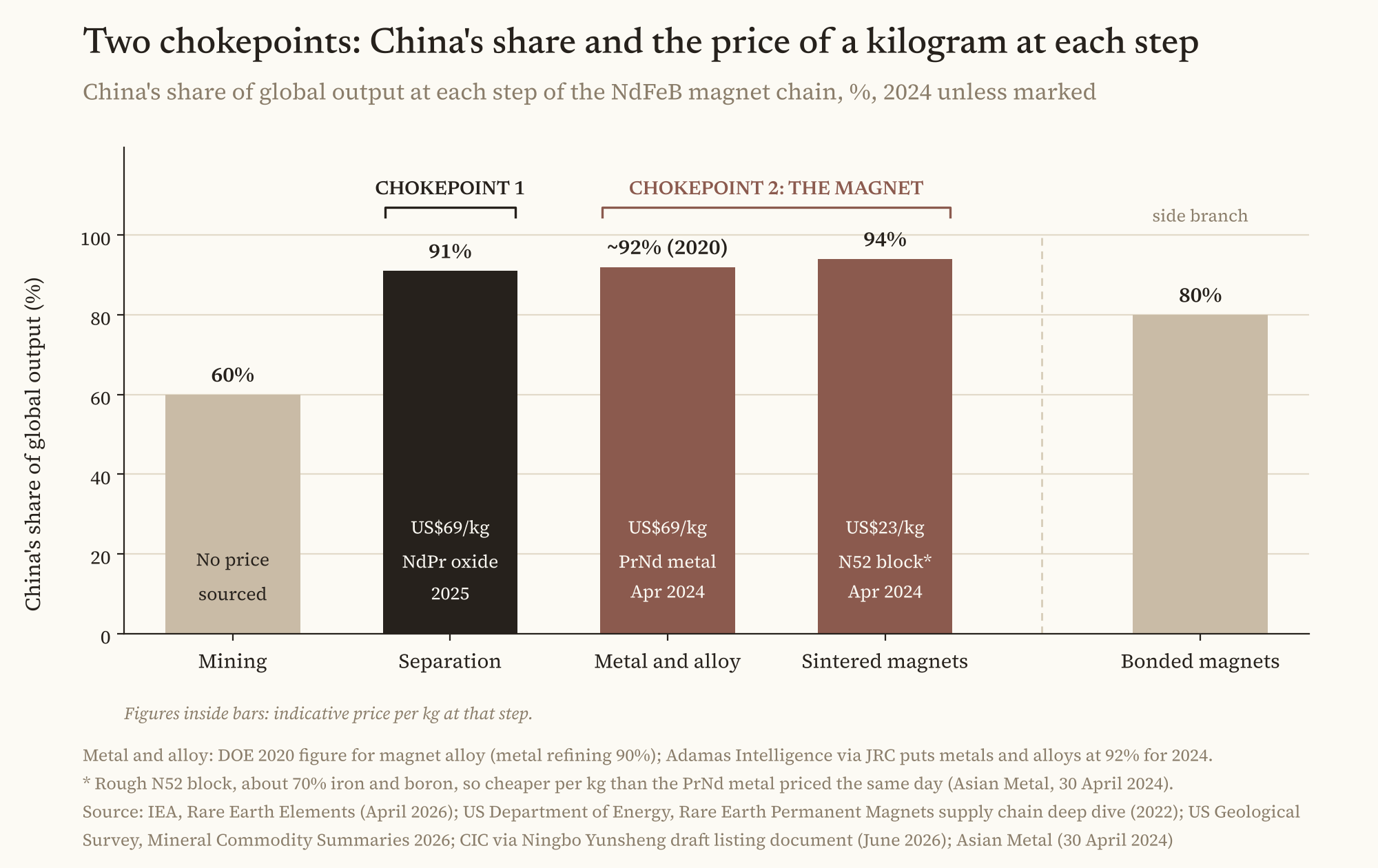
China's share of each step of the rare-earth magnet chain, with the price of a kilogram of the step's product where a sourced price exists. China's share rises from 60% of magnet rare-earth mining to 91% of separation, about 92% of metal and alloy making and 94% of sintered magnets, while the price of a kilogram falls from about US$69 for praseodymium-neodymium metal to about US$23 for a rough N52 block on the same day in April 2024, because a block is about 70% iron and boron. Shares are for 2024 except metal and alloy (2020); prices are for different dates and are indicative, not a series. Source: IEA, Rare Earth Elements (April 2026); US Department of Energy, Rare Earth Permanent Magnets supply chain deep dive (2022); US Geological Survey, Mineral Commodity Summaries 2026; CIC via Ningbo Yunsheng draft listing document (June 2026); Asian Metal (30 April 2024).
Who Makes the World's Magnets
The industry is large in China, small elsewhere, and outside China increasingly state-funded.
China has about 200 makers of neodymium magnets, most of them small, on CIC's count, and the five largest held about 32% of global sales in 2025 between them.18 JL MAG, which says it is the largest, has 40,000 tonnes a year of capacity, sold 25,300 tonnes of finished magnets in 2025, and expects to reach 60,000 tonnes by the end of 2027.22 Ningbo Yunsheng, third by CIC's ranking, had 23,500 tonnes of blank capacity in 2025 and plans 36,000 tonnes by the end of 2028.18 For scale, JL MAG's existing capacity alone is more than six times the whole of India's scheme.
Japan's makers lead outside China, at small volume: the IEA names Shin-Etsu, TDK, Daido and Proterial.16 Proterial has been reported to plan a 1,200-tonne plant in Andhra Pradesh.23
The United States is rebuilding with public money. In July 2025 the Department of Defense agreed to buy US$400 million of preferred stock in MP Materials, guarantee a ten-year floor of US$110 a kilogram for its neodymium-praseodymium and guarantee offtake of all the magnets from a second plant.24 MP's Fort Worth plant began commissioning at the end of 2025 for 3,000 tonnes a year; the second, 7,000 tonnes, is due to start commissioning in 2028.25 USA Rare Earth commissioned a first 600-tonne line in the first quarter of 2026 and targets 10,000 tonnes by 2029.19 VAC, the German maker, runs a 2,000-tonne plant in South Carolina that can reach 4,000 tonnes without disrupting output and 12,000 with more land, and in June 2026 agreed to be bought by Energy Fuels for an aggregate price of about US$1.9 billion.26 In October Energy Fuels disclosed that the customer the plant was built to supply had tried in July to end its supply agreement, now in arbitration, that the 12,000 tonnes depend on further buyers, and that the merger price now allows for a settlement.27
Europe made under 1% of the world's neodymium magnets in 2024 on Adamas Intelligence's estimate.28 That began to change in September 2026, when Neo Performance Materials said its plant at Narva in Estonia was in commercial production, with nameplate capacity of about 2,000 tonnes a year and first volumes going to a traction-motor supplier.29 Korea's Star Group's planned 5,000-tonne Vietnam plant is unconfirmed as operating.30 31
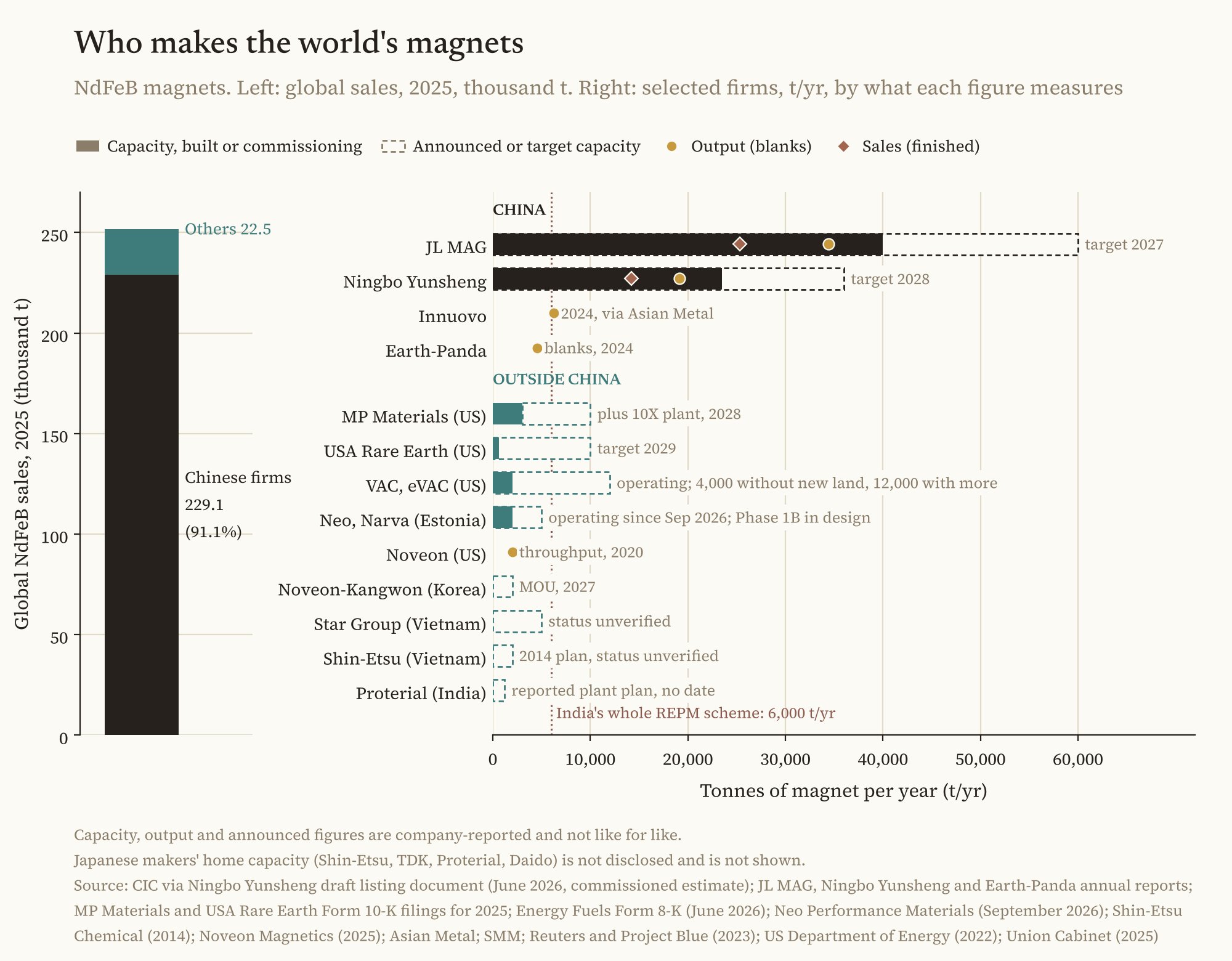
Left: Chinese firms sold 229,100 of the 251,600 tonnes of neodymium magnets sold worldwide in 2025 (91.1%), on a commissioned estimate. Right: selected firms' capacity, output and announced capacity, in tonnes a year, each marked by what it measures, with India's whole 6,000-tonne scheme for scale. Capacities are company statements; announced capacity is not output. Source: CIC via Ningbo Yunsheng draft listing document (June 2026, commissioned estimate); JL MAG, Ningbo Yunsheng and Earth-Panda annual reports; MP Materials and USA Rare Earth Form 10-K filings for 2025; Energy Fuels Form 8-K (June 2026); Neo Performance Materials (September 2026); Shin-Etsu Chemical (2014); Noveon Magnetics (2025); Asian Metal; SMM; Reuters and Project Blue (2023); US Department of Energy (2022); Union Cabinet (2025).
The fifth-largest maker in CIC's ranking sold 10,200 tonnes in 2025,18 and the largest permitted beneficiary under India's scheme is capped at 1,200 tonnes.32 Operating and commissioning capacity outside China in our sources, about 7,600 tonnes at MP, USA Rare Earth, VAC's US plant and Neo's Estonian plant, is a fraction of one large Chinese firm, and every announced target added together only approaches JL MAG's planned 60,000 tonnes. The largest, MP's, rests on a state equity stake, a price floor and an assured buyer. VAC's dispute shows why the last of those matters.
Two things travel with the magnet that tonnage misses. The first is equipment. Ningbo Yunsheng says its main production and testing equipment comes from Chinese suppliers,18 and the IEA notes that grain-boundary diffusion, which cuts heavy rare earths, is highly patented and has one equipment supplier outside China, at reportedly over ten times the cost.15 The second is know-how. Since December 2023 China has prohibited the export of technology for rare-earth separation, metal and alloy production, and samarium-cobalt, neodymium-iron-boron and cerium magnets.33 A plant outside China can buy Chinese magnets with a licence. It cannot legally buy Chinese instructions for making them.
The Licence as an Operating Condition
China's controls are best read as an industrial fact: since April 2025 a licence has been a standing condition of buying the magnets that matter.
The December 2023 technology prohibition came first.33 Announcement No. 18 of April 2025 then put seven elements under licence, samarium, gadolinium, terbium, dysprosium, lutetium, scandium and yttrium, and with them samarium-cobalt magnet material and neodymium magnet material containing terbium or dysprosium, in magnet or powder form.3 The annex gives the magnet items no customs tariff code, so they are defined by what is in them.3 A neodymium magnet without dysprosium or terbium is not on the list, which is why a scooter maker could recover output by redesigning its motor.
The effect on flows was sharp and brief. China's magnet exports fell to 2,627 tonnes in April 2025, about half of March, and to 1,238 tonnes in May.34 4 5 They recovered to 3,188 tonnes in June and 6,146 tonnes in August.5 35 Over 2025 as a whole China exported 57 kilotonnes on the IEA's figures, against 58 kilotonnes in 2024 on SMM's.16 36 37 The damage was done in the gap. CLEPA, the European auto suppliers' association, reported in June 2025 that several lines and plants in Europe had shut and that about a quarter of hundreds of licence applications appeared approved.38 The controls split the market rather than lifting the price everywhere: the average free-on-board price of dysprosium oxide fell to US$239 a kilogram in 2025 from US$257 in 2024, on US Geological Survey figures,39 while the IEA puts European prices for heavy rare earths at around five times China's domestic level.15
India's experience followed the same curve. The Ministry of Heavy Industries told the Rajya Sabha in August 2025 that the government was aware of the disruption and that the automobile and component makers' associations had submitted detailed inputs on its impact, which have not been published.40 The commerce ministry's Lok Sabha answer of 19 August acknowledged the bottleneck; neither answer gave a count of licences or a figure for lost output.41 In October the Ministry of External Affairs' spokesperson confirmed that some Indian companies had received licences, as Business Standard reported.42 Press reports, citing unnamed sources, said the licences barred re-export to the United States and use in defence.43 By 2026 flows had grown: Silverado Policy Accelerator puts China's magnet exports to India in January to July 2026 about 39% above the same months of 2024.44 No Indian authority has published how many licences were sought or refused.
On 9 October 2025 China issued six further announcements. No. 56 would have controlled rare-earth processing equipment and inputs from 8 November; No. 57 would have added five more medium and heavy rare earths; No. 61's rule on items made abroad with Chinese rare earths or technology was to apply from 1 December, with military users refused in principle; and No. 62, effective at once, controlled the technology for making magnets and for assembling, commissioning and maintaining production lines.45 46 47 After the US-China talks in Kuala Lumpur, Announcement No. 70 suspended exactly those six instruments, Nos. 55 to 58, 61 and 62, from 7 November 2025 to 10 November 2026, before most of them took effect; only No. 62 and parts of No. 61 had operated, for four weeks.12 No. 18 was not suspended.12 In December MOFCOM confirmed it had approved general licences for some Chinese exporters.48
The two governments describe that truce differently. The White House said the general licences meant "the de facto removal of controls China imposed since 2023".49 China's instruments say something narrower: the October package is paused, while the April licence and the 2023 technology prohibition remain. In April 2026 MOFCOM tied the suspension to the Kuala Lumpur consensus and restated its end date of 10 November 2026.50 In June it set up a channel for reporting violations, including evasion through third countries.51 The licence can also be aimed: in January 2026 MOFCOM banned dual-use exports to Japanese military users and uses,52 and Reuters reported in June that China had restricted exports of several heavy rare earths and other materials to Japan for at least four months.53 In late September the White House said the two sides were still working toward "shipment levels" that "return to appropriate levels".54 China's magnet exports were 5,010 tonnes in August 2026, 18% below August 2025,55 and 6,165 tonnes in September, up 23% on August and 6.7% on a year earlier; SMM, our only source for September, puts that down to shipments held up by tighter licensing in July and August clearing, "not a loosening of controls".56
The end date looks set to move by agreement, but it has not moved in China's instrument. On 28 September MOFCOM said the two governments had agreed to extend the Kuala Lumpur arrangement, which suspended parts of each side's tariff and non-tariff measures to 10 November 2026, to 10 January 2027, and that it expected talks before year-end on a further extension.13 57 The statement does not name rare earths, but it is the arrangement MOFCOM cited in April.50 No. 70 has not been amended: MOFCOM's policy listing, checked on 23 October 2026, showed no announcement changing it, and its text still ends the suspension on 10 November.58 12 The natural reading is that a new announcement will move the date; as of publication, none had been issued.
Other governments have answered with money, floors and stockpiles. The US floor of US$110 a kilogram under the MP Materials agreement24 was matched in March 2026 by Japan's JOGMEC and Sojitz, with a US$110 floor for 5,000 tonnes of Lynas's neodymium-praseodymium a year to 2038 and rights to half its heavy rare-earth oxides.59 The United States announced a critical minerals reserve of up to US$12 billion in February 2026, starting with rare earths.60 The European Commission's RESourceEU plan of December 2025 committed up to EUR 3 billion over twelve months and a stockpiling pilot, and announced restrictions on exports of permanent-magnet scrap for early 2026.61 No scrap restriction had been adopted by late October 2026, when the European Parliament backed a clause letting the Commission impose them, still to be agreed with member states.62
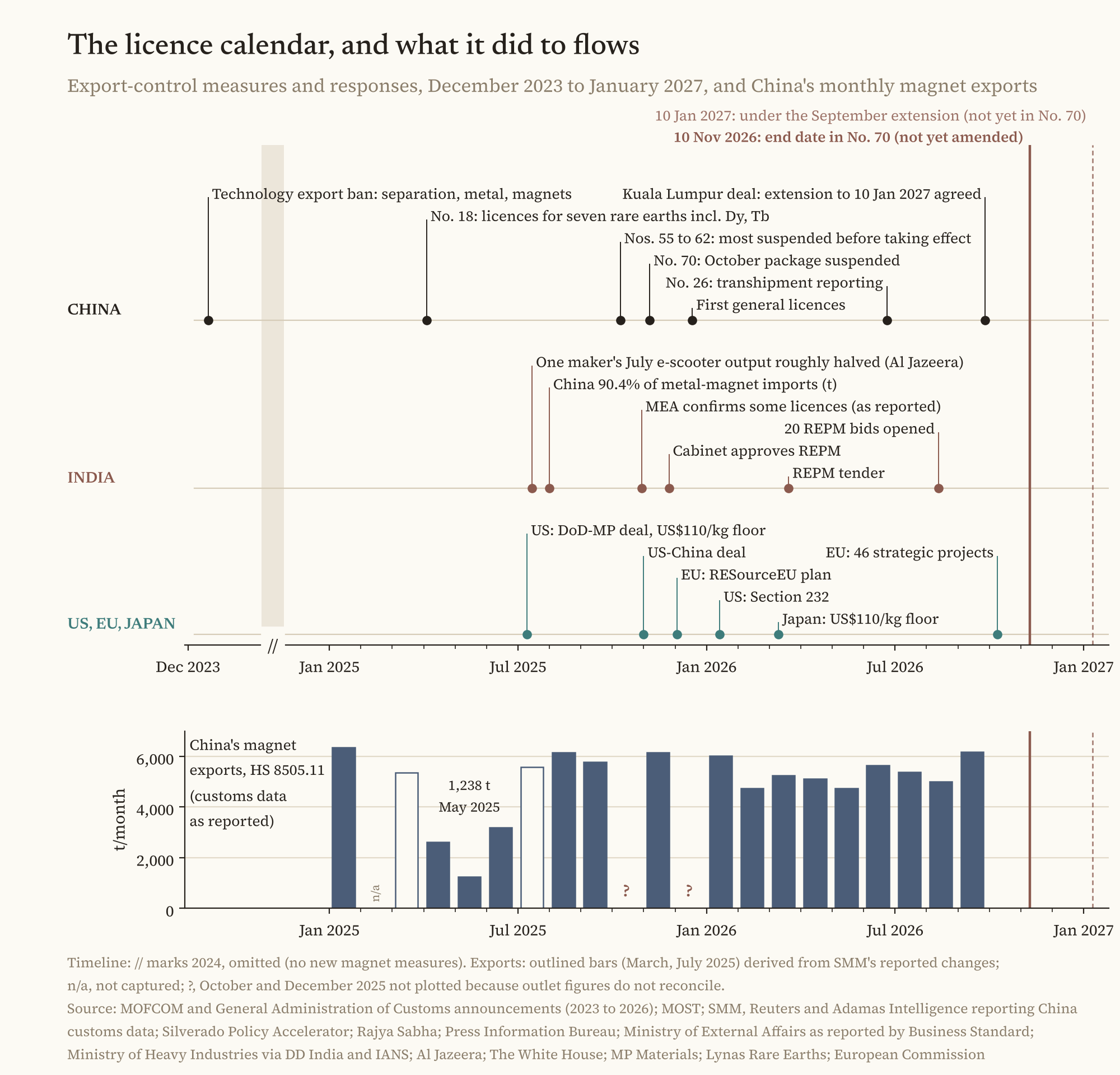
China's monthly exports of rare-earth permanent magnets, January 2025 to September 2026, as reported from Chinese customs data, under a timeline of Chinese measures, Indian events and foreign responses from December 2023 to the end of the suspension: 10 November 2026 in China's instrument, 10 January 2027 under the extension the two governments agreed in September. October and December 2025 are omitted because the reported figures do not reconcile; February 2025 was not captured; March and July 2025 are derived from SMM's reported month-on-month and year-on-year changes. Monthly figures are mostly single-sourced to SMM or Reuters. Source: MOFCOM and General Administration of Customs announcements (2023 to 2026); MOST; SMM, Reuters and Adamas Intelligence reporting China customs data; Silverado Policy Accelerator; Rajya Sabha; Press Information Bureau; Ministry of External Affairs as reported by Business Standard; Ministry of Heavy Industries via DD India and IANS; Al Jazeera; The White House; MP Materials; Lynas Rare Earths; European Commission.
The chart carries the episode's lesson. The trough lasted about two months and annual exports barely moved: the April licence cost certainty, not tonnage. A stockpile and a second qualified supplier can absorb that cost; a domestic plant takes years to remove it.
Three ways the suspension can end
We do not predict China's decision. Each outcome lands differently on Indian buyers and the scheme's bidders.
Extension. The announced intention: the end date moves to 10 January 2027 or later, and the past year's regime continues: the April licence for heavy-rare-earth magnets, case-by-case and general licences, reported end-use conditions on Indian importers, and flows of about 4,700 to 6,200 tonnes a month.63 56 Bidders keep access to Chinese equipment, but not know-how.
Selective reinstatement. Some of the six instruments return. The ones that matter most for a country building magnet plants are No. 56 on equipment and No. 62 on magnet-making technology and production-line maintenance.45 47 If those return alone, Indian importers barely notice and Indian plant-builders lose the furnaces, mills and commissioning engineers they expected from China.
Full reinstatement. All six instruments return. No. 61 would then require a licence for samarium-cobalt magnets and neodymium magnets containing terbium or dysprosium made outside China with Chinese rare earths worth 0.1% or more of their value, or with Chinese magnet-making technology, and for parts, components and modules containing them; it does not name motors, and it would refuse military users in principle.46 64 Indian makers of traction-grade magnets, and of rotors and modules built around them, would need a Chinese licence whenever they used Chinese dysprosium or terbium or Chinese know-how. A heavy-rare-earth-free neodymium magnet would stay outside, even if made from Chinese neodymium.
In all three cases the April 2025 regime and the 2023 technology prohibition stay in force; No. 70 never suspended either. Indian policy should therefore be built for the floor that does not move, not for a date that is already being renegotiated.
How the Technology Is Moving, and the Case Against Building Magnets
Magnet technology is moving two ways: toward less heavy rare earth in each magnet, and toward no magnet at all. The second is the strongest argument against a magnet-building programme, so we state it at full strength before answering it.
The magnet gets leaner
Grain-boundary diffusion, first proposed in 2005, puts dysprosium or terbium along a finished magnet's grain boundaries. For the same gain in coercivity it uses about a tenth of the dysprosium that alloying needs, and most commercial magnets at SH grade and above are now made this way.65
Magnets with no heavy rare earths at all have been in series production since 2016, when Daido Steel and Honda put a hot-deformed neodymium magnet with no dysprosium or terbium into the motor of a hybrid car.66 Japan's science ministry puts its performance at the level of a sintered magnet containing 4% to 5% dysprosium, against the 8% to 10% traditionally used in hybrid traction magnets.67 VAC launched a sintered grade with no heavy rare earths in 2025, with room-temperature coercivity of at least 1,190 kA/m by its own datasheet.68 Substituting cheaper rare earths for neodymium has gone less far: Toyota's 2018 lanthanum-cerium magnet69 did not reach its hybrids,17 and Adamas Intelligence finds cerium magnets confined to low-performance uses.70
The steel-man: the magnet disappears
Magnet-free traction motors already run in volume. BMW's fifth-generation drive uses a current-excited synchronous motor with no rare earths in the i4, iX, i5 and i7.71 ZF says its brushless separately excited motor matches a permanent-magnet machine in power and torque density,72 and Valeo and MAHLE say they are developing magnet-free motors of 220 to 350 kW.73 Tesla said in 2023 that its next motor would be a permanent-magnet design with no rare earths, a move the Department of Energy noted in its critical materials assessment.74 Iron-nitride magnets, which contain no rare earths, have backing from Stellantis and from General Motors, which said in 2023 that it would co-develop motors with Niron to cut rare earths;75 76 Niron's 1,500-tonne plant in Minnesota is due to produce from 2027.77
Forecasters expect the magnet-free share to grow: S&P Global Mobility projects rare-earth-free motors growing at 15% a year to 2037, against 7% for electric motors as a whole,78 and IDTechEx expects nearly 30% of the electric vehicle market to use rare-earth-free motors by 2036.79
Nor does cost anchor the choice: with rare earths under 1% of a car's value, a carmaker can pick its motor on supply security alone.15 And wind, the second-largest line in India's demand estimate, has an obvious exit. A direct-drive permanent-magnet generator needs about 650 kg of magnet per megawatt and a geared one about 160 kg, on the Joint Research Centre's figures, consistent with a peer-reviewed study from the US National Renewable Energy Laboratory.28 80 The doubly fed induction generator, the most common type, uses no rare-earth magnet at all.17 Geared machines made up 91.3% of global installations in 2024 by the Global Wind Energy Council's count, though that includes medium-speed machines, 29.1%, which carry permanent-magnet generators of about 160 kg a megawatt.81 28 The shift is toward less magnet per turbine, not none.
Recycling adds a third route: the IEA estimates that recovered material could cut the need for mined supply by up to 35% by 2050.16
Put together, the steel-man says India's demand estimate projects today's designs: redesign fans, two-wheelers and turbines now, and much of the 8,220 tonnes never materialises, leaving a magnet industry built for it subscale, high-cost and dependent on Chinese equipment.
What survives the steel-man
Much of it survives. Three things limit it.
First, the share of magnet motors has barely moved in a decade. IDTechEx puts permanent-magnet motors above 75% of the electric car market every year from 2015 to 2024.82 79 Adamas Intelligence, counting motor power, has nearly 91% in the first half of 2025;83 S&P Global Mobility has 94.7% of the 2025 light-vehicle market.78 Three sources on three bases agree, and the alternatives are mostly announcements. BYD, Nio and Huawei have rare-earth-free designs but none in mass production, Rest of World reported in February 2026.84 Niron has named no customers, and the only performance figure it has published is a development target of 10 MGOe for its first magnet, not a measured specification.77 85 General Motors, Niron's backer, answered the 2025 licence by buying US-made neodymium magnets from Noveon for its full-size SUVs and trucks from July 2025, on Noveon's account: a hedge, not an exit.86
Second, the market grows faster than the share falls. The IEA expects demand for magnet rare earths to grow by a third from 2024 to 2030, past 120 kilotonnes, with electric vehicles' share doubling to 18%.16 Losing a fifth of the motor market inside that growth still leaves more magnet tonnes, not fewer.
Third, thrifting saves heavy rare earths, not neodymium. A heavy-rare-earth-free magnet reaches roughly the performance of a 4% to 5% dysprosium grade,67 not the EH and AH grades of a high-power traction motor.17 Grain-boundary diffusion still needs some heavy rare earth to reach the highest grades65 and depends on equipment that is almost all Chinese.15 Recycling is small: the end-of-life recycling input rate for rare earths is around 1%,87 and 94% of manufacturing scrap arises in China.16
So the steel-man wins in some places and loses in others, and the roadmap should be drawn along the boundary. It wins where power is low, heat is manageable and a heavy-rare-earth-free or ferrite design already works: two-wheelers, fans, onshore wind with geared or induction generators, most industrial drives. It loses in high-power, hot, compact traction: electric cars and buses, and the heavier three-wheelers. It is irrelevant for defence, where the question is whether a licence will be granted at all. And thrifting changes which magnet to make, not whether to make one: a plant designed today should make heavy-rare-earth-free and diffusion grades, or it will be built around the chain's most controlled inputs.
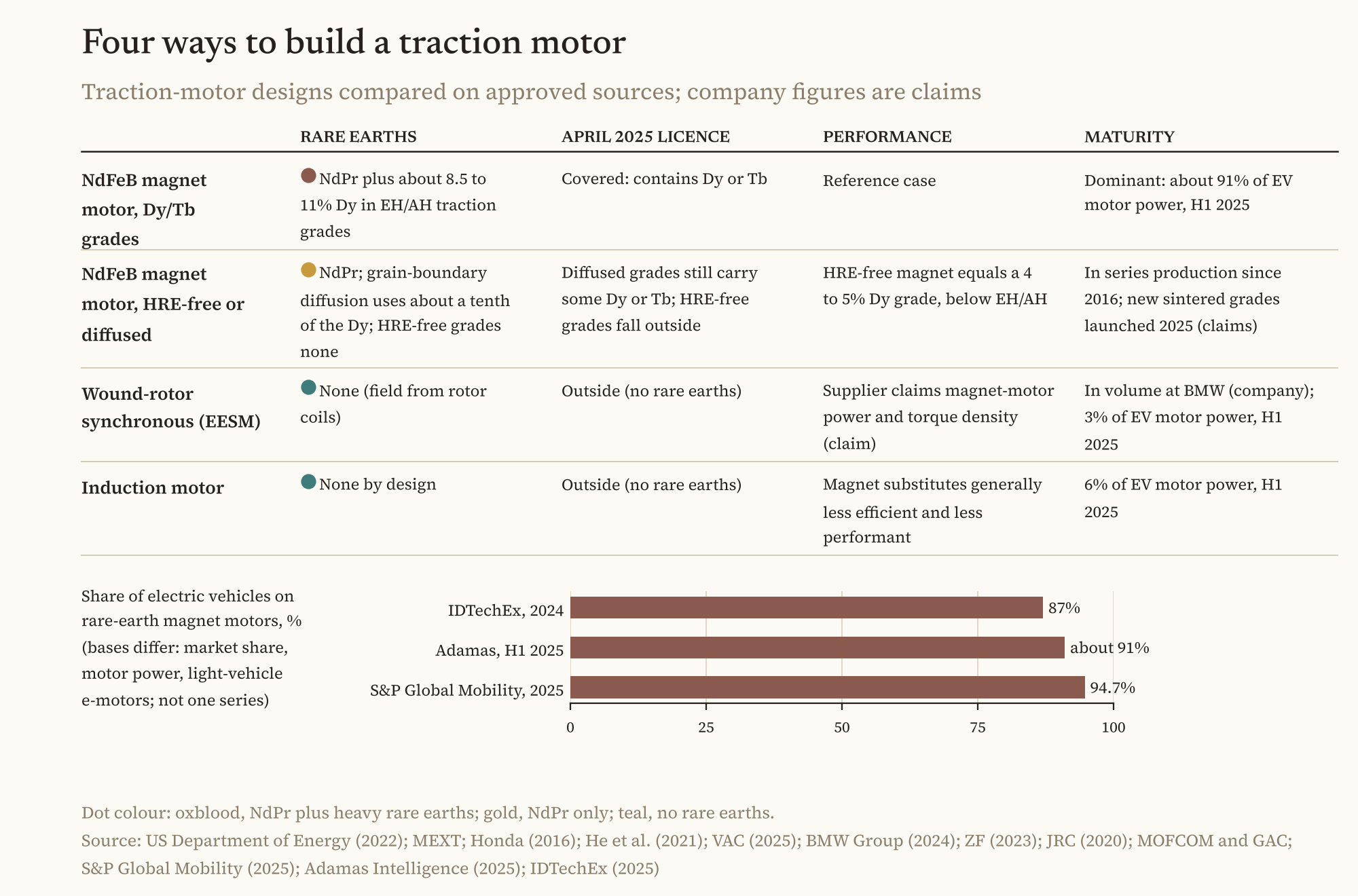
Permanent-magnet synchronous motors with conventional (dysprosium or terbium) magnets and with diffused or heavy-rare-earth-free magnets, and two magnet-free designs (wound-rotor or separately excited, and induction), compared on rare-earth content, exposure to China's April 2025 licence, performance and production maturity. Inset: the share of electric vehicles using permanent-magnet motors, one source per bar with its basis stated (IDTechEx, share of the EV market, 2024: 87%; Adamas Intelligence, motor power, H1 2025: about 91%; S&P Global Mobility, light-vehicle e-motors, 2025: 94.7%). Company performance figures are claims. Source: US Department of Energy (2022); MEXT; Honda (2016); He et al. (2021); VAC (2025); BMW Group (2024); ZF (2023); JRC (2020); MOFCOM and GAC; S&P Global Mobility (2025); Adamas Intelligence (2025); IDTechEx (2025).
Magnet-free designs are mature only in passenger cars from a few large carmakers. For the vehicles India makes in volume, the practical choice in the next five years is between conventional, diffused and heavy-rare-earth-free neodymium magnets, with ferrite where power is low.
Where India Stands
What India makes
India's monazite resources are about 13.15 million tonnes, containing an estimated 7.23 million tonnes of rare-earth oxide equivalent.88 India mined about 2,900 tonnes of rare-earth oxide in 2025, under 1% of world output.14 The ore is light-rare-earth ore: IREL told Parliament's Committee on Public Undertakings it holds 0.0112% neodymium and 1.3 parts per million of dysprosium.89 India can make neodymium magnets from its own ore, but not the dysprosium for traction grades.
IREL, the state-owned company that mines and processes beach sands,90 produced 5,872 tonnes of mixed rare-earth chloride, an intermediate, in 2023-24, and told the committee it keeps neodymium-praseodymium oxide for domestic magnet making.89 We found no official series for its separated oxide output, but there is a commitment: under the magnet scheme's gazette notification, IREL will allocate 500 tonnes a year of neodymium-praseodymium oxide to the three lowest bidders, 200, 167 and 133 tonnes respectively, and none to the other two.91
Downstream, India's magnet making is one strategic line: IREL's plant at Visakhapatnam makes 3 tonnes a year of samarium-cobalt magnets for atomic energy, defence and space, on two written parliamentary answers.90 88 At Bhopal it has mini-plants for lanthanum, cerium and neodymium metal and a magnet-recycling facility.90 The Visakhapatnam line rests on technology from the Bhabha Atomic Research Centre and the Defence Metallurgical Research Laboratory.89 92 The Department of Atomic Energy said in March 2026 that a pilot project on neodymium magnets had recently been launched.8
What India imports, and what the data cannot see
India's trade data has one line for metal permanent magnets, HS 85051190, which carries sintered neodymium, samarium-cobalt and AlNiCo magnets together and does not separate them.93 In 2025-26 India imported 23,653 tonnes under it, worth US$163.36 million, 91.0% of it from China by quantity and 80.2% by value.93 Since 2017-18 the line has grown about 4.8 times in value, and China's share of the tonnage has risen from 84.6%.93 Figures for 2024-25 tabled in the Rajya Sabha, 19,573 tonnes and 90.4% from China, are consistent.40
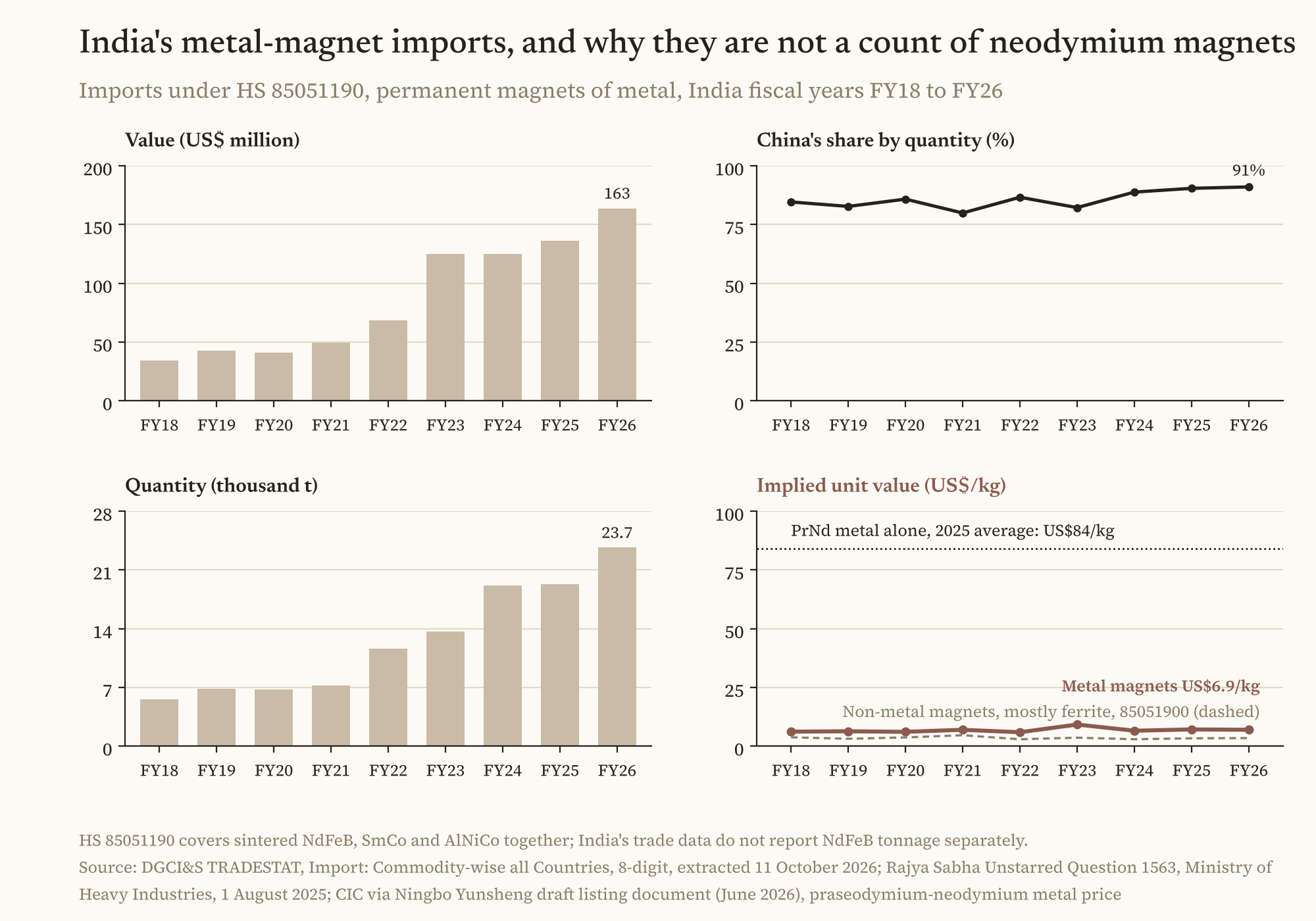
Imports under HS 85051190 (permanent magnets of metal, including neodymium, samarium-cobalt and AlNiCo), FY2017-18 to FY2025-26: tonnes and US$ million, with China's share by quantity and the implied unit value. The unit value stays at US$6 to 7 a kilogram in every year but one, a fraction of the price of the praseodymium-neodymium metal a neodymium magnet contains, so most of the tonnage cannot be neodymium magnets. The "53,700 tonnes of rare-earth magnets" figure in circulation is close to the sum of three wider HS 8505 lines and is not used here. Source: DGCI&S TRADESTAT, Import: Commodity-wise all Countries, 8-digit, extracted 11 October 2026; Rajya Sabha Unstarred Question 1563, Ministry of Heavy Industries, 1 August 2025; CIC via Ningbo Yunsheng draft listing document (June 2026), praseodymium-neodymium metal price.
The unit value gives the game away. At about US$7, the average kilogram in this line is worth less than a tenth of a kilogram of the praseodymium-neodymium metal in a neodymium magnet.93 18 Most of the line must be other magnets, and Indian trade data does not report how many tonnes of neodymium magnets the country imports.
That gap produces this piece's most important finding about India. Suppose India's demand of about 4,000 tonnes8 all crossed the border as loose magnets. At SMM's September 2026 prices for unfinished blanks, US$30 to 47 a kilogram,21 or Asian Metal's US$23 for a rough block in 2024,20 they would be worth about US$92 million to US$190 million, most or all of the line's US$163 million. Even on rare-earth content alone, at about 30%17 and US$84 a kilogram,18 they would leave the line's other 19,650 tonnes at about US$2.80 to US$4 a kilogram, at or below the US$3.38 India paid for non-metal, mostly ferrite, magnets.93 So most of India's neodymium-magnet consumption must arrive already built into imported motors, compressors, speakers and sub-assemblies, outside HS 8505, or be counted that way in the official demand figure. Either way, the exposure sits mostly in assemblies, and a magnet plant in India will find buyers only if Indian firms also build the motors the magnets go into.
What India needs, and what the scheme will make
The 2030 estimate, assessed by IREL, the Defence Metallurgical Research Laboratory and the Bhabha Atomic Research Centre, splits 8,220 tonnes across eight uses: electric vehicles 3,250 tonnes, wind turbines 1,800, ceiling fans with brushless motors 980, other applications including consumer electronics 820, phones and computers 600, industrial motors 500, solar pumps 170, and lifts and escalators 100.7 It matches the Department of Atomic Energy's "nearly 8,000 tonnes by 2030", but both come from one government, and the current 4,000 tonnes rests on a single release.8
The wind line deserves a question. India added a record 6.05 GW of wind in 2025-26 and targets 100 GW by 2030, against 56.09 GW installed in March 2026.94 At 6 GW a year, 1,800 tonnes implies about 300 kg of magnet per megawatt, as if nearly half of new capacity were direct-drive; at the roughly 11 GW a year the 100 GW target needs, about 165 kg, as if every new turbine had a geared permanent-magnet generator. Either way, on our arithmetic, the estimate assumes a magnet-heavy fleet, and the fleet being built is not one. Siemens Gamesa's India platform uses a doubly fed induction generator behind a three-stage gearbox;95 MNRE's list of approved models names the largest domestic maker's 2.1 MW platforms as doubly fed;96 and on the industry databases we consulted, the other high-volume platforms use the same magnet-free generator. MNRE's list does not record generator type, and the assessment may assume a shift to permanent-magnet platforms, so we put this as a question, not an error.
The scheme is the response. Approved on 26 November 2025 at Rs 7,280 crore, it offers Rs 6,450 crore of sales-linked incentives over five years and Rs 750 crore of capital subsidy for 6,000 tonnes a year of integrated oxide-to-magnet capacity, split among up to five beneficiaries of up to 1,200 tonnes each, chosen by a two-envelope least-cost bid.9 97 98 32 The gazette notification sets the terms. Bidders compete on the incentive they ask per kilogram sold, capped at Rs 2,150, about US$24 at Rs 88 to the dollar, and at 40% of net sales; the chain from oxide to magnet must be integrated, but there is no percentage rule for local value addition; and only the three lowest bidders get IREL oxide.91 The tender went out on 20 March 2026,99 the deadline moved to 12 August,100 10 and 20 technical bids were opened on 13 August, including from Neo Performance Materials, through its Singapore arm, and Proterial, through its Indian subsidiary.10 11 As of publication, no beneficiary had been announced.101
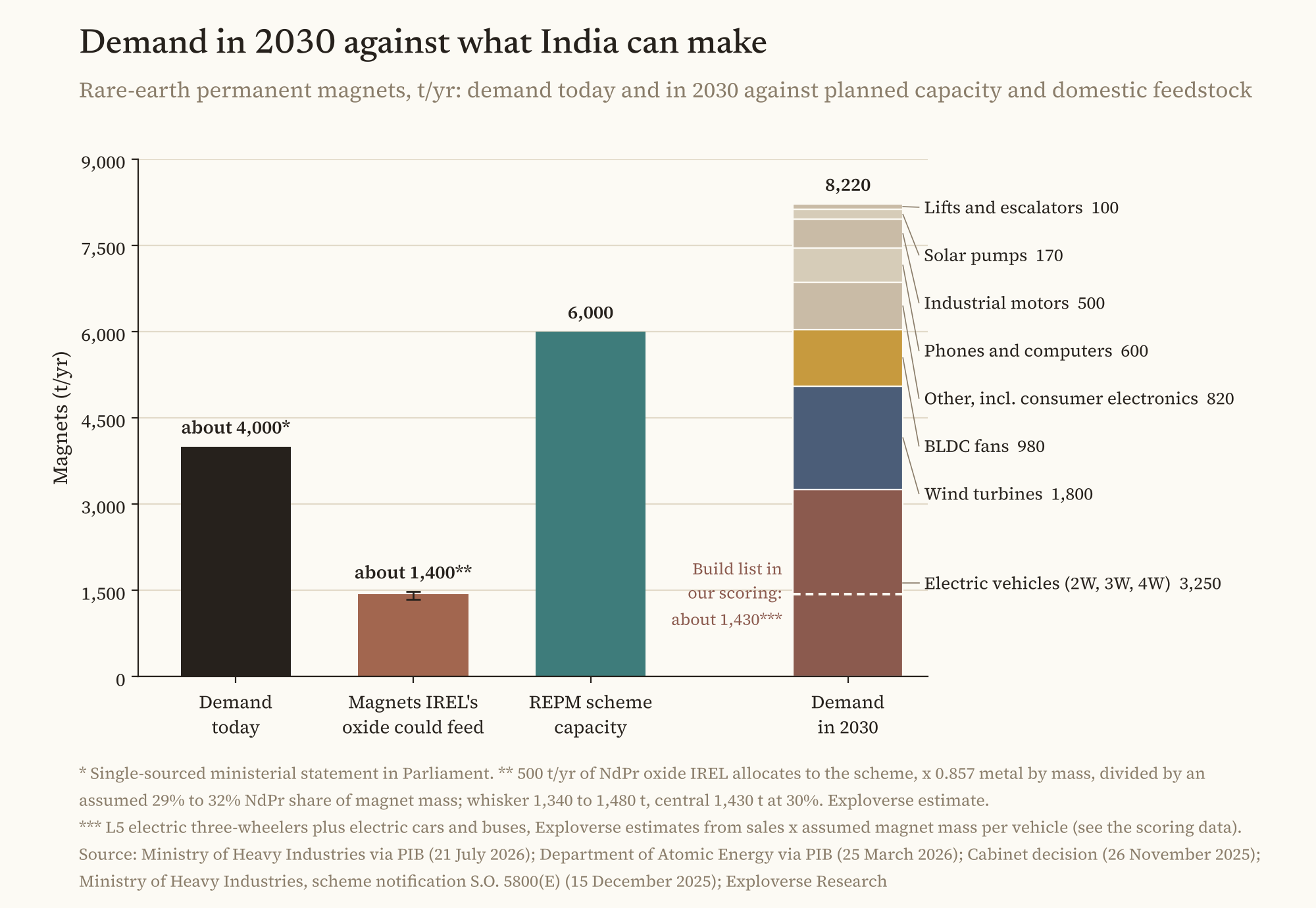
The official 2030 demand estimate of 8,220 tonnes by application, against current demand of about 4,000 tonnes, the scheme's 6,000 tonnes, and the magnet tonnage the 500 tonnes of neodymium-praseodymium oxide IREL has committed to the scheme could feed (about 1,300 to 1,500 tonnes, an Exploverse estimate). The build-list applications identified in this piece's scoring, about 1,430 tonnes, are marked. Source: Ministry of Heavy Industries via PIB (21 July 2026); Department of Atomic Energy via PIB (25 March 2026); Cabinet decision (26 November 2025); Ministry of Heavy Industries, scheme notification S.O. 5800(E) (15 December 2025); Exploverse Research.
The chart sets out the feedstock problem. The oxide is about 86% metal by weight and a magnet about 30% rare earth, so on our arithmetic IREL's 500 tonnes could feed roughly 1,300 to 1,500 tonnes of magnets, about a quarter of the scheme's capacity and close to this piece's build list, and none of the dysprosium or terbium a traction grade needs.91 17 Two of the five beneficiaries get no IREL oxide at all. The rest must be imported as oxide or metal, the material the April licence and the 2023 technology ban surround.
What India Should Make, and in What Order
The rule, stated first
Each application gets three scores from 0 to 3.
- Demand (a) is India's magnet demand in 2030, in tonnes: the official figure where there is one, otherwise our estimate of magnet mass per unit times units a year. 0 is under 100 tonnes or not estimated, 1 is 100 to under 500, 2 is 500 to 1,500, and 3 is over 1,500.
- Criticality (b) is how hard the magnet is to do without. 0 means a mature magnet-free alternative is already in production at cost parity. 1 means an alternative exists with a modest penalty, including a magnet without heavy rare earths, which falls outside the April 2025 licence list. Criticality is scored against the controls in force in October 2026, the April 2025 licence and the 2023 technology ban; that is a choice, revisited under the trade-offs. 2 means the alternative carries a large penalty, is immature, or has no evidence of working in that application; absence of evidence scores 2, not 1. 3 means there is no practical alternative.
- Feasibility (c) is whether India already makes the end product. 0 means neither the product nor its motor; 1 means assembly from imported motors or sub-assemblies; 2 means the product but mostly not the motor; 3 means the product and the motor at scale.
The scores add to a total out of 9, and a gate turns it into a prescription. If criticality is 1 or less, the prescription is to design the magnet out or thrift it to grades outside the licence, whatever the total. If criticality is 2 or more and the total is 6 or more, the application is a build-magnet priority. Otherwise the prescription is to monitor and qualify suppliers outside China. One exception is stated now: defence and strategic uses go to a state production line whatever their total, because China's October 2025 rules refuse licences for military users in principle46 and Indian importers' licences reportedly exclude defence use.43
The official electric-vehicle line covers two-, three- and four-wheelers and is not split, so we split it, folding the few buses and goods vehicles in with cars. Of 2.3 million electric vehicles sold in 2025, about 1.28 million were two-wheelers and 0.8 million three-wheelers, leaving about 0.22 million cars, buses and goods vehicles.102 In 2025, 70% of electric three-wheelers registered were low-speed e-rickshaws and e-carts; the rest were L5 passenger and goods models.103 For cars, Oak Ridge teardowns measured 0.77 to 1.35 kg of magnet in hybrid traction motors of 50 to 110 kW,104 and Adamas Intelligence puts the industry average near 1.5 kg a motor.105 We take 1.5 kg, inside the Department of Energy's 1 to 2 kg and below the IEA's 2 to 4 kg,17 16 and treat it as a floor, since twin-motor cars and buses carry more. For two-wheelers, peer-reviewed designs put 0.24 to 0.27 kg in a 0.4 kW scooter motor and about 0.25 kg in a 1 kW hub motor,106 107 and Oak Ridge's teardown of a 12.4 kW hybrid motor implies about 0.8 kg.108 A 2 to 8 kW scooter motor plausibly sits between, at 0.3 to 0.6 kg. We use 0.4 kg for a scooter, 0.75 kg for an L5 three-wheeler by analogy with the 12.4 kW motor, and 0.25 kg for an e-rickshaw's low-speed hub motor by analogy with the 1 kW design. These are Exploverse estimates: we found no published measurement of an Indian two- or three-wheeler motor. On these figures the electric vehicles sold in 2025 used about 1,160 tonnes of magnets. Scaled to the official 3,250 tonnes, our 2030 estimates are about 1,430 tonnes for two-wheelers, 510 for L5 three-wheelers, 390 for e-rickshaws and e-carts, and 920 for cars and buses. At 1 kg or 2 kg a car instead of 1.5, the build list below moves between about 1,240 and 1,590 tonnes.
The scores
| Application | 2030 demand, t | a | b | c | Total | Prescription |
|---|---|---|---|---|---|---|
| Electric three-wheelers, L5 | about 510 (estimate) | 2 | 2 (default) | 3 | 7 | Build |
| Wind turbines | 1,800 | 3 | 1 | 3 | 7 | Design out: induction, or geared drives with less magnet |
| Electric cars and buses | about 920 (estimate) | 2 | 2 | 2 | 6 | Build |
| Electric two-wheelers | about 1,430 (estimate) | 2 | 1 | 3 | 6 | Design out heavy rare earths; test ferrite |
| Ceiling fans (brushless) | 980 | 2 | 1 | 3 (assumed) | 6 | Design out: ferrite |
| Industrial motors, solar pumps, lifts (three official lines) | 770 | 2 | 1 | 3 (assumed) | 6 | Design out: induction and reluctance |
| E-rickshaws and e-carts | about 390 (estimate) | 1 | 1 | 3 | 5 | Design out heavy rare earths; test ferrite |
| Room air conditioners | up to about 1,300 (ceiling at FY2025 volumes) | 2 | 1 | 2 | 5 | Design out: heavy-rare-earth-free and ferrite compressors |
| Phones and computers | 600 | 2 | 2 | 1 | 5 | Monitor; qualify suppliers outside China |
| Defence, aerospace, space | not separately estimated | 0 | 3 | 2 | 5 | State line (override) |
| Robotics and drones | not separately estimated | 0 | 2 | 1 (assumed) | 3 | Monitor |
Sources: demand from the official 2030 estimate7 except where marked as an Exploverse estimate; scores and their inputs, with a source for each, in data/published/application-scoring.csv.
Two-wheelers score 1 on criticality because the April licence covers only magnets with dysprosium or terbium,3 heavy-rare-earth-free magnets have run in traction since 2016,66 67 and one Indian maker moved some of its motors to light-rare-earth magnets within a quarter in 2025.6 The score does not rely on ferrite, which no independent test in our sources shows working at Indian two-wheeler power. E-rickshaws and e-carts, with smaller and slower motors, score 1 on the same reasoning. L5 three-wheelers score 2 by the rule's default, not on evidence: we found no test of an alternative in that segment, and an engineer could fairly argue that an L5 motor is close enough to a scooter's to score 1. If it did, the build list would shrink to cars and buses. Cars and buses score 2 because traction grades sit at EH and AH,17 beyond what heavy-rare-earth-free magnets reach,67 and magnet-free designs are mature only in passenger cars from a few large carmakers.71 78 84
Feasibility turns on where motors are made. Since April 2021 the subsidy rules have required electric two- and three-wheeler makers to use traction motors made in India,109 and the listed maker's filing shows motors made in India, with magnet fitting the step that broke.1 Two- and three-wheelers score 3 on feasibility. A rule that bus makers fit magnets into traction motors in India, first due around September 2025, has been deferred three times, now to 1 April 2027, so bus motors with magnets are still imported.110 We found no evidence on where electric cars' motors are made. Cars and buses score 2 on feasibility.
Wind scores 1 because doubly fed induction generators are widespread,81 17 though about a quarter of onshore installations worldwide used permanent-magnet generators in 2022,28 and because the platforms sold in India use doubly fed generators95 96 and India makes turbines at scale.94 The score would rise with offshore wind, where permanent-magnet generators made 92% of global installations in 2022.28 Fans and industrial motors score 1 because ferrite and magnet-free machines are established alternatives there, at an efficiency penalty.15 14 These are the thinnest scores in the table: we found no Indian data on ferrite in brushless fans or induction in industrial motors, and the official 980-tonne fan line suggests the assessment assumes neodymium in fans. Feasibility of 3 for both, and 1 for robots, is our assumption. The industrial row groups three official lines; industrial motors alone, at 500 tonnes, sit in the same band. Air conditioners score 1 because in China about a fifth of inverter units already use compressors without neodymium magnets.111 India sold 12.5 to 13 million room air conditioners in 2024-25, on ICRA's figures;112 at SMM's 100 grams of magnet a unit,111 that is at most about 1,300 tonnes, if every unit had a neodymium inverter compressor. With no citable inverter share, this is a ceiling, and it exceeds the official 820-tonne "other" line it should sit within. We score demand 2 on it; the gate decides the prescription either way. Phones and computers score 2 on criticality for want of evidence of an alternative for their small speaker, haptic and camera magnets, and 1 on feasibility because those magnets arrive mainly inside imported sub-assemblies.7 93
The result is a short build list: L5 three-wheelers and electric cars and buses, about 1,430 tonnes of 2030 demand by our estimate, are where India should make magnets, plus defence on a state line. That is close to the 1,300 to 1,500 tonnes IREL's committed oxide could feed. Two-wheelers, e-rickshaws, wind, fans and industrial drives, about 5,370 tonnes, and air conditioners are where India should design the licence out. For phones, computers and robots, qualify more than one supplier and watch.
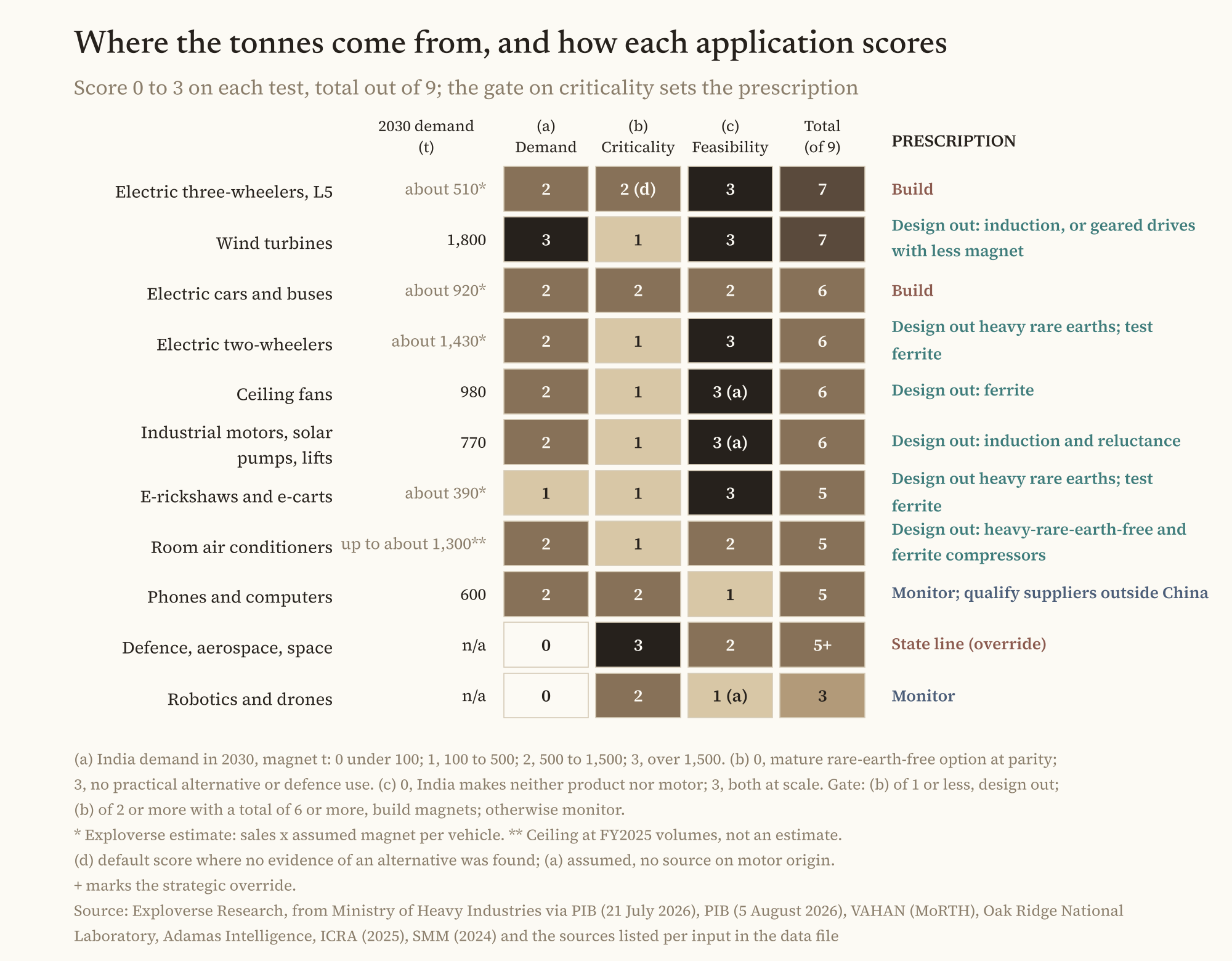
For each application, India's 2030 magnet demand (official estimate, or an Exploverse estimate from magnet mass per unit multiplied by units a year where marked) with the three scores and the prescription the stated rule produces. The build list totals about 1,430 tonnes; the design-out applications about 5,370 tonnes before air conditioners, whose demand is shown as a ceiling at FY2025 volumes. Electric three-wheelers are split into L5 models and low-speed e-rickshaws and e-carts. Source: Exploverse Research, from Ministry of Heavy Industries via PIB (21 July 2026), PIB (5 August 2026), VAHAN (MoRTH), Oak Ridge National Laboratory, Adamas Intelligence, ICRA (2025), SMM (2024) and the sources listed per input in the data file.
Nearly two-thirds of India's projected tonnage sits where the licence can be designed around and India already makes the product, so the redesign is within Indian firms' reach. The build list would fill little more than one plant at the scheme's 1,200-tonne cap.
To end-2027: get through the decision and award well
Milestones: the end of the suspension (10 November 2026 in China's instrument, 10 January 2027 under the announced extension) and the scheme's awards.
Government. Award the scheme and publish each beneficiary's capacity, grades and timeline. Weight the incentive toward magnets sold into the build list and toward heavy-rare-earth-free and diffusion grades. The rule for IREL's oxide is now published, 500 tonnes to the three lowest bidders;91 say whether 500 tonnes is the ceiling of what IREL can supply, and where the other two beneficiaries' feedstock is to come from. Hold a buffer of traction-grade magnets and of dysprosium and terbium oxide for the build list and defence, as Japan, the United States, Australia and the European Union do in different forms.59 60 113 61 For scale, the US Defense Logistics Agency's plan for fiscal 2025 set purchase ceilings of 450 tonnes of neodymium magnet block and 300 tonnes of neodymium-praseodymium oxide.114 The National Critical Mineral Mission has a mineral stockpile target,115 but we found no rare-earth stockpile decision. Create separate tariff lines for neodymium, samarium-cobalt and other metal magnets, so India can count what it imports.
Industry. Qualify a second magnet supplier outside China for every build-list application and accept the price. Neo Performance Materials' chief executive told Reuters buyers outside China would pay US$10 to 30 a kilogram above Chinese prices;116 at 1 to 2 kg a motor, that is US$10 to 60 a motor, more for twin-motor cars. Move two-wheeler and fan motors to heavy-rare-earth-free magnets now, test ferrite designs at Indian duty cycles, and specify induction generators for onshore turbines where the project allows.
To 2030: build metal, alloy and motors alongside magnets
Milestones: the scheme's first output and the 8,220-tonne demand year.
Government. Treat oxide-to-metal and alloy making as the step to secure first: it is the most exposed to China's equipment and technology rules, and the IEA's main bottleneck outside China.16 45 47 A single shared metal and alloy plant serving all beneficiaries would make more sense than five subscale ones; IREL's Bhopal metal work is the seed.90 Source technology from Japan, Europe or the United States; China's has been closed to export since 2023.33 Fold magnet scrap into the Rs 1,500 crore recycling incentive.90
Industry. Build traction motors for L5 three-wheelers, cars and buses in India, so that a domestic magnet has a domestic buyer, and sign multi-year offtake with scheme plants. The auto incentive scheme already lists rare-earth magnets for electric-vehicle motors as an Advanced Automotive Technology component.117 Invest in grain-boundary diffusion capability early, because its equipment is the narrowest point in the chain.15
To 2035: heavy rare earths and the export market
Milestone: the IEA's horizon, when planned capacity outside China would still meet well under a fifth of its magnet demand.16
Government. Secure dysprosium and terbium through partners, because Indian ore holds 1.3 parts per million of dysprosium:89 the Lynas-JARE model of a state-backed buyer with an offtake and a floor is the template.59 Size any second tranche of the scheme to the demand left after substitution, not to the 2030 projection.
Industry. Treat the non-Chinese market as the scale market. Closing the gap outside China needs about six times the magnet capacity now planned,16 and the United States and Japan are underwriting US$110 floors to get supply.24 59 Indian makers that qualify there can run at volumes the domestic build list cannot give them.
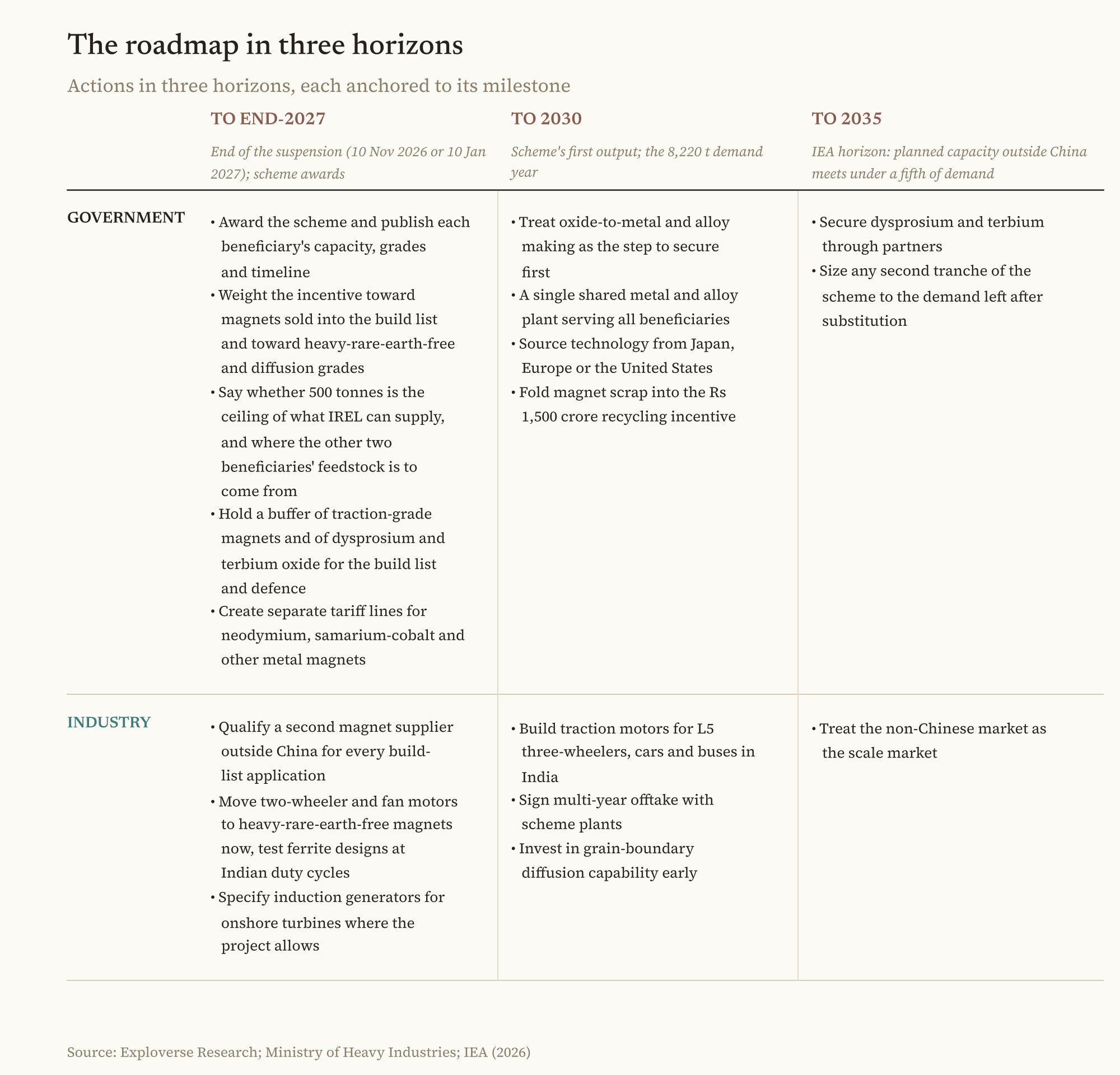
Actions for government and for industry to end-2027, to 2030 and to 2035, each anchored to its milestone: the end of the suspension (10 November 2026 in China's instrument, 10 January 2027 under the extension announced in September) and the scheme's awards; the scheme's first output and the 8,220-tonne demand year; and the IEA's 2035 horizon for capacity outside China. Each action is footnoted in the text. Source: Exploverse Research; Ministry of Heavy Industries; IEA (2026).
The trade-offs, plainly
Security costs money. A non-Chinese magnet costs more, and one from a 1,200-tonne Indian plant more again than one from a 40,000-tonne Chinese maker.22 The case for paying is that the premium is small against the product: under 1% of a car's value in rare earths,15 and US$10 to 60 a motor for a non-Chinese magnet at the reported premium.116
Design-out and build pull against each other. Every two-wheeler and fan moved to ferrite or a heavy-rare-earth-free magnet is offtake a subscale Indian plant does not get. This is the strongest objection to the portfolio. The answer is to size the domestic build to what cannot be designed out, about 1,430 tonnes by our estimate, close to what IREL's committed oxide could feed, and to seek the rest of a plant's volume in export markets, not in applications that should be redesigned. Export buyers will demand automotive qualification, which takes years, so that volume comes late.
The floor itself can move. We scored criticality against the controls in force in October 2026, which reach only medium and heavy rare earths.3 Even a reinstated No. 61 would leave heavy-rare-earth-free magnets outside,64 which strengthens the design-out prescriptions, though a build-list plant using Chinese dysprosium, terbium or know-how for its traction grades would sit inside it. The residual risk is a control on neodymium-praseodymium itself, which China has not imposed. If it came, the design-outs that rest on heavy-rare-earth-free neodymium magnets would be exposed again, and the build list to the extent its plants run on imported oxide or metal. Both argue for plants that can make heavy-rare-earth-free grades and source heavy rare earths outside China.
Technology has to come from somewhere. China's is closed by law;33 Japan's comes with Japanese partners, and Proterial is already among the bidders.11 Licensing is faster than home development, and less sovereign.
Speed is the last constraint. A plant awarded in 2026 has a two-year gestation,118 so output before 2028 is unlikely. Until then India's protection is a stockpile, a second supplier and a redesigned motor.
The Month a Licence Is Refused
The test of this programme in 2030 will not be how many tonnes of capacity India has commissioned, but how many Indian-made products keep shipping in a month when a Chinese licence is refused or delayed, the kind of month India's scooter makers lived through in 2025.
On that test, most protection is cheaper and faster than a magnet plant. A two-wheeler motor without dysprosium, a fan with a ferrite rotor, a turbine with an induction generator: each removes a product from the licence's reach without a single new furnace. The plant is for what is left: the traction motors of L5 three-wheelers, cars and buses, the defence systems no foreign licence will cover, and export customers outside China who need a second source more than India does.
Whatever China decides when the suspension ends, the April 2025 licence on dysprosium and terbium magnets and the 2023 ban on exporting magnet-making technology will still be in force the next morning. The scheme should be built for that morning.
Disclosure: Exploverse Research's founder holds executive and board roles in Indian manufacturing companies. This piece was produced under the house byline; no Indian company is named, and no company he is associated with was consulted for it.
Sources
- Disclosure on subsidy, National Stock Exchange of India (filing by a listed electric two-wheeler maker), 25 September 2025.
- Press release on rare-earth magnet inventories and electric two-wheeler motor costs, ICRA Limited, 12 June 2025.
- 商务部、海关总署公告2025年第18号 (MOFCOM and GAC Announcement No. 18 of 2025, export controls on certain medium and heavy rare-earth items), Ministry of Commerce and General Administration of Customs of the People's Republic of China, 4 April 2025.
- Rare-earth permanent magnets exports in May 2025 hit a new historical low in nearly five years (SMM Analysis), SMM (Shanghai Metals Market), June 2025.
- China's exports of rare earth magnets to the US surge in June, Reuters (via Kitco), 21 July 2025.
- How rare earth shortages are stalling India's burgeoning EV sector, Al Jazeera, 28 August 2025.
- Assessment of Rare Earth Permanent Management Scheme [sic; Lok Sabha written reply], Press Information Bureau, Ministry of Heavy Industries, 21 July 2026.
- Domestic production capacity of Rare Earth Permanent Magnet to reach 5,000 tonnes by 2030, Press Information Bureau, Department of Atomic Energy, 25 March 2026.
- Cabinet approves Rs 7,280 crore scheme to promote manufacturing of Sintered Rare Earth Permanent Magnets (REPM), Prime Minister's Office, 26 November 2025.
- Ministry of Heavy Industries receives bids to set up REPM facilities, IANS (via Telangana Today), 13 August 2026.
- Government receives 20 bids for rare earth permanent magnet manufacturing scheme, DD India (Prasar Bharati), 13 August 2026.
- 商务部、海关总署公告2025年第70号 (MOFCOM and GAC Announcement No. 70 of 2025, suspending Announcements No. 55, 56, 57, 58, 61 and 62 of 2025), Ministry of Commerce and General Administration of Customs of the People's Republic of China, 7 November 2025.
- 商务部美大司负责人解读第八轮中美经贸磋商成果 (MOFCOM Department of American and Oceanian Affairs official on the outcome of the eighth round of China-US economic and trade consultations), Ministry of Commerce of the People's Republic of China, 28 September 2026.
- Mineral Commodity Summaries 2026: Rare Earths, U.S. Geological Survey, 2026.
- Global Critical Minerals Outlook 2026, International Energy Agency, 16 July 2026.
- Rare Earth Elements: Pathways to secure and diversified supply chains, International Energy Agency, 8 April 2026.
- Rare Earth Permanent Magnets: Supply Chain Deep Dive Assessment, U.S. Department of Energy, 24 February 2022.
- Ningbo Yunsheng Co., Ltd., draft listing document (Application Proof): Industry Overview and Business sections, with industry data from China Insights Consultancy (CIC), HKEXnews, 15 June 2026.
- USA Rare Earth, Inc., Form 10-K for fiscal year 2025, U.S. Securities and Exchange Commission (EDGAR), 2026.
- Chinese rough sintered NdFeB magnet N52 prices increase, Asian Metal, 30 April 2024.
- Pr-Nd prices hold firm with a steady rise, trading tends to thin before the holiday (SMM Rare Earth Weekly Review), SMM (Shanghai Metals Market), 30 September 2026.
- JL MAG Rare-Earth Co., Ltd., Annual Report 2025, JL MAG Rare-Earth Co., Ltd., 2026.
- Proterial to invest $225M in rare earth magnet plant in Andhra Pradesh, India, SMM (Shanghai Metals Market), 2 July 2026.
- MP Materials Announces Transformational Public-Private Partnership with the Department of Defense to Accelerate U.S. Rare Earth Magnet Independence, MP Materials, 10 July 2025.
- MP Materials Corp., Form 10-K for fiscal year 2025, U.S. Securities and Exchange Commission (EDGAR), 2026.
- Form 8-K, exhibit 99.1: agreement and plan of merger to acquire VAC, Energy Fuels Inc. (US Securities and Exchange Commission filing), June 2026.
- Form 8-K: First Amendment to Agreement and Plan of Merger (VAC); e-VAC customer dispute, Energy Fuels Inc. (US Securities and Exchange Commission filing), 13 October 2026.
- Deep dive on critical raw materials for wind turbines in the EU (JRC141759), European Commission Joint Research Centre, 2025.
- Neo Performance Materials Advances to Commercial Production at its European Magnet Facility, Neo Performance Materials, 14 September 2026.
- Rare earths magnet firms turn to Vietnam in China hedge, Reuters (republished by Viet Nam Government News), 22 August 2023.
- Vietnam continues charge to offer alternative to Chinese rare earth permanent magnets, Project Blue, 23 August 2023.
- Powering India's Next Tech Leap through Rare Earth Permanent Magnet Manufacturing Ecosystem, Press Information Bureau, 27 December 2025.
- 中国禁止出口限制出口技术目录 (Catalogue of Technologies Prohibited and Restricted from Export), MOFCOM and MOST Announcement No. 57 of 2023, Ministry of Commerce and Ministry of Science and Technology of the People's Republic of China, 21 December 2023.
- Rare-earth permanent magnets exports in April 2025 hit a record low in nearly five years (SMM Analysis), SMM (Shanghai Metals Market), May 2025.
- Rare Earth Market Monthly, October 2025, Adamas Intelligence, December 2025.
- With new export controls on critical minerals, supply concentration risks become reality, International Energy Agency, 23 October 2025.
- China's Magnet Exports 2022-2026: Geopolitics, US-China Dynamics (SMM Analysis), SMM (Shanghai Metals Market), 28 April 2026.
- Urgent action needed as China's export restrictions on rare earths disrupt European automotive supply chains, CLEPA (European Association of Automotive Suppliers), 4 June 2025.
- Mineral Commodity Summaries 2026: Rare Earths (Heavy), U.S. Geological Survey, January 2026.
- Disruption in the supply of rare earth magnets, Rajya Sabha Unstarred Question No. 1563, Ministry of Heavy Industries, 1 August 2025.
- Impact of China's Magnet Export Curbs on Indian Industries, Lok Sabha Unstarred Question No. 4309, Ministry of Commerce and Industry, 19 August 2025.
- Some companies in India get China licences to import REMs, says MEA, Business Standard, 30 October 2025.
- Indian firms get licenses to import rare earth magnets from China, IANS, 30 October 2025.
- China's Global Exports of Rare Earths: August 2026 Update, Silverado Policy Accelerator, 31 August 2026.
- 商务部、海关总署公告2025年第56号 (MOFCOM and GAC Announcement No. 56 of 2025, export controls on certain rare-earth equipment and raw and auxiliary materials), Ministry of Commerce and General Administration of Customs of the People's Republic of China, 9 October 2025.
- 商务部公告2025年第61号 (MOFCOM Announcement No. 61 of 2025, export controls on relevant overseas rare-earth items), Ministry of Commerce of the People's Republic of China, 9 October 2025.
- 商务部公告2025年第62号 (MOFCOM Announcement No. 62 of 2025, export controls on rare-earth-related technologies), Ministry of Commerce of the People's Republic of China, 9 October 2025.
- 商务部:已批准部分稀土出口通用许可申请 (MOFCOM: some general-licence applications for rare-earth exports approved), Xinhua (via China Daily), 18 December 2025.
- Fact Sheet: President Donald J. Trump Strikes Deal on Economic and Trade Relations with China, The White House, 1 November 2025.
- 商务部回应稀土出口管制 (MOFCOM responds on rare-earth export controls), Xinhua, 9 April 2026.
- 商务部公告2026年第26号 (MOFCOM Announcement No. 26 of 2026, on handling reports of violations of export controls on strategic-mineral dual-use items), Ministry of Commerce of the People's Republic of China, 24 June 2026.
- 商务部公告2026年第1号 (MOFCOM Announcement No. 1 of 2026, on strengthening export control of dual-use items to Japan), Ministry of Commerce of the People's Republic of China, 6 January 2026.
- Japan gov backs new Shin-Etsu rare earth refinery build amid China's export control, Reuters (republished by Engineering News), 11 June 2026.
- Fact Sheet: President Donald J. Trump Advances a Fair and Reciprocal Relationship with China While Hosting Historic State Visit, The White House, 25 September 2026.
- China's rare earth magnet exports down 6% MoM, 18% YoY in August 2026, SMM (Shanghai Metals Market), September 2026.
- China's Rare Earth Magnet Exports Hit Record in September, Driven by Backlog Release and Regulatory Easing (SMM Analysis), SMM (Shanghai Metals Market), 20 October 2026.
- China says US trade truce extension creates space to advance talks, Reuters (via Investing.com), 28 September 2026.
- 商务部 政策发布 (MOFCOM policy releases listing), checked through the browser, Ministry of Commerce of the People's Republic of China, accessed 23 October 2026.
- Enhanced JARE Agreement for Japanese Industry, Lynas Rare Earths (ASX announcement), 10 March 2026.
- US Strategic Critical Minerals Reserve (Project Vault), International Energy Agency, Policies database, 2026.
- RESourceEU (press release IP/25/2891), European Commission, 3 December 2025.
- Critical Raw Materials: securing Europe's supply and strategic autonomy (press release), European Parliament, 20 October 2026.
- China rare earth permanent magnet export analysis and outlook, July 2026 (SMM Analysis), SMM (Shanghai Metals Market), 21 August 2026.
- Ministry of Commerce Notice 2025 No. 61 (English translation, with Appendix 1), Center for Security and Emerging Technology, Georgetown University, translation of the 9 October 2025 instrument.
- Grain Boundary Diffusion Sources and Their Coating Methods for Nd-Fe-B Permanent Magnets, Metals 11(9):1434, He, Cao, Yu, Song, Yu, Hussain and Liu (MDPI), 10 September 2021.
- Daido Steel and Honda Adopt World's First Hybrid Vehicle Motor Magnet Free of Heavy Rare Earth Elements, Honda Motor Co., 12 July 2016.
- Development of Heavy-Rare-Earth-Free Hot-Deformed Nd-Fe-B Magnets and Their Practical Realization for Traction Motors (Elements Strategy Initiative digest), Ministry of Education, Culture, Sports, Science and Technology, Japan, undated (after 2016).
- VACODYM 902 TP: Heavy Rare Earth Free Permanent Magnets, Vacuumschmelze (VAC), 9 September 2025.
- World's first neodymium-reduced, heat-resistant magnet developed by Toyota, Toyota Motor Corporation, 20 February 2018.
- Cerium NdFeB magnets: gift or a curse?, Adamas Intelligence, 22 October 2024.
- BMW's 5th generation electric drive system wins 2024 AJAC Best Green Innovation award, BMW Group PressClub Canada, 21 March 2024.
- ZF makes magnet-free electric motor uniquely compact and competitive, ZF Friedrichshafen, 1 September 2023.
- Valeo and MAHLE expand their product range of magnet-free electric motors to upper segment applications, MAHLE, 14 October 2024.
- Critical Materials Assessment 2023, U.S. Department of Energy, July 2023.
- Niron Magnetics and Stellantis Partner to Pioneer Rare-Earth-Free Electric Motor Innovation, Niron Magnetics (Business Wire), 16 October 2025.
- GM Ventures and Niron Magnets pursue sustainable EV motor magnets, General Motors, 8 November 2023.
- Niron Magnetics Receives $150 Million Loan from the Shakopee Mdewakanton Sioux Community to Support Iron Nitride Magnet Manufacturing, Niron Magnetics, 18 August 2026.
- Eliminating rare earth elements from the EV motor supply chain, S&P Global Mobility, 27 November 2025.
- Routes for EV motors to reduce their Chinese rare earth reliance, IDTechEx (Electric Vehicles Research), 19 November 2025.
- Beyond 15 MW: A cost of energy perspective on the next generation of drivetrain technologies for offshore wind turbines, Applied Energy 344:121272, Barter, Sethuraman, Bortolotti, Keller and Torrey (National Renewable Energy Laboratory), 2023.
- Wind turbine suppliers deliver new record volume despite difficult year full of diverse challenges, Global Wind Energy Council, 16 May 2025.
- Electric Motors for Electric Vehicles 2026-2036, IDTechEx, 20 October 2025.
- Top 5 EV makers by permanent magnet motor power deployed, Adamas Intelligence, 15 September 2025.
- China's rare-earth dominance is hard for EV makers to escape, Rest of World, 18 February 2026.
- Niron Magnetics presentation on iron nitride permanent magnets, Niron Magnetics (hosted by NDIA/DTIC), c. 2024.
- General Motors & Noveon Magnetics Sign Multi-Year Agreement, Noveon Magnetics, 6 August 2025.
- The role of rare earth elements in wind energy and electric mobility (JRC122671), European Commission Joint Research Centre, 2020.
- Parliament Question: Rare Earth Reserves and Magnet Manufacturing, Press Information Bureau, Ministry of Earth Sciences, 2 April 2026.
- Committee on Public Undertakings (2024-25), Twelfth Report, Eighteenth Lok Sabha: IREL (India) Limited, Lok Sabha Secretariat, 27 March 2025.
- Production of Rare Earth Elements and Magnets, Rajya Sabha Unstarred Question No. 481, Department of Atomic Energy, 23 July 2026.
- Scheme to Promote Manufacturing of Sintered Rare Earth Permanent Magnets, Gazette notification S.O. 5800(E), Ministry of Heavy Industries, Gazette of India, 15 December 2025.
- High Energy Rare Earth Permanent Magnets, Defence Research and Development Organisation, undated.
- Import: Commodity-wise all Countries, HS 8505 eight-digit lines, quantity and value, FY2017-18 to FY2025-26 (select HS code and year on the form), Directorate General of Commercial Intelligence and Statistics (TRADESTAT, Export Import Data Bank), Ministry of Commerce and Industry, extracted 11 October 2026.
- Global Wind Day 2026: Charting India's Path to 100 GW and Beyond, Press Information Bureau (Ministry of New and Renewable Energy), 14 June 2026.
- SG 3.4-145 (India) product brochure, Siemens Gamesa Renewable Energy (Siemens Energy), April 2025.
- Revised List of Models and Manufacturers (RLMM) of wind turbines, as on 19.10.2022, Ministry of New and Renewable Energy (copy hosted by the Indian Wind Power Association), 19 October 2022.
- Promoting manufacturing of sintered REPM, Lok Sabha Unstarred Question No. 2603, Ministry of Heavy Industries, 16 December 2025.
- Electric vehicle manufacturing and global trends, Rajya Sabha Unstarred Question No. 1521, Ministry of Heavy Industries, 31 July 2026.
- Ministry of Heavy Industries invites global bids to set up rare earth magnet manufacturing units, News On AIR (Prasar Bharati), 20 March 2026.
- Govt extends rare earth scheme's global tender timelines, IANS, 25 June 2026.
- Press releases and scheme notifications (REPM scheme), checked for an award, Ministry of Heavy Industries, accessed 23 October 2026.
- Roads Reimagined: The Rise of India's Electric Vehicles Ecosystem, Press Information Bureau, 5 August 2026.
- Vahan Dashboard: Vehicle Class Wise Fuel Data For All State, calendar year 2025 and financial year 2025-26, Ministry of Road Transport and Highways (VAHAN 4, NIC), accessed 11 October 2026.
- Evaluation of the 2010 Toyota Prius Hybrid Synergy Drive System (ORNL/TM-2010/253), Oak Ridge National Laboratory, March 2011.
- EV Motor Materials Monthly, public sample (June 2022 issue), Adamas Intelligence, June 2022.
- Design and optimization of a high-performance multi-barrier IPMS motor for an electric scooter and bicycle (Gor and Dalcali), Royal Society Open Science 11: 231650, The Royal Society, 2024.
- Application of Halbach magnetic assembly in the outer rotor of BLDC motor to improve its performance (Al_Issa et al.), Frontiers in Energy Research 14: 1880377, Frontiers, 2026.
- Evaluation of 2005 Honda Accord Hybrid Electric Drive System (ORNL/TM-2006/535), Oak Ridge National Laboratory, September 2006.
- PM E-DRIVE Scheme notification S.O. 4259(E), Annexure-5 (Phased Manufacturing Programme), Ministry of Heavy Industries, Gazette of India, 29 September 2024.
- Fourth Amendment to the PMP for e-buses (M2, M3) under PM E-DRIVE, S.O. 4884(E), Ministry of Heavy Industries, Gazette of India, 3 September 2026.
- Strong Growth in Air Conditioner Production: Can This Market Boost NdFeB Demand (SMM Analysis), SMM (Shanghai Metals Market), 24 December 2024.
- Room air-conditioner industry faces the heat with unseasonal rains set to dampen volumes by 10-15% in FY2026: ICRA, ICRA Limited, 24 September 2025.
- About the Critical Minerals Strategic Reserve, Department of Industry, Science and Resources, Australian Government, undated, accessed 11 October 2026.
- Annual Materials Plan for FY 2025, potential acquisitions (DLA-SM-25-3256), Defense Logistics Agency Strategic Materials, US Department of Defense, 1 October 2024.
- National Critical Mineral Mission, Powering India's Clean Energy Future, Press Information Bureau, Ministry of Mines, 9 April 2025.
- Rare earth magnet users jolted into paying premium prices for ex-China supply, Reuters (republished by American Journal of Transportation), 1 July 2025.
- Overcoming Shortage of Rare Earth Magnets for EV Production, Press Information Bureau, Ministry of Heavy Industries, 12 December 2025.
- India's Rare Earth Strategy: Manufacturing, Corridors, and Global Integration, Press Information Bureau, 3 February 2026.