China, Vietnam and Taiwan each turned a single accountable entity into their electronics manufacturing edge, not incentives alone. India's own version, the BHAVYA scheme, was approved this March. Here is what the model actually requires, and which of India's six competing state corridors is likeliest to get there first.
Key takeaways
- Suzhou, VSIP and Shenzhen/Hsinchu all trace back to one accountable vehicle building shared infrastructure and services, not to incentives alone.
- India has already run four smaller versions of this experiment, Special Economic Zones, the National Investment and Manufacturing Zones, the MSME Cluster Development Programme and AMTZ, and PM MITRA, and governance, not incentive design, is what separated the ones that worked from the ones that didn't.
- BHAVYA, approved in March 2026, is India's first national attempt to build this vehicle at scale: 100 parks targeted by FY32, an SPV for each, national equity capped at 50%.
- Of six state corridors chasing an integrated electronics cluster, only two currently hold a central semiconductor-mission approval; the rest are still converting announcements into approvals.
- The likeliest failure mode is not incentive design, it is land acquisition, deal bankability and single-anchor dependence, risks that have already cost two states a marquee investment each.
Why clusters, and not just factories
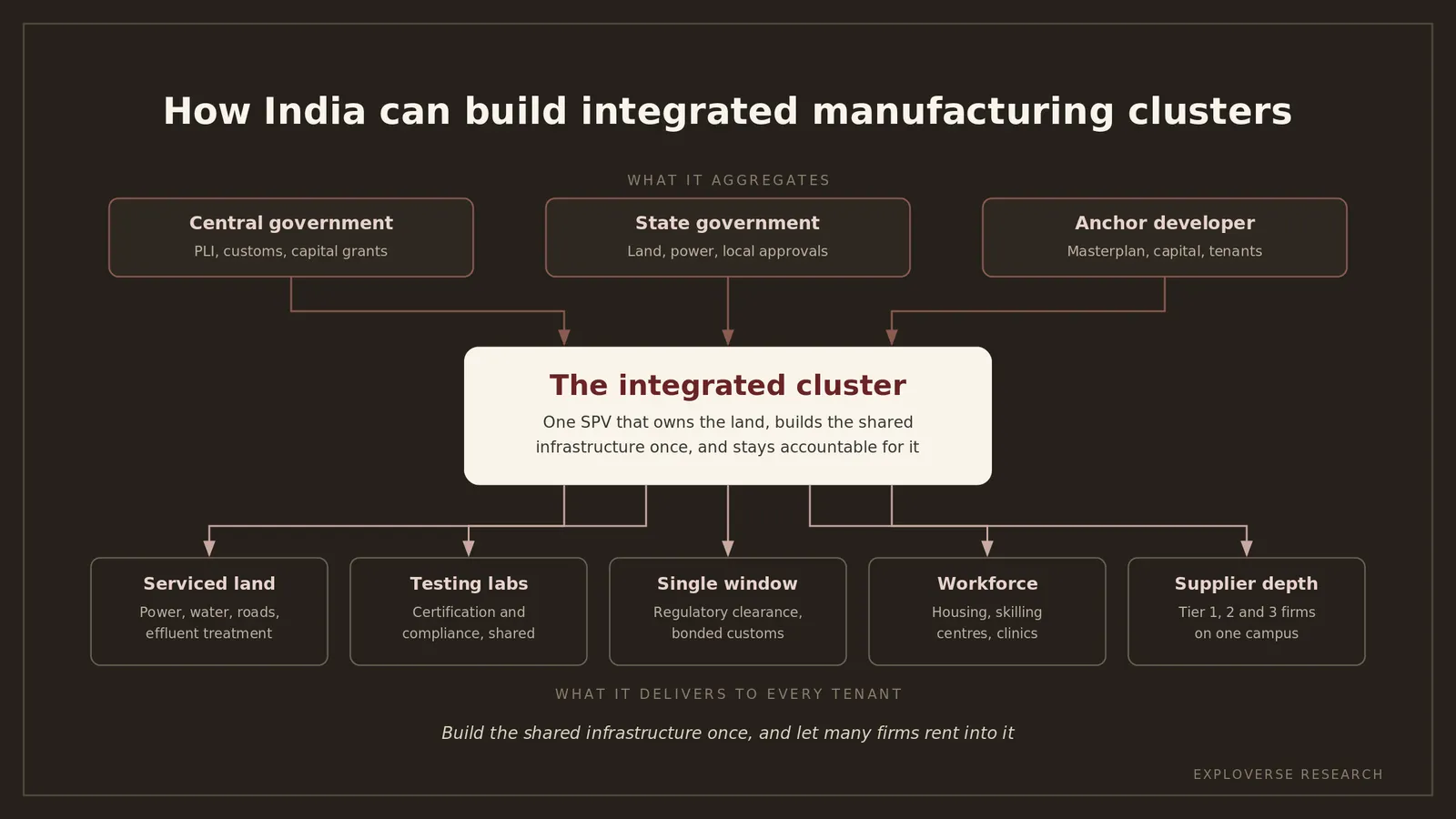
A factory solves one firm's production problem. A cluster solves an industry's. The distinction sounds semantic until you look at what a single mid-sized manufacturer has to build before it can ship a product: its own compliance function, its own testing setup, its own logistics contracts, its own effluent treatment, often its own worker housing. Michael Porter's original formulation of industry clusters describes geographic concentrations of interconnected firms, specialised suppliers and supporting institutions that compete but also cooperate, reducing the transaction costs of frequent dealings between firms and enabling specialisation that no single company could sustain in isolation.[1] The practical version of that idea, for a country trying to industrialise quickly, is simpler still: build the shared infrastructure once, and let many firms rent into it.
China's manufacturing map is a portfolio of exactly this logic applied industry by industry. Shenzhen, Guangzhou and Dongguan together form the core of China's export-oriented electronics assembly base, with Shenzhen the anchor for Guangdong province's integrated-circuit and semiconductor output.[2] Foshan, next door, is China's furniture capital; Dongguan doubles as a toy and plastics hub; Shanghai anchors biopharmaceuticals. None of this happened by accident of geography alone. Each cluster was seeded, subsidised and serviced by government at some stage, usually multiple levels of it at once.
That last point matters for India specifically, because India's federal structure already allows a version of this stacking that unitary systems cannot: central schemes such as production-linked incentives and customs facilitation can be layered directly on top of state land, power and stamp-duty concessions, on the same site, for the same firm. The constraint has not been the availability of incentives. It has been the absence of a vehicle that aggregates them, builds the shared infrastructure around them, and stays accountable for both once construction is over.
There is also a cost argument that has quietly shifted in India's favour. A DPIIT-commissioned NCAER report released in 2025 put India's logistics cost at 7.97% of GDP in FY24, down from 8.84% the year before, well below China's 14.4% in 2023, replacing an older and less rigorous estimate of 13 to 14% that had shaped policy thinking for years.[3] That does not make India cheaper than China on every input. It does mean the logistics penalty that used to be cited as a reason clusters could not work here is smaller than assumed, and shared logistics infrastructure inside a cluster can close most of the remaining gap.
What the leading clusters actually did
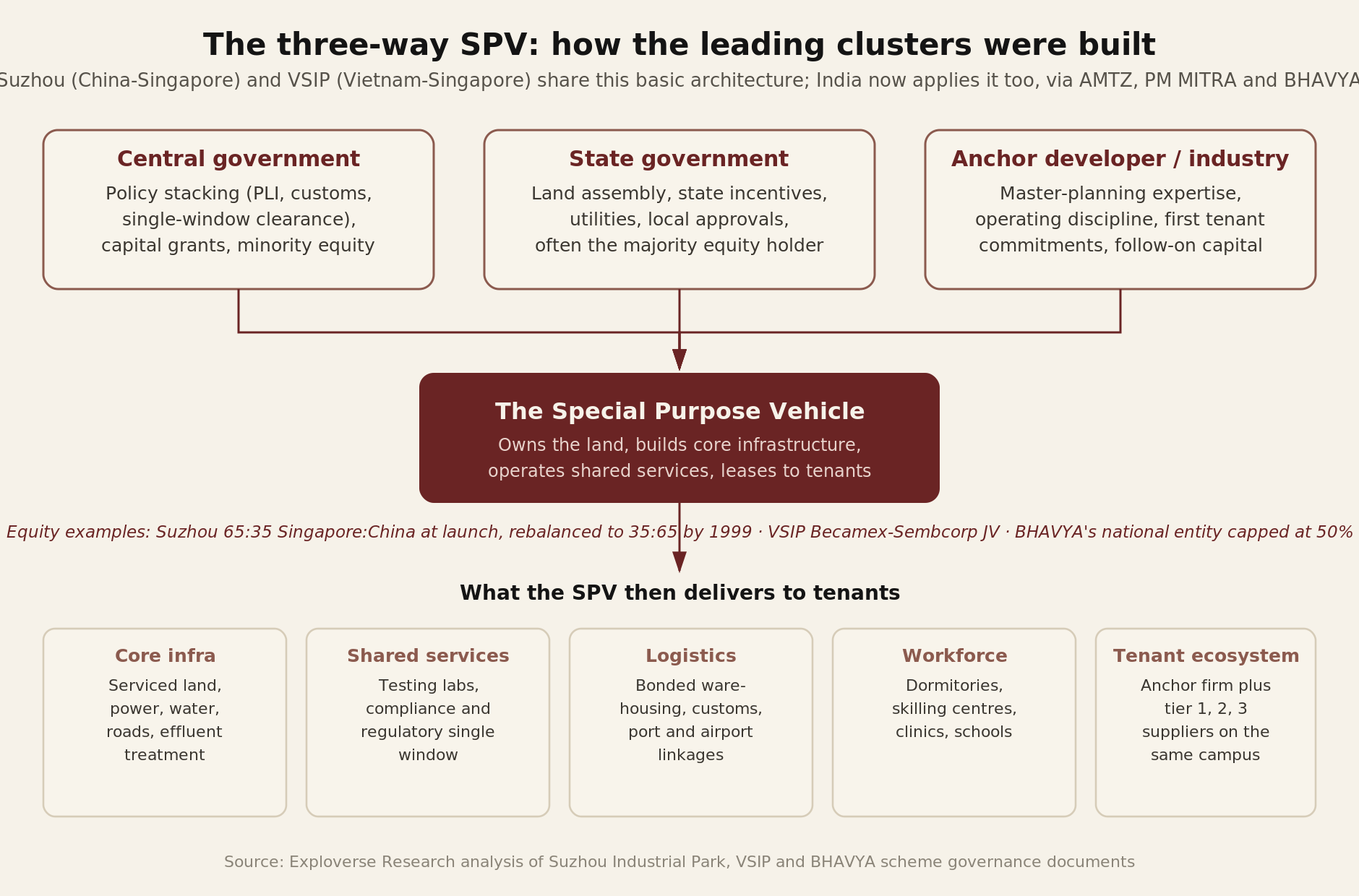
Suzhou Industrial Park is the clearest illustration of the model, because its ownership structure changed in public. When China and Singapore launched it in 1994, the joint-venture holding company was split 65:35 in Singapore's favour, reflecting how much of the master-planning and management expertise Singapore was expected to contribute. In 1999, with a rival zone under the same city government pulling tenants away, Singapore and China agreed to rebalance the stake to 35:65 in China's favour, a change that took effect in January 2001. The park did not fail because incentives were wrong. It struggled while ownership sat with the party least able to move local approvals, and it recovered once that changed.[13] By 2019, the park was generating roughly 274 billion RMB in GDP, hosting thousands of tenant companies across a mix of domestic and foreign-funded projects, and had crossed a cumulative $1 trillion in trade.[13]
Vietnam took the same architecture and simply repeated it. VSIP, a joint venture between Vietnam's Becamex IDC and Singapore's Sembcorp, has been replicated in more than 25 locations since its first park opened in Binh Duong in 1996, now covering roughly 14,500 hectares, hosting more than 1,000 investors, and drawing over $31 billion in registered capital across more than 350,000 jobs.[14] The lesson from VSIP is different from Suzhou's: not that governance can be corrected mid-flight, but that once a format is proven, discipline in repeating it beats redesigning each new park from scratch.
Set against these, Shenzhen looks like the exception, an organically grown cluster rather than a planned one. It is not, quite. Shenzhen's rise began with its 1980 designation as one of China's first Special Economic Zones, a deliberate national policy choice that seeded the tax and trade privileges around which private electronics manufacturing later agglomerated. Taiwan's Hsinchu Science Park makes the same point from a different government: established by the Taiwan state in December 1980, it seeded the foundry model directly, both of Taiwan's top two semiconductor manufacturers trace back to the government's Industrial Technology Research Institute, and the park now hosts more than 500 high-tech companies.[15] The lesson from both is not "clusters emerge naturally." It is that even the most successful "organic" cluster needed a state to remove the first set of obstacles before market forces could take over.
India has already run smaller versions of this experiment
The temptation in Indian policy debates is to treat the cluster model as untested here. It is not. India has run at least four variants, two that struggled, two that are working, and the difference between them is diagnostic.
Special Economic Zones are the cautionary case. Only about 37% of India's approved SEZ land is actually in use nationally, leaving around 20,000 hectares of land and 10 crore square feet of built-up area standing vacant as of February 2022, and only 267 of the 427 approved zones are operational at all.[4] Research on the programme has found that firm productivity rises inside privately run SEZs but declines in publicly run ones, consistent with political interference and rent-seeking crowding out commercial discipline in zones where no single accountable operator has skin in the game.[5] The National Investment and Manufacturing Zones announced under the 2011 National Manufacturing Policy, which targeted 25% of GDP from manufacturing and 100 million new jobs within a decade, mostly did not reach the scale envisaged.[6] Governance was not the only cause: the Centre's own later imposition of Minimum Alternate Tax and Dividend Distribution Tax on SEZ units removed much of what made the tax status attractive in the first place, a policy reversal rather than an execution failure.[6] But governance was still the larger cause. Neither policy failed only for lack of incentives. Both failed, above all, for lack of an entity structured, financed and staffed to make the incentives usable.
Set against that, two India-grown models are working at smaller scale. The Ministry of MSME's Cluster Development Programme has funded more than 1,018 interventions across 29 states and one union territory, building common facility centres for testing, training, effluent treatment and shared production processes, with government grants covering a majority of project cost, rising further for clusters that are majority micro, women-owned or SC/ST-owned.[7] It is, in effect, a proof of concept for shared services at MSME scale, just not yet built into a fully integrated, plug-and-play campus. AMTZ, the Andhra Pradesh MedTech Zone in Visakhapatnam, is closer to that fuller model: a 270-acre park with common manufacturing and scientific facilities, testing labs run in partnership with an international certification body covering biocompatibility and electrical-safety standards, and enough real capacity that press reports from the pandemic period put its tenants' peak daily output at more than 100 ventilators, 500 oxygen concentrators and roughly a million RT-PCR test kits.[8]
A third category is worth noting precisely because it did not wait for a government SPV at all: the privately developed, multi-product township. Sri City in Andhra Pradesh, built by a private promoter across more than 7,500 acres, bundles a multi-product SEZ, a domestic tariff zone, a free-trade and warehousing zone and an electronics manufacturing cluster on one site, and now hosts more than 220 operational companies, Kellogg's, Mondelez, Colgate-Palmolive and Isuzu among them.[9] Reliance's Model Economic Township in Jhajjar, Haryana, spans 8,250 acres, India's largest privately developed industrial township, and hosts a formally designated Japanese Industrial Township within it, anchoring Panasonic and Denso alongside other Japanese manufacturers, inside a wider township Reliance's own disclosures now put at more than 600 companies overall.[10] Neither needed a bilateral treaty or a national scheme to build the plug-and-play stack this piece describes; a private developer with patient capital and a credible masterplan did it instead. The SPV is one route to this model, evidently not the only one, though it is the route that scales fastest when the state wants to pick the location rather than wait for a developer to choose it.
The live experiment to watch is PM MITRA, the textile parks scheme. It explicitly offers three delivery models and is letting states self-select: a PPP master-developer model, a hybrid PPP/EPC model, and a government SPV-led model in which the state holds 51% and the Centre 49%, with some states running theirs through state implementing agencies instead.[11] The Centre is backing this with up to ₹500 crore per greenfield park (₹200 crore for brownfield) plus a ₹300 crore competitive incentive for early operationalisation, against a total outlay of ₹4,445 crore for seven parks through 2027-28.[11] Within two or three years, India will have real comparative data on which of the three governance models actually delivers, inside one country, one incentive structure, one time period. That is a more useful natural experiment than any cross-country comparison.
All of this sits inside the larger National Industrial Corridor Development Programme, which now spans 11 corridors and has had 12 new industrial cities approved across 10 states, anchored by the Delhi-Mumbai Industrial Corridor's roughly $100 billion, 1,500-kilometre footprint across six states.[12] The corridor programme provides the connective infrastructure; it is not, on its own, a cluster model, because it does not bundle shared technical services the way AMTZ or a well-run SPV does. The two need to be read together.
| Model | Governance | Scale reached | What made or broke it |
|---|---|---|---|
| Suzhou Industrial Park (China-Singapore) | Tri-partite SPV, rebalanced from 65:35 to 35:65 Singapore:China stake, agreed 1999, effective 2001 | 274bn RMB GDP (2019), thousands of tenant companies, $1tn+ cumulative trade | Struggled while competing with a rival zone under the same city government; recovered once local government held majority stake and accountability |
| VSIP (Vietnam-Singapore) | Becamex IDC and Sembcorp joint venture, replicated 25+ times | 14,500+ hectares, 1,000+ investors, $31bn+ registered capital, 350,000+ jobs | Discipline in repeating one proven format rather than redesigning each new park |
| AMTZ (India, medtech) | Andhra Pradesh state enterprise with private testing partners | 270 acres, national-scale pandemic output | Deep, sector-specific shared testing and compliance infrastructure from day one |
| PM MITRA (India, textiles) | Three parallel models: SPV-led (51:49 state:centre), PPP master-developer, state implementing agency | 7 parks approved, Rs 4,445cr outlay through FY27-28 | Live test of which governance model performs best under identical incentives |
BHAVYA: the national-scale answer, approved in March 2026
On 18 March 2026, the Union Cabinet approved Bharat Audyogik Vikas Yojna, BHAVYA, India's first attempt to build this model at national scale rather than case by case. Operating guidelines followed on 23 May 2026.[17]
| BHAVYA at a glance | |
|---|---|
| Outlay | Rs 33,660 crore, including a Rs 60 crore administrative fund, through FY2026-32 |
| Scale target | 100 industrial parks by FY32, minimum 100 acres each (25 acres for hilly and northeastern states), scalable to 1,000 acres |
| Vehicle | An SPV under the Companies Act 2013 for every park, greenfield or eligible brownfield |
| Equity structure | NICDIT, the National Industrial Corridor Development and Implementation Trust, holds the national stake, capped at 50% of paid-up equity and linked to land value contributed; states and private developers hold the rest via their own land or capital |
| Delivery agency | NICDC, the National Industrial Corridor Development Corporation, acts as project management agency, and holds no equity itself |
| Selection | Challenge mode: parks are scored competitively on connectivity, site suitability, infrastructure quality, ecosystem strength and sustainability, among other parameters |
BHAVYA is not a merger of India's existing park programmes. PM MITRA and the National Industrial Corridor Development Programme continue in parallel, and the guidelines require pending issues in either to be resolved before a fresh BHAVYA application on the same site.16 Nor is it restricted to a single sector: the scoring rewards a sectoral focus without mandating one. That flexibility is also where the design questions start.
- Does the equity cap protect state accountability, or just cap national skin in the game? BHAVYA fixes the national entity's stake at up to 50%, the same ceiling Suzhou crossed only after its 1999 correction shifted control the other way. Specific fix: track, park by park, whether the operating decisions, not just the paid-up equity, sit with whichever partner is actually approving land and utilities locally.
- Will a sectoral preference become a sectoral commitment, or stay diffuse? The guidelines score sectoral parks favourably but do not require a single-sector focus. Specific fix: an electronics-focused SPV should say so in its founding documents and staff its shared-services stack accordingly, testing labs, customs desks, skilling, rather than build generic infrastructure and hope the right tenants self-select.
- Does land-value-linked equity solve the acquisition problem, or just relocate it? States and private developers post land as their equity stake, which only works if that land is actually assembled and clear of dispute. Specific fix: publish a park's land-acquisition status, assembled, contested or pending, before it is scored in challenge mode, not after.
What strategy India should adopt inside the BHAVYA framework
Start product-specific
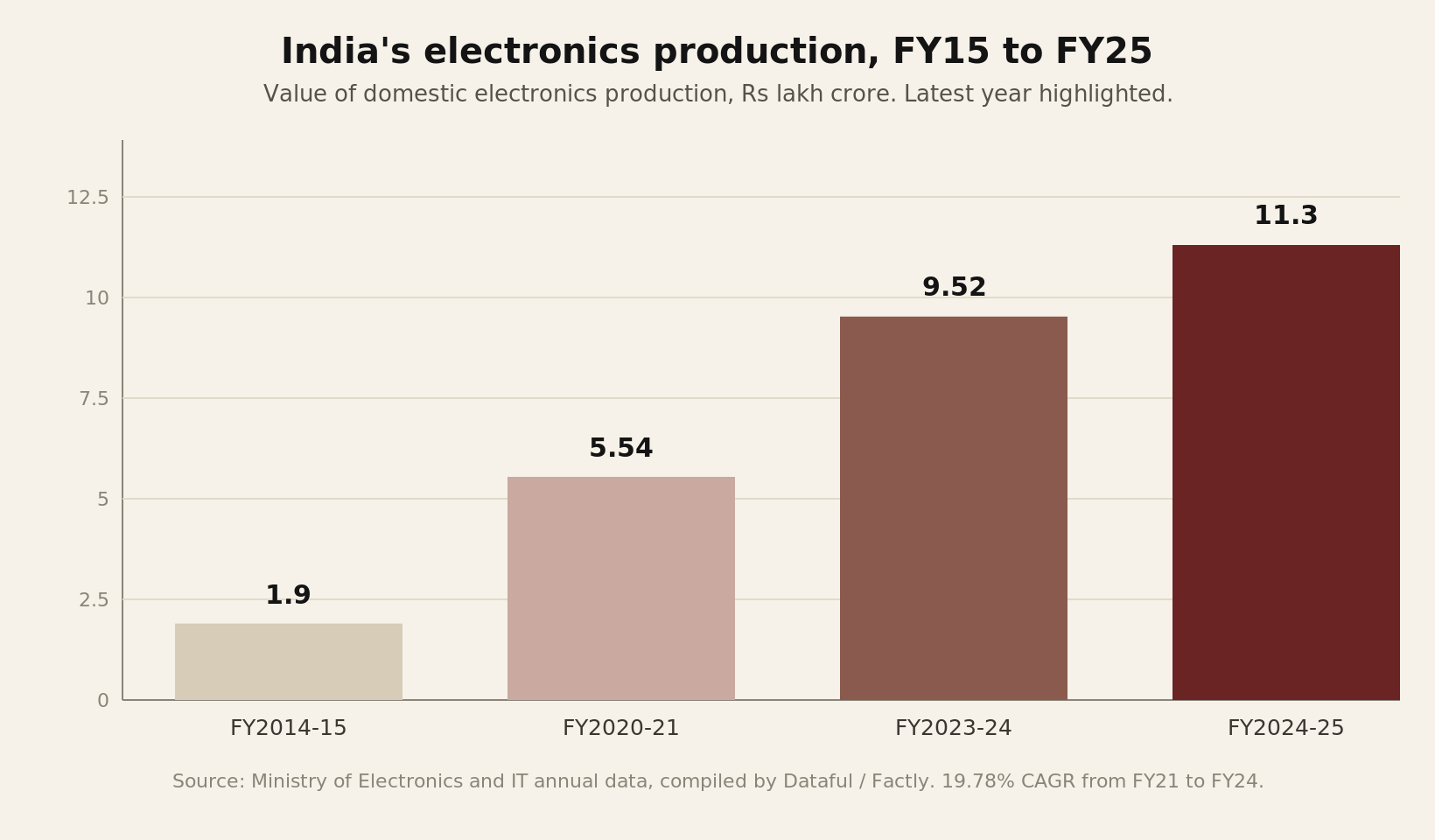
The case for making BHAVYA's first electronics park product-specific rather than multi-product starts with where India's growth has actually concentrated. Domestic electronics production rose from roughly Rs 1.9 lakh crore in FY15 to Rs 11.3 lakh crore in FY25, a nearly sixfold increase, growing at close to 19.78% a year between FY21 and FY24 alone.17 But almost all of that growth sits in one category. Mobile phones went from about 10% of production value in FY15 to 44% in FY24, while consumer electronics fell from 29% to 11% and industrial electronics from 21% to 11% over the same period.17
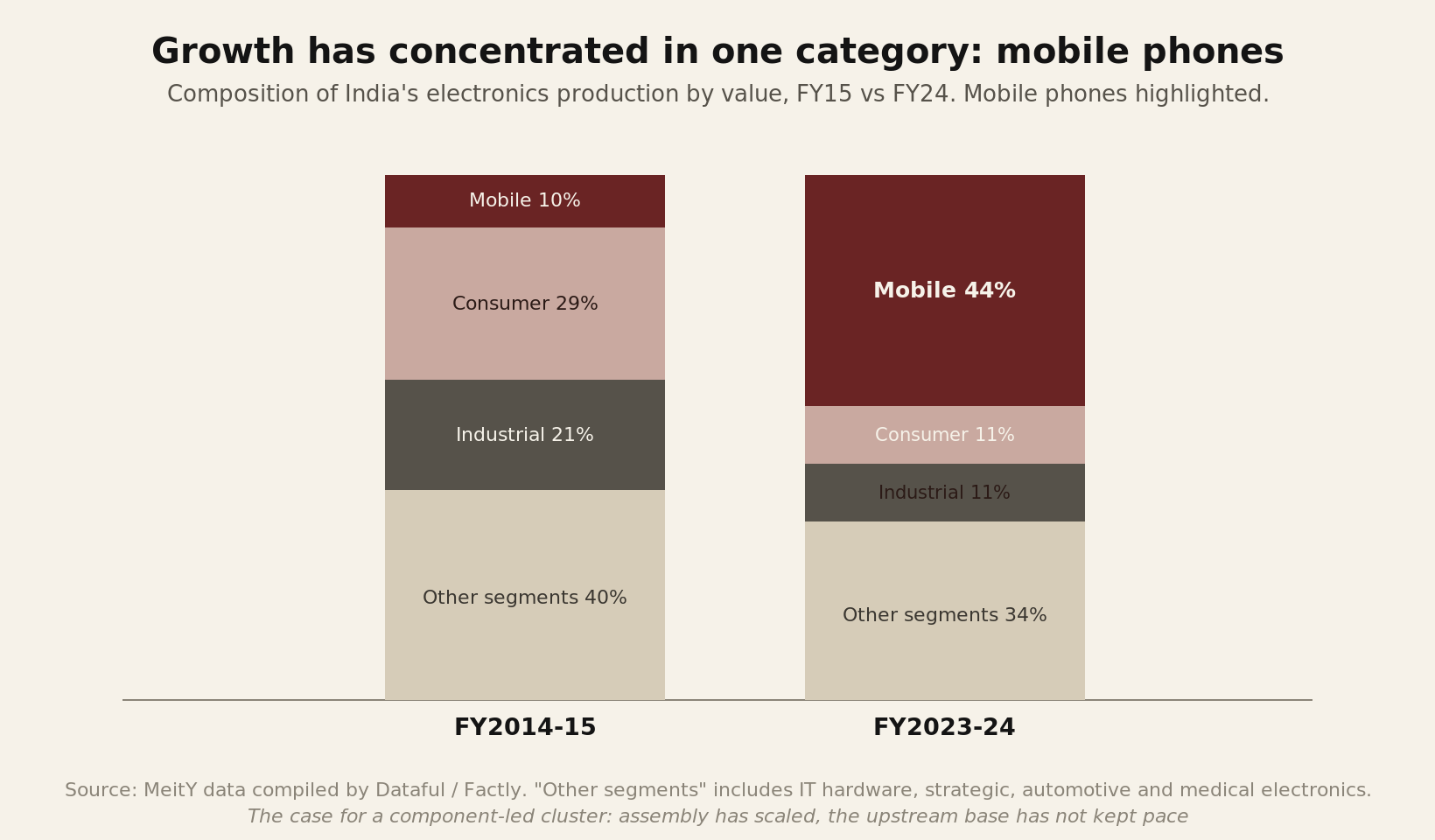
Assembly scaled. The layer beneath it, components, has not kept pace, a gap this publication has covered in more depth in its earlier essentials on the PCB and components layer, on smartphone-assembly-led growth, and on the EMS sector's trajectory. A cluster built around one product family, rather than a generic multi-sector industrial park, is what let Suzhou concentrate testing and compliance infrastructure specific to electronics rather than infrastructure generic enough to serve any tenant equally badly.
Make it genuinely plug and play
Plug and play is a marketing phrase until it is tested against what a mid-sized supplier actually has to build today: its own compliance filings, its own effluent treatment, its own logistics contracts, sometimes its own worker housing. A cluster earns the phrase only when a new tenant can skip building all of these and simply lease into a campus where they already exist.
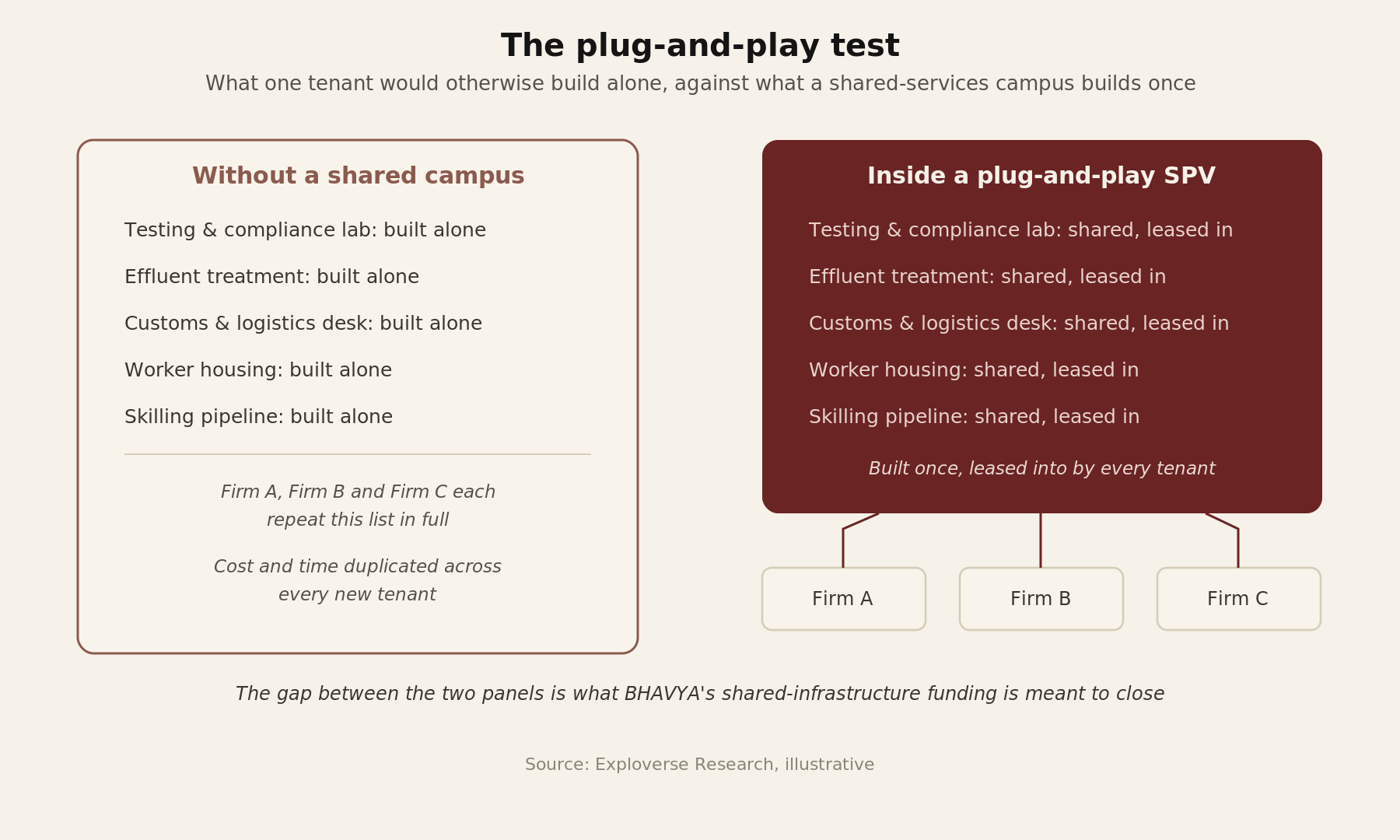
BHAVYA's guidelines fund exactly this layer, core infrastructure, value-added infrastructure and social infrastructure, at up to Rs 1 crore an acre, which is the right unit of funding only if the SPV actually builds shared testing labs and a compliance single window rather than treating the money as a subsidy for basic roads and drainage a state would have built anyway.
Who should build it
BHAVYA answers "who should build it" with the same tri-partite logic as Suzhou and VSIP (Chart 1), formalised through NICDIT, the National Industrial Corridor Development and Implementation Trust, as the capped national equity holder, and NICDC, the National Industrial Corridor Development Corporation, as a separate project management agency that does not hold equity at all.16 Splitting funding from delivery this way is closer to VSIP's model, where Sembcorp's operating discipline stayed distinct from Becamex's land and political relationships, than to a single fused entity trying to do both jobs at once.
The probable locations for an integrated electronics cluster
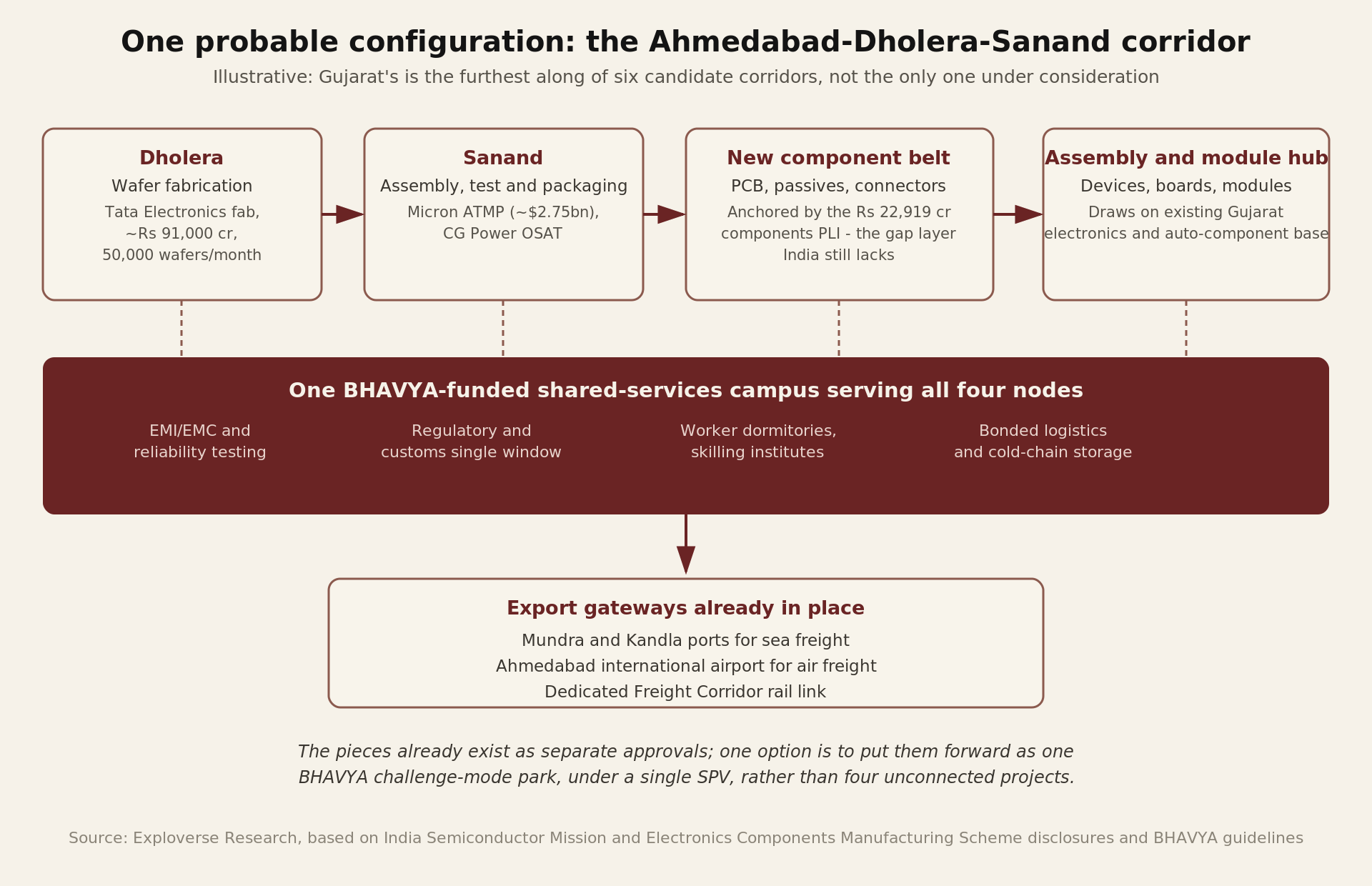
Six state corridors are now positioned to compete for BHAVYA's first electronics-specific park, though "compete" understates how differently placed they actually are. Of the six compared here, only Gujarat and Uttar Pradesh currently hold a central India Semiconductor Mission approval of scale; Andhra Pradesh holds one for a smaller assembly-and-test project; Maharashtra, Tamil Nadu and Telangana hold none, despite each having a dedicated state policy and, in two cases, a headline anchor announcement that has since moved to a rival state or paused entirely.18 The investment figures below are drawn from company and government announcements rather than audited disclosure, and should be read with that caveat throughout.
| State / corridor | Anchor investment | Central approval status | Value-chain layer | Strength / gap |
|---|---|---|---|---|
| Gujarat (Dholera-Sanand-Ahmedabad) | Tata Electronics wafer fab (~Rs 91,000cr, 50,000 wafers/month), Micron ATMP (~$2.75bn), CG Semi OSAT (~Rs 7,600cr)19 | Multiple ISM approvals, including India's only wafer fab | Fab, ATMP and OSAT: the most complete stack of the six | Furthest along, but concentrated in one corridor and exposed to land-cost inflation as it scales |
| Uttar Pradesh (YEIDA / Jewar) | HCL-Foxconn OSAT (Rs 3,706cr, approved May 2025); Tarq Semiconductors/Hiranandani proposed fab (Rs 28,440cr, state-approved)20 | ISM-approved for OSAT; the larger fab still awaits central clearance | OSAT plus India's largest existing mobile-assembly base | Most generous state subsidy in the country, but its marquee fab proposal has sat pending for over a year |
| Maharashtra (Talegaon / Taloja) | Vedanta-Foxconn JV moved to Gujarat (2022); Adani-Tower Semiconductor $10bn talks paused (2025); RRP Electronics' OSAT facility is tied to RRP Semiconductor Limited, now under SEBI fraud investigation21 | Zero ISM approvals | Aspirational fab and OSAT; verified capability is in EMS only | Strong auto-component base and aggressive deal-courting, undercut by two consecutive marquee deals that failed to convert |
| Tamil Nadu (Sriperumbudur-Oragadam-Hosur) | Tata Electronics Hosur iPhone plant (~Rs 6,000cr); Foxconn Sriperumbudur/Oragadam, additional $1.5bn committed22 | Zero ISM semiconductor approvals | Assembly and EMS, extending into enclosures, not yet fab or OSAT | Unmatched EMS scale and supplier depth, offset by zero fab approval despite a dedicated policy since 2024 |
| Andhra Pradesh (Sri City / Visakhapatnam) | ASIP-APACT OSAT joint venture (Cabinet-approved Aug 2025); LG smart-appliance plant (~Rs 5,001cr)23 | One ISM approval, for a small OSAT project | Consumer-electronics assembly plus one packaging toehold | Fast-moving deal pipeline under the current government, but its "semiconductor and display fab" policy has not yet landed a fab |
| Telangana (Kongara Kalan) | Foxconn AirPods assembly (~Rs 4,800cr, operating and scaling); Kaynes OSAT MoU (Rs 2,800cr) relocated to Gujarat24 | Zero ISM approvals | Final assembly only | One of the few genuinely operating, expanding anchor facilities in this group, but lost its one semiconductor-specific commitment to a rival state |
None of this happens in a vacuum. The same pool of anchor capital that Gujarat, Uttar Pradesh and Andhra Pradesh are courting is also being courted by Vietnam, Mexico and Malaysia, and by some measures India is not winning that wider contest yet. Vietnam drew $27.6 billion in disbursed FDI in 2025, with Samsung and Hana Micron both expanding packaging capacity there; Malaysia already runs an estimated 13% of global outsourced semiconductor assembly and test capacity through Intel, Infineon and Micron, well ahead of where India's own OSAT lines will reach comparable volume; Mexico's duty-free access to the US market under USMCA is an advantage no Indian state can offer.25 The six-way contest among Indian states is real, but it sits inside a larger contest India itself has not yet clearly won.
What could still go wrong
The clearest illustration of what can go wrong is not hypothetical, it has already happened twice. Maharashtra courted the Vedanta-Foxconn joint venture for a 1,100-acre site at Talegaon, reportedly worth close to $20 billion, only for the venture to sign with Gujarat instead in September 2022, a decision that became a political controversy in its own right; Foxconn exited the joint venture entirely the following year. Telangana separately signed a memorandum with Kaynes Technology in 2023 for a Rs 2,800 crore OSAT facility at Kongara Kalan, which instead materialised as Kaynes Semicon in Sanand, Gujarat, inaugurated in March 2026.21 Both cases share a pattern: an early, well-publicised memorandum of understanding is not the same as a bankable project with land assembled, and the gap between the two is where a state's chances quietly move to a competitor.24
Land acquisition and SPV bankability are the mechanical version of the same risk. A BHAVYA SPV's equity is meant to be backed partly by the land value a state or developer contributes, which only works if that land is actually assembled and free of dispute before the SPV is capitalised; a challenge-mode process that scores parks on paper before land status is verified risks repeating the SEZ experience of large approved footprints that never convert into built, tenanted space. Financing discipline matters just as much: Maharashtra's Adani-Tower Semiconductor talks, a proposed $10 billion facility, were paused in 2025 over disagreement on financial commitment and demand uncertainty, not over incentives, and a Maharashtra OSAT facility that did open, run by RRP Electronics, is tied to a separately listed entity, RRP Semiconductor Limited, now the subject of a SEBI investigation into stock-price manipulation so severe that regulators barred dozens of entities including its promoters.21 Neither failure was a policy design problem. Both were failures to underwrite a specific deal before celebrating the announcement of it.
The last risk is external and outside any single state's control: the same capital being courted by six Indian corridors is also being courted by Vietnam, Mexico and Malaysia, and a cluster that wins its domestic contest can still lose the larger one.
Sources
- Clusters and the New Economics of Competition, Michael E. Porter, Harvard Business Review, November-December 1998. https://hbr.org/1998/11/clusters-and-the-new-economics-of-competition.
- China's electronics manufacturing geography, Shenzhen, Guangzhou and Dongguan as the core export-assembly belt and Shenzhen as Guangdong's integrated-circuit anchor, compiled from Mordor Intelligence and EqualOcean industry reporting and Shenzhen municipal government economic profiles.
- Assessment of Logistics Cost in India, NCAER, commissioned by the Department for Promotion of Industry and Internal Trade (2025). https://www.dpiit.gov.in/static/uploads/2025/07/b6c9db15ce083fd10caa9787bf8a281f.pdf. Launch release, Press Information Bureau (20 September 2025, PRID 2168995). https://www.pib.gov.in/PressReleasePage.aspx?PRID=2168995.
- Suzhou Industrial Park case study, World Bank Open Knowledge Repository. https://openknowledge.worldbank.org/server/api/core/bitstreams/d9ffe6bc-ce31-5f9d-88bd-ef5d1001a942/content. Twenty-fifth anniversary reporting, China Daily (12 April 2019). https://www.chinadaily.com.cn/cndy/2019-04/12/content_37457505.htm.
- VSIP corporate disclosures, Vietnam Singapore Industrial Park. https://www.vsip.com.vn. Sembcorp Industries newsroom releases on the Becamex IDC joint venture.
- Hsinchu Science Park Bureau company registry and park profile, National Science and Technology Council, Taiwan. https://data.gov.tw. Shenzhen Special Economic Zone designation approved by the Standing Committee of the 5th National People's Congress, 26 August 1980, per CGTN retrospective. https://news.cgtn.com/news/2020-08-26/.
- Special Economic Zones backgrounder, Press Information Bureau, Government of India (20 January 2022). https://static.pib.gov.in/WriteReadData/specificdocs/documents/2022/jan/doc2022153001.pdf.
- Place-based policies and firm performance: evidence from special economic zones in India, Holger Görg and Aida Mulyukova, European Economic Review 165:104752 (2024). https://www.sciencedirect.com/science/article/pii/S0014292124000813. Plain-language summary, VoxDev (22 July 2025). https://voxdev.org/topic/firms/special-economic-zones-india-engines-economic-growth-or-inefficiency.
- National Manufacturing Policy 2011, Press Information Bureau, Government of India. https://www.pib.gov.in/newsite/PrintRelease.aspx?relid=76843. Minimum Alternate Tax applied to SEZ units and developers from 1 April 2012 and Dividend Distribution Tax exemption withdrawn from 1 June 2011, Press Information Bureau. https://www.pib.gov.in/newsite/PrintRelease.aspx?relid=108615.
- Micro and Small Enterprises Cluster Development Programme (MSE-CDP), Ministry of Micro, Small and Medium Enterprises, Government of India. https://msme.gov.in/micro-small-enterprises-cluster-development-mse-cdp.
- Andhra Pradesh MedTech Zone (AMTZ), Visakhapatnam, official profile. https://amtz.in. Pandemic-period peak daily output figures per contemporaneous press coverage.
- Sri City FAQ Booklet and company profile, Sri City, Andhra Pradesh (2024). https://sricity.in/wp-content/uploads/2024/06/FAQ_Booklet_-_27.06.2024.pdf.
- MET City (Model Economic Township), Jhajjar, Haryana, project disclosures, Reliance Industries. https://metcity.in/met-city.
- PM MITRA scheme update, Press Information Bureau, Government of India (1 August 2025, PRID 2151231). https://www.pib.gov.in/PressReleasePage.aspx?PRID=2151231. First Revised Guidelines for PM MITRA Parks, Ministry of Textiles (28 August 2025). https://texmin.nic.in/sites/default/files/1st revised Guidelines PM MITRA park (1).pdf.
- National Industrial Corridor Development Programme overview, National Industrial Corridor Development Corporation. https://nicdc.in. Twelve new industrial cities approved, Press Information Bureau (August 2024, PRID 2050136). https://www.pib.gov.in/PressReleasePage.aspx?PRID=2050136.
- Cabinet approves a new era of plug-and-play industrial development through Bharat Audyogik Vikas Yojna (BHAVYA), Prime Minister's Office (18 March 2026). https://www.pmindia.gov.in/en/news_updates/cabinet-approves-a-new-era-of-plug-and-play-industrial-development-through-bharat-audyogik-vikas-yojna-bhavya/. DPIIT releases guidelines for implementation of the BHAVYA scheme, Press Information Bureau (23 May 2026, PRID 2264533). https://www.pib.gov.in/PressReleasePage.aspx?PRID=2264533. BHAVYA scheme guidelines, Department for Promotion of Industry and Internal Trade (May 2026). https://www.dpiit.gov.in/static/uploads/2026/05/56bdc6d167272593fbeae8b4c44d6cc4.pdf.
- India's Electronics Production: Rapid Growth, Mobile-Led Concentration, Sai Krishna Muthyanolla, Dataful / Factly (27 December 2025), using Ministry of Electronics and Information Technology annual report data. https://insights.dataful.in/articles/indias-electronics-production-rapid-growth-mobile-led-concentration.
- India's Semiconductor Mission: The Story So Far, Konark Bhandari, Carnegie India (25 August 2025). https://carnegieendowment.org/india/research/2025/10/indias-semiconductor-mission-the-story-so-far. Cabinet approves semiconductor manufacturing units in Odisha, Punjab and Andhra Pradesh, Press Information Bureau (12 August 2025, PRID 2155456). https://www.pib.gov.in/PressReleasePage.aspx?PRID=2155456.
- Tata Electronics and PSMC sign pact for Rs 91,000 crore chip manufacturing unit, Business Standard (26 September 2024). https://www.business-standard.com/companies/news/tata-electronics-psmc-sign-pact-for-rs-91-000-cr-chip-manufacturing-unit-124092600806_1.html. PM inaugurates the CG Semi OSAT facility in Sanand, Gujarat, Prime Minister's Office. https://www.pmindia.gov.in/en/news_updates/pm-inaugurates-the-cg-semi-outsourced-semiconductor-assembly-and-test-osat-facility-in-sanand-gujarat/. Micron opens India's first semiconductor assembly and test facility in Gujarat, CRN Asia (2026). https://www.crnasia.com/india/news/2026/micron-opens-india-s-first-semiconductor-assembly-and-test-facility-in-gujarat.
- Cabinet clears HCL-Foxconn chip assembly unit under India Semiconductor Mission, Business Standard (14 May 2025). https://www.business-standard.com/industry/news/cabinet-clears-hcl-foxconn-chip-assembly-unit-under-india-semiconductor-125051401135_1.html. Uttar Pradesh Semiconductor Policy 2024, Invest UP. https://invest.up.gov.in/semiconductor-sector/.
- Explained: why did Maharashtra lose out on Vedanta's semiconductor chip project to Gujarat?, The Quint (2022). https://www.thequint.com/news/india/explained-why-did-maharashtra-government-lose-vedanta-foxconn-semiconductor-project-to-gujarat-eknath-shinde-devendra-fadnavis-bhupendra-patel-narendra-modi. Adani Group puts on hold $10 bn chip deal with Israel's Tower Semiconductor, Business Standard (1 May 2025). https://www.business-standard.com/companies/news/adani-group-pauses-chip-deal-israel-tower-semiconductor-125043001140_1.html. Interim order in the matter of RRP Semiconductor Limited, Securities and Exchange Board of India (10 April 2026). https://www.sebi.gov.in/enforcement/orders/apr-2026/interim-order-in-the-matter-of-rrp-semiconductor-limited_100894.html.
- Tata's Rs 6,000 crore plant for iPhones likely to start operations in November, Business Standard (18 August 2024). https://www.business-standard.com/companies/news/tata-s-s-6-000-crore-plant-for-iphones-likely-to-start-ops-in-november-124081800631_1.html. Foxconn eyes iPhone enclosure manufacturing in Tamil Nadu, Business Standard (20 June 2025). https://www.business-standard.com/industry/news/foxconn-iphone-enclosure-manufacturing-oragadam-tamil-nadu-125062000343_1.html. Tamil Nadu Semiconductor and Advanced Electronics Policy 2024. https://tnswp.com/DIGIGOV/StaticAttachment?AttachmentFileName=/pdf/poli_noti/SCP_2024.pdf.
- Cabinet approves semiconductor manufacturing units in Odisha, Punjab and Andhra Pradesh, Press Information Bureau (12 August 2025, PRID 2155456). https://www.pib.gov.in/PressReleasePage.aspx?PRID=2155456. LG to invest Rs 5,000 crore in Andhra Pradesh for smart appliance facility, Business Standard (8 May 2025). https://www.business-standard.com/companies/news/lg-to-invest-rs-5000-crore-in-ap-for-smart-appliance-factory-125050800746_1.html. Andhra Pradesh Semiconductor and Display Fab Policy 4.0 (2024-29), Government Order Ms. No. 7 (14 November 2024). https://apdti.in/wp-content/uploads/2024/12/GOMS-No-7-dt-14-11-2024-_AP-Semiconductor-and-Display-Fab-Policy-4-0-2024_-29.pdf.
- Foxconn Hyderabad ramps up AirPods production, eyes 200,000 units monthly, Business Standard (25 October 2025). https://www.business-standard.com/companies/news/foxconn-hyderabad-airpods-production-expansion-india-jobs-apple-125102500392_1.html. PM inaugurates the Kaynes Semicon plant at Sanand, Gujarat, Prime Minister's Office (31 March 2026). https://www.pmindia.gov.in/en/news_updates/pm-inaugurates-the-kaynes-semicon-plant-at-sanand-gujarat/.
- Vietnam is winning the chip race India wanted to lead, Business Today (30 April 2026). https://www.businesstoday.in/technology/story/vietnam-is-winning-the-chip-race-india-wanted-to-lead-528181-2026-04-30. India, Mexico and Malaysia are chasing the same semiconductor dream, Rest of World (11 August 2025). https://restofworld.org/2025/india-mexico-malaysia-semiconductor-chip-hubs/. Adani pauses talks with Israel's Tower for $10 billion India chip foray, Reuters (30 April 2025). https://www.reuters.com/world/india/adani-pauses-talks-with-israels-tower-10-billion-india-chip-foray-sources-say-2025-04-30/.