Key takeaways
- India has flipped its camera market to home-grown brands. By one widely cited estimate, domestic names now hold more than 80% of it, up from roughly a third in 2024. That is an industrial-policy win, and it is mostly a win over the badge and the box, not the parts inside.
- The market is not saturated, it is under-built. On the best available comparison India has roughly one surveillance camera for every hundred people, against about fifteen in the United States and China, so there is room to grow for years yet, whoever supplies the hardware.
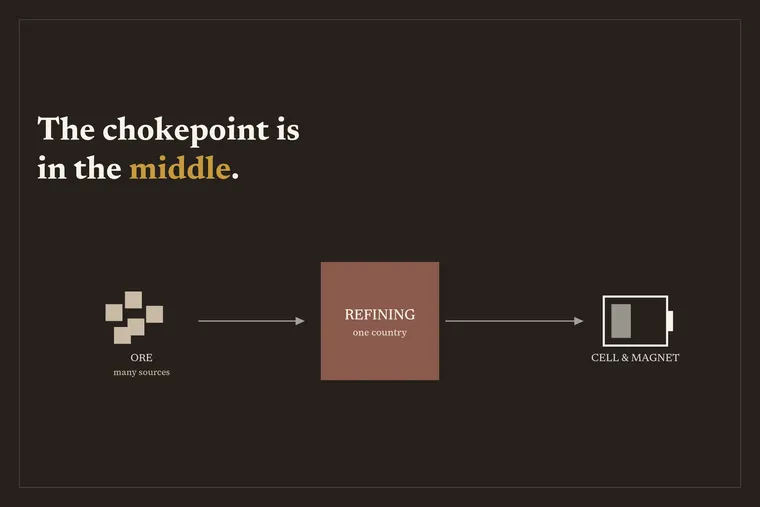
- The two components that set a camera's cost, quality and control, the image sensor (the eye) and the system-on-chip (the brain), are still imported. India designs and fabricates neither at commercial scale.
- The government's own local-content rule for CCTV, notified in March 2024, footnotes the semiconductor value in every bill-of-materials table with a single line: it will be reviewed "when the Semiconductor FAB in India is operational." The state wrote the exception into its own self-reliance rule.
- India's route differs from the West's. Where the United States names specific Chinese firms in statute and the United Kingdom acts by category, India restricts by origin and certifies by standard. Its certification regime can even see the silicon, through mandatory disclosure, but it cannot yet make it.
- The next layer of value is design and software, not assembly. A handful of Indian chip-design firms and one large engineering group are at test-chip stage, and the analytics that increasingly define a camera are where India could plausibly win without a fab.
Until the fab is operational
On 6 March 2024, the Ministry of Electronics and Information Technology notified a rule with a long name and a narrow purpose: a local-content order for CCTV and video-surveillance systems under the Make in India procurement framework. It reads like a schedule. For each kind of camera it lists the parts, the main circuit board, the bare board, the optics, the housing, the cables, the assembly and testing, and it sets how much of each must be made in India for the device to count as domestic. The threshold rises over time, from 25% of the essential value in 2023-24 and 2024-25 to 35% in 2025-26 and 45% from 2026-27 onwards.1
Read down any of those tables and you reach a footnote attached to the semiconductor value on the main board. It confirms that the imported chip can still be counted toward domestic value, and then adds one sentence: "This shall be reviewed when the Semiconductor FAB in India is operational."1 The government wrote the exception into its own self-reliance rule. Until India has a working chip fab, the most valuable part of the camera is allowed to be foreign and still pass as local.
That footnote is the whole story in miniature, and the story is not a failure. India has turned its camera market domestic. Counterpoint Research data, reported by the Economic Times in March 2026, put home-grown brands above 80% of the market, up from roughly a third in 2024, when Chinese and Indian brands each held about a third, multinationals around a tenth, and smaller unorganised traders the rest.2 By early 2026, 507 camera models had cleared the new certification, and from 1 April 2026 non-compliant cameras cannot be sold at all.2 The deployment is large: as of March 2025 the Smart Cities Mission alone had installed more than 84,000 CCTV cameras across 100 cities.3
Open one of those cameras, though, and the achievement thins. The badge is Indian and the box may well be assembled in India, but the eye that sees and the brain that processes what it sees are almost certainly imported, and the government, as its own footnote shows, knows it.
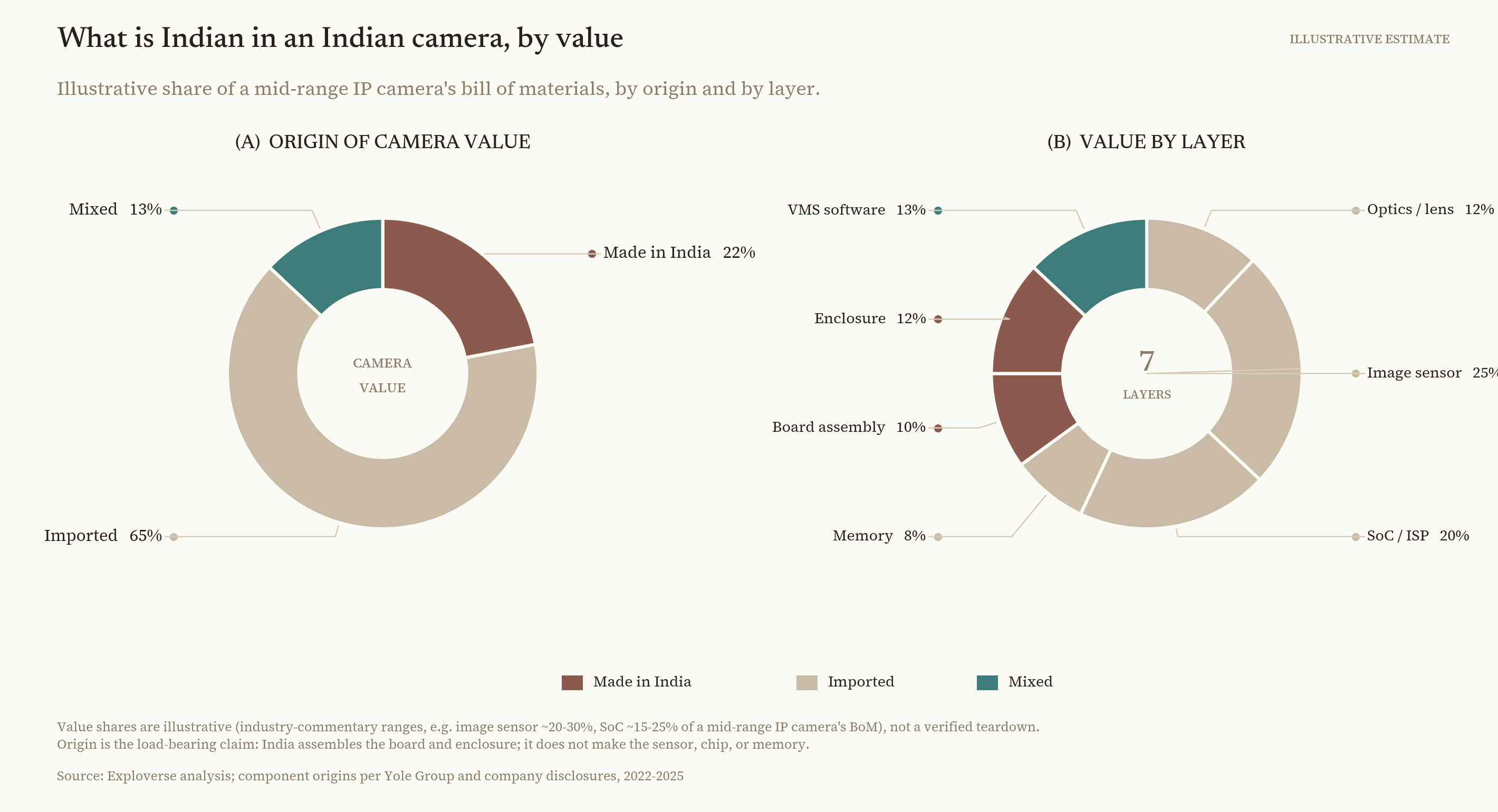
The bill-of-materials value of a mid-range IP camera, split by origin (left) and by component layer (right). India assembles the board and the enclosure; the image sensor, the chip and the memory are imported. Shares are an illustrative estimate, not a verified teardown. Source: Exploverse analysis; component origins per Yole Group and company disclosures, 2022-2025
How the market got here
India did not choose an import-shaped camera market. It inherited one. The industry grew up in the analog era and then shifted, over the 2010s, to internet-connected IP cameras, exactly as a Chinese supply chain drove the cost of sensors, chips and finished cameras down far enough to put a camera on every shopfront and staircase. Cheap hardware built the market, and the cheap hardware was Chinese. By 2022-23, Chinese brands led comfortably: Hikvision alone held around a third of the Indian market and Dahua another sixth, with CP Plus the largest domestic name.4
That demand now runs across three broad segments. Government and institutional buyers are the single largest, somewhere around a third of the market by most commissioned estimates, followed by enterprise, with home and consumer cameras the fastest-growing slice.5 The consumer boom is not a projection. In the Common Cause and Lokniti-CSDS "Status of Policing in India" survey of 2023, 51% of respondents said their household or residential colony had CCTV coverage, a level that would have been unthinkable a decade earlier.6
The size of all this is uncertain, and worth treating with suspicion. Commissioned market-research estimates for the Indian market scatter from under $2 billion to more than $7 billion for the mid-2020s, and two reports from the same firm do not always agree with each other.5 The shape matters more than the size, and the shape is consistent: a large, fast-growing market, built on imported components, that the state both dominates as a buyer and now governs as a regulator.
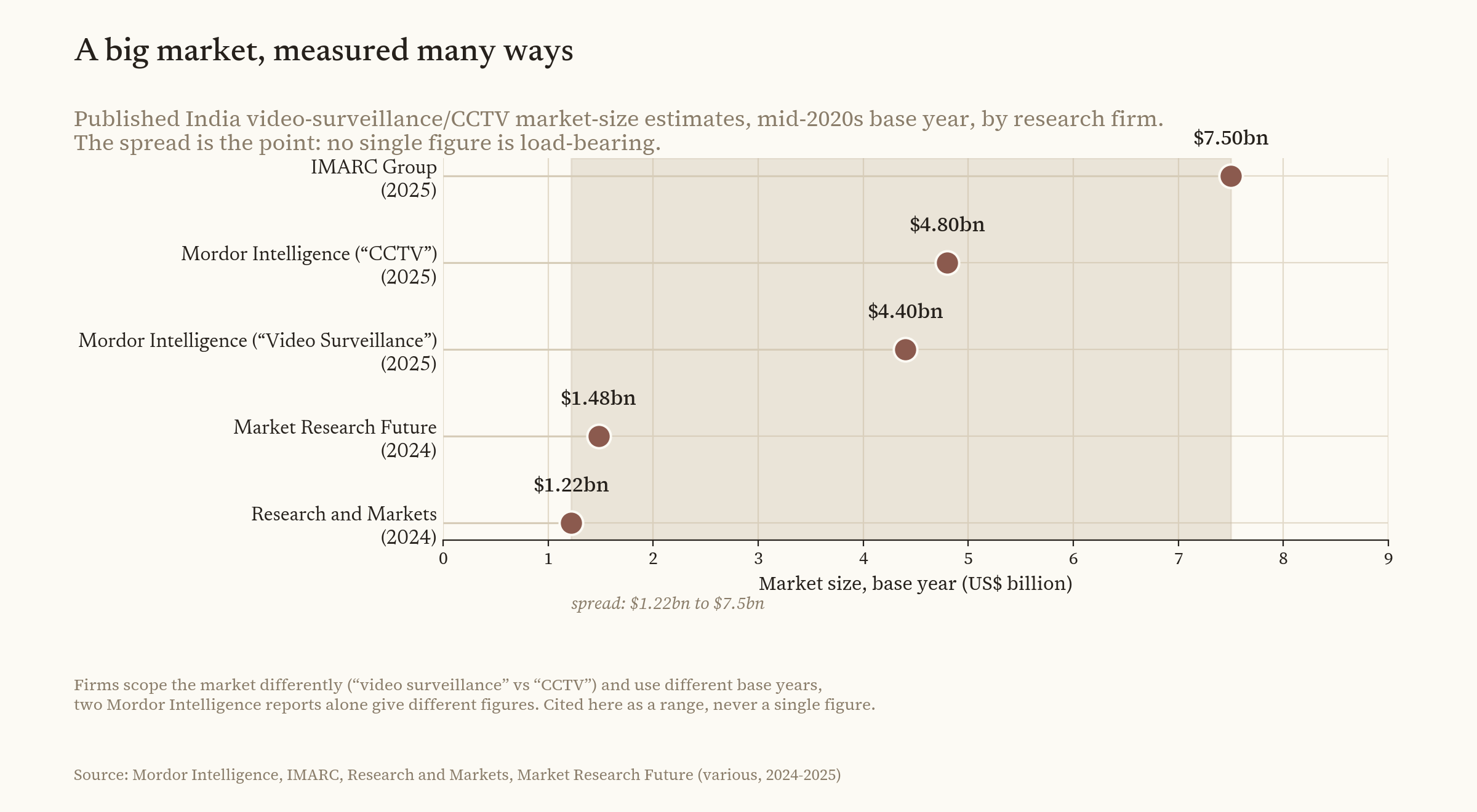
Published estimates of the Indian video-surveillance market for the mid-2020s, by research firm, shown as a range rather than a point. The spread is the point: no single figure is load-bearing. Source: Mordor Intelligence, IMARC, Research and Markets, Market Research Future (various, 2024-2025)
The more revealing number is not how big the market is but how far it still has to run. India is under-cameraed, not over-cameraed. On the best available cross-country comparison, a 2019 dataset from Comparitech relayed in a December 2025 brokerage note, the United States had about 153 surveillance cameras for every 1,000 people and China about 144, against roughly 11 in India. That Indian figure is a serious undercount, built from just nine cities rather than a national census, so the true figure is higher, but the direction is not in doubt. The same note, sell-side research with an interest in a growth story, frames it as about 15 cameras per 100 people in the United States and China against one in India, and reads the low base as the industry's structural runway.7 A market this thinly covered has years of growth ahead of it, whoever ends up supplying the hardware.
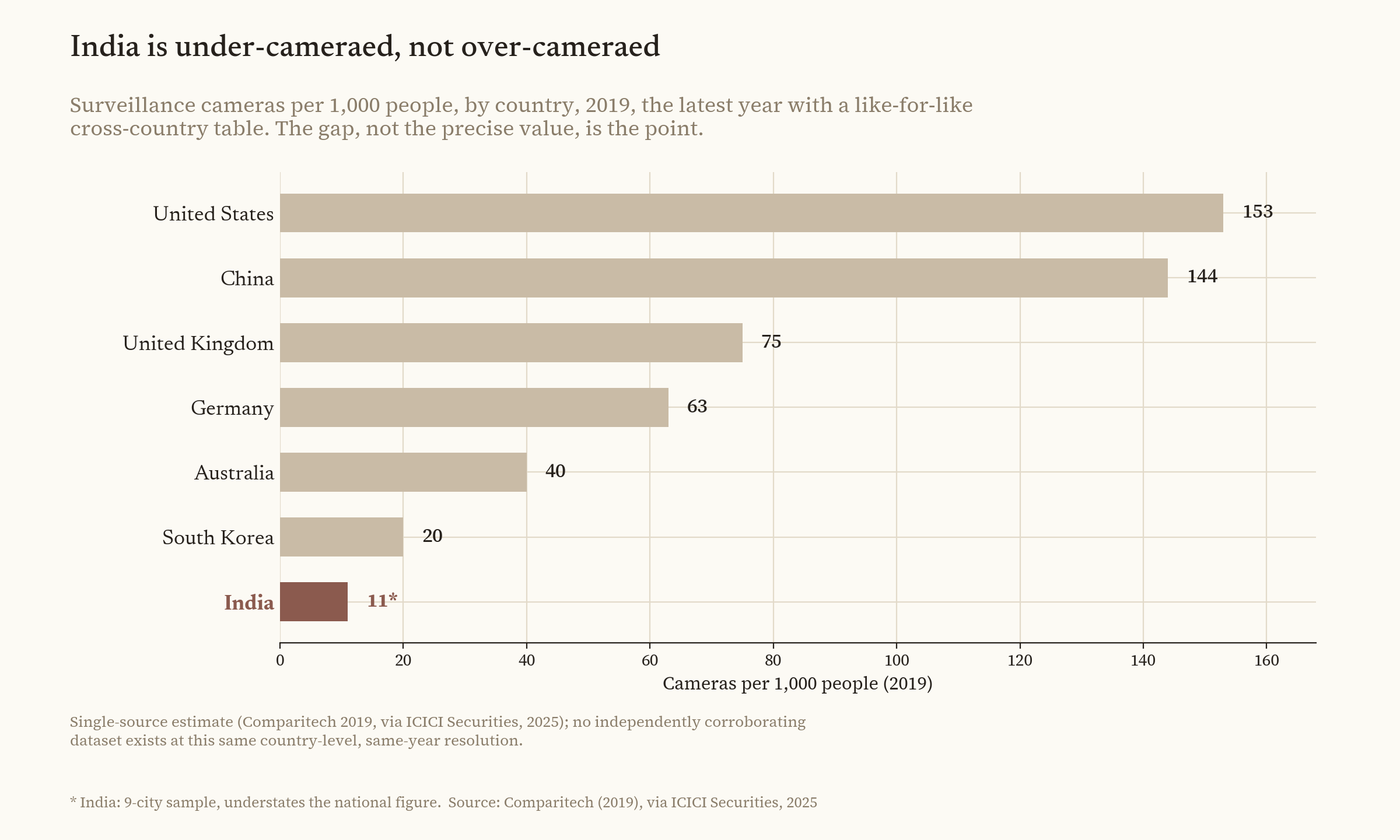
Surveillance cameras per 1,000 people, by country, 2019, the latest year with a like-for-like cross-country table. India's figure is drawn from only nine cities and understates the national picture; a single-source estimate (Comparitech, relayed via ICICI Securities). The gap, not the precise value, is the point. Source: Comparitech (2019), via ICICI Securities, 2025
Who owns the market now
The flip is worth stating precisely, because it is easy to oversell. The best single number, Counterpoint's 80%-plus, rests on one research house relayed through one news report, with the metric unstated.2 Set against it is a harder figure from ten months earlier: CARE Ratings, assessing the market in June 2025, still had the top three brands, CP Plus, Dahua and Hikvision, together holding an estimated 70% to 75%, with the two Chinese names still among them.8 Both can be true. What they describe is a fast, late, deadline-driven transition, not a settled long-run share.
The concrete weight sits on one company. Aditya Infotech, which owns the CP Plus brand, is the clearest case study in what "domestic champion" means here. It listed on the market in 2025 in an issue of about Rs 1,300 crore. Its revenue grew from Rs 2,782.42 crore in FY24 to Rs 3,111.87 crore in FY25, up 11.84%, and its profit after tax more than tripled, from Rs 115.17 crore to Rs 351.36 crore.9 Its prospectus, citing a commissioned market study, called it the largest video-surveillance brand in India, with a 20.8% share in FY25.9 A company executive has claimed a post-flip share of 45% to 50%, which is a claim, not a measured figure.10
Here is the tell. One of Aditya Infotech's two business segments is the "trading and distribution of Dahua products." India's flagship home-grown camera brand is also a distributor for a Chinese one. The dependence has been falling, which is the encouraging part: Dahua-linked sales as a share of the company's own revenue dropped from 34.09% in FY22 to 32.07%, then 28.41%, and to roughly 24.7% by FY25.9 That is a supplier-dependency figure, the share of one firm's revenue, not a market share. And not every domestic brand rode the wave up: Zicom, once a well-known Indian security name, has been in insolvency proceedings since 2022.11
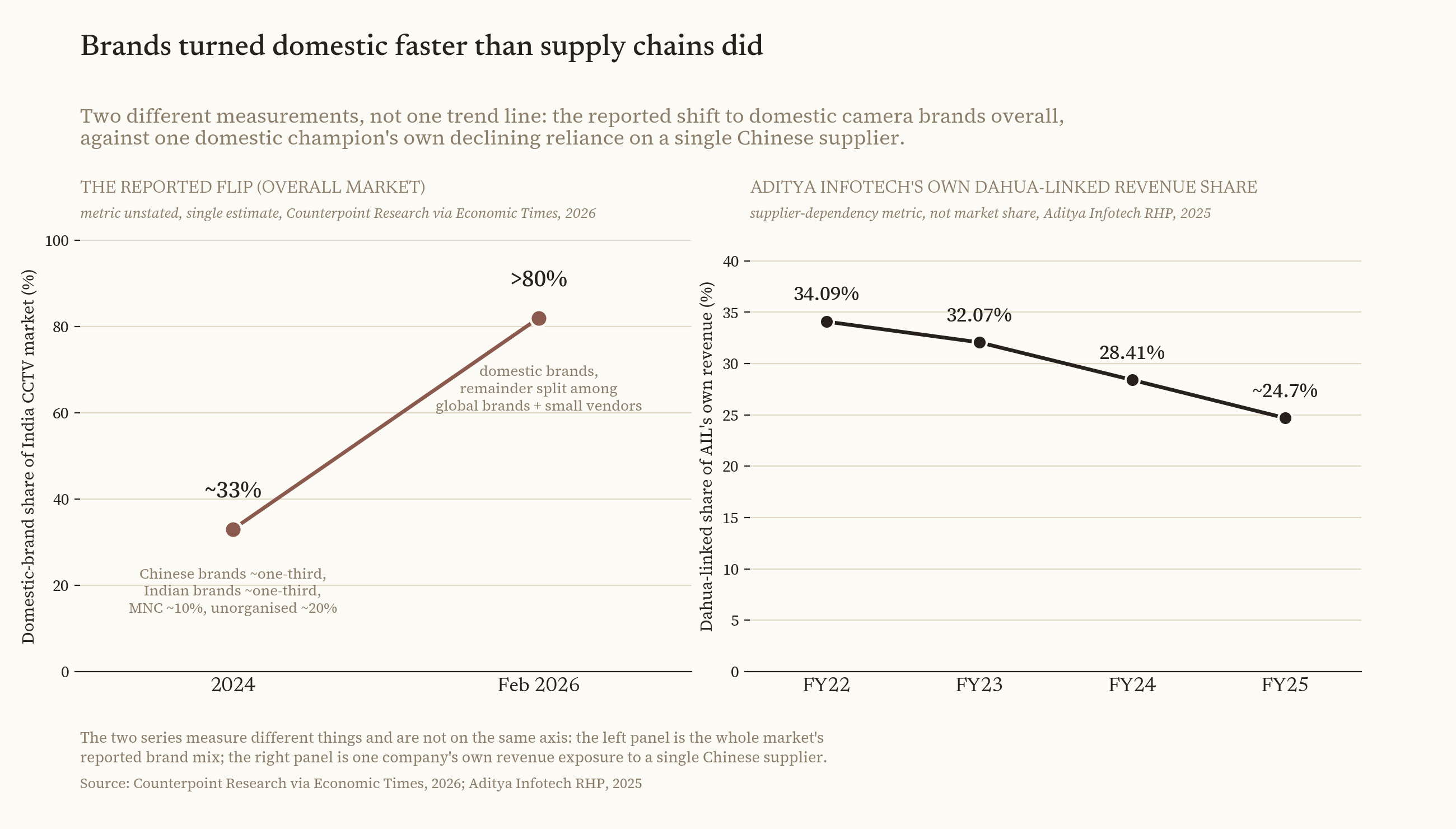
Two series side by side: the reported shift to domestic camera brands (Counterpoint estimate, metric unstated), against Aditya Infotech's declining but still-material reliance on Dahua-branded product (share of its own revenue, FY22-FY25). Source: Counterpoint Research via Economic Times, 2026; Aditya Infotech RHP, 2025
The eye and the brain
Two components decide most of what a camera is: how well it sees in the dark, how much it costs, how much intelligence it can run. The first is the image sensor, the eye. The second is the system-on-chip, the SoC, the brain that turns light into a compressed, often already-analysed, video stream. India makes neither at commercial scale. On the best available estimates the two together are also the costliest part of the camera, something like 40 to 50% of its bill of materials, though exact teardown figures are not public.
The eye is concentrated. Sony is the largest maker of CMOS image sensors in the world across all uses, closing on half of a market worth $23.2 billion in 2024, according to Yole Group.12 In the security segment specifically, the leader is OmniVision, which is Chinese-owned through Will Semiconductor, with Samsung, STMicroelectronics and onsemi also present in the segment.13 OmniVision claims a 52.8% share of security sensors, citing a Japanese research firm, though that is the company's own figure.14 India has no commercial image-sensor line and no fab; the closest thing is 3rdiTech, a small fabless design house focused on low-light imaging for defence, not the mass CCTV market.
The brain is where a ban changed the badge but not the dependence. Before 2019, Huawei's chip arm HiSilicon dominated surveillance SoCs, holding around 70% of the IP-camera SoC market at its peak.15 After the United States tightened sanctions on Huawei from 2019, HiSilicon's share collapsed, on one brokerage estimate from about 60% of surveillance-camera chips as recently as 2018 to under 4% by 2021.16 The gap did not go to an Indian supplier. It went to other Chinese firms such as SigmaStar, Fullhan, Ingenic and Goke, to Novatek in Taiwan, and to Ambarella and Texas Instruments in the United States.15 Their exact current shares are not reliably published, and anyone quoting a precise split is guessing. The point holds regardless: sanctioning one vendor reshuffled which foreign chip sits in the camera, not whether the chip is foreign. India designs essentially none of these.
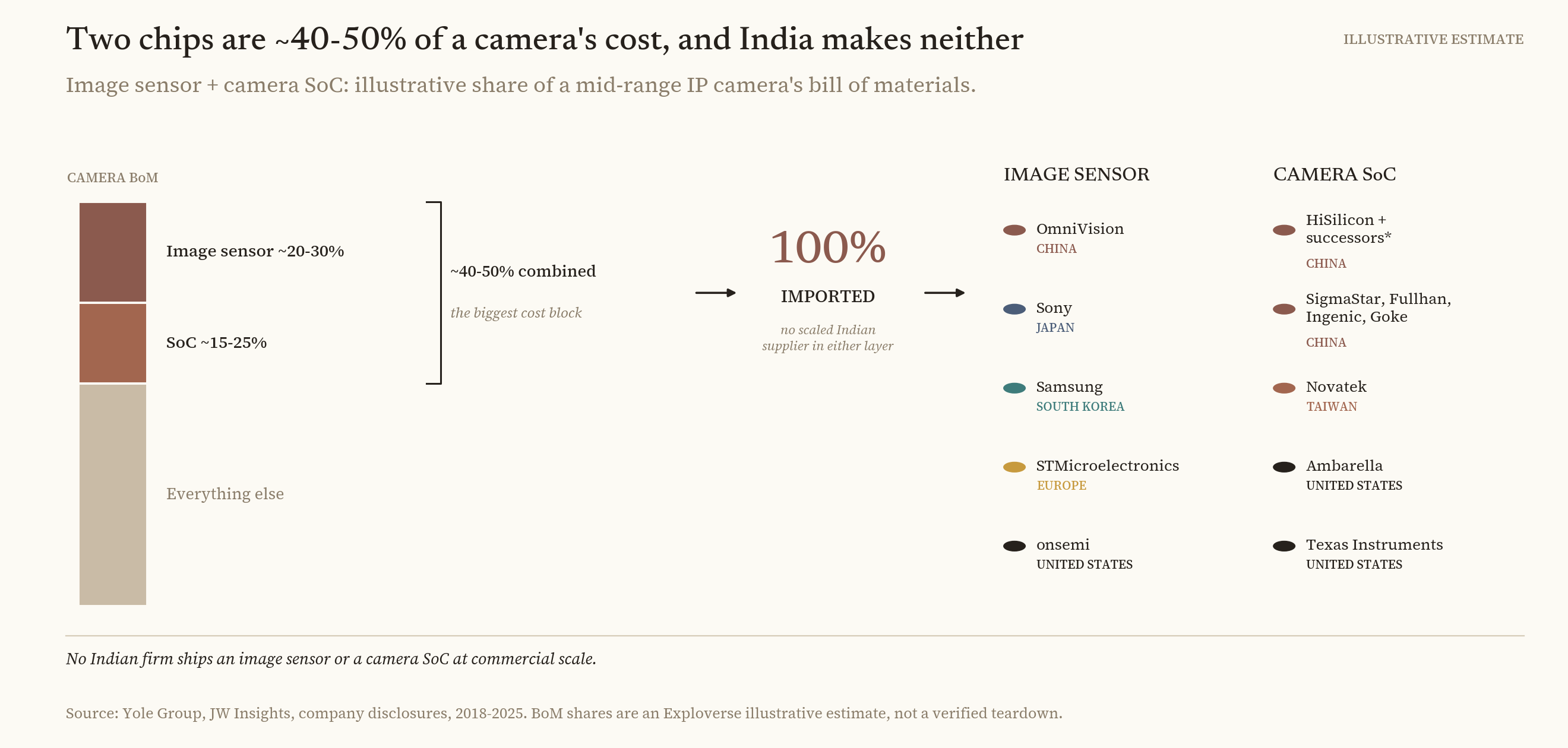
The image sensor and the SoC are an estimated 40 to 50% of a mid-range camera's bill of materials, its biggest cost block, and both are effectively 100% imported. The suppliers of each are shown by country. BoM shares are an illustrative estimate, not a verified teardown. Source: Yole Group, JW Insights, company disclosures, 2018-2025
What "made in India" means here
Return to the March 2024 rule, and what it actually rewards comes into focus. Its thresholds fall on assembly value: populating and soldering the circuit board in India, which it makes mandatory; final assembly and testing; the housing; in-house research and design, for which it grants a rising credit.1 Nowhere does it require the sensor or the SoC itself to be Indian-made. It requires them to be counted, tested and disclosed, and, in the case of the chip, it lets the imported value stand in until a fab exists. This is an escalating mandate on where a camera is put together, not a mandate on where its core is made.
That distinction has a rough price. The government's own industrial policy treats the assembled parts as the ones worth subsidising: the Electronics Component Manufacturing Scheme names camera modules and printed circuit boards as priorities for domestic manufacture, but not image sensors or SoCs.17 And across electronics generally, the government puts domestic value addition at only about 18% to 20% by industry estimates, a figure for electronics as a whole rather than cameras specifically, but a useful marker of how thin local value can be when the expensive parts are imported.17 Assembly can be localised quickly. The parts that carry the value take a different kind of investment, and a longer clock, the one the March 2024 footnote is quietly counting down.
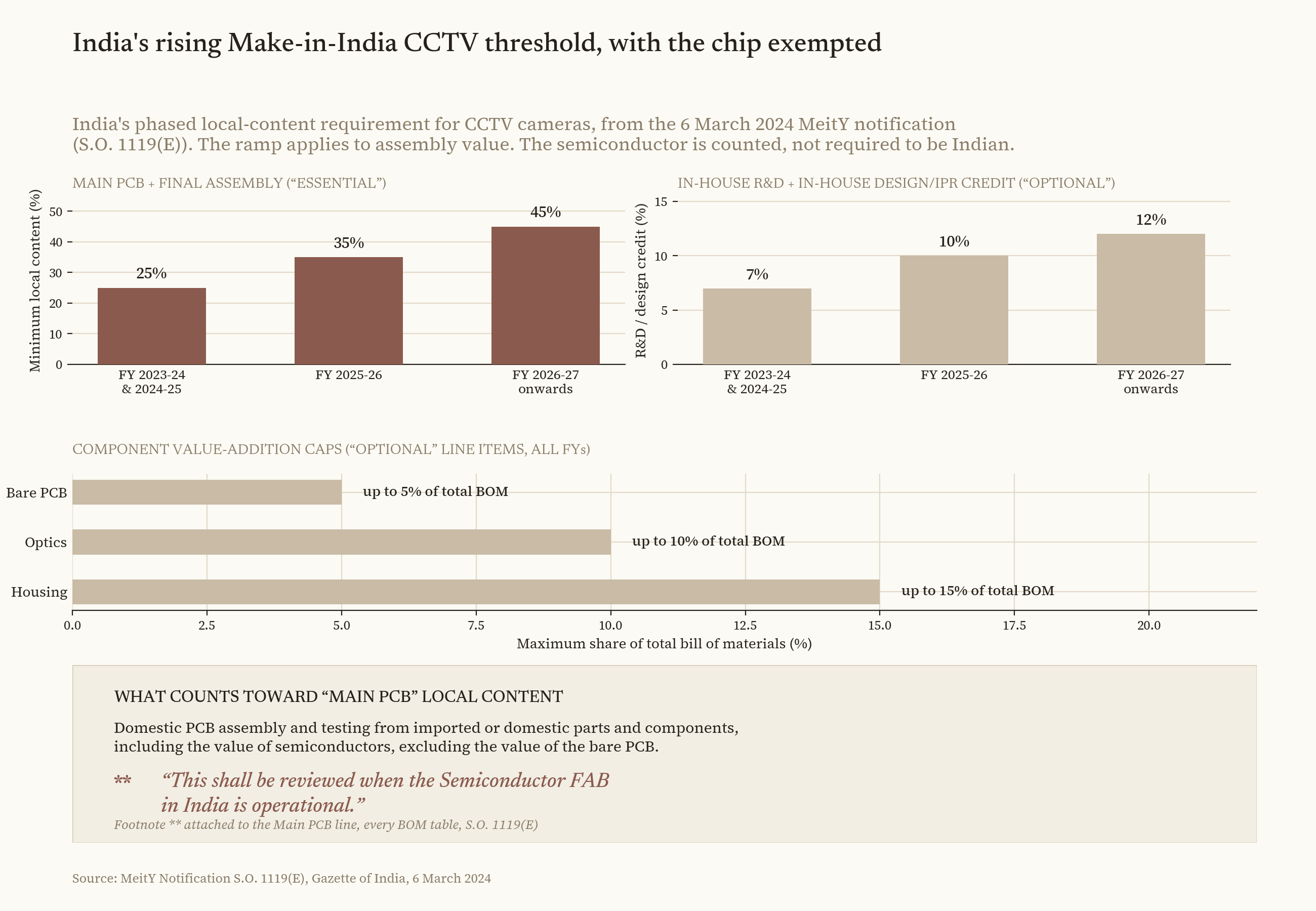
India's phased local-content requirement for CCTV, from the 6 March 2024 notification: the 25/35/45% ramp on board assembly plus final assembly, the caps on optics, housing and bare board, and the semiconductor value footnoted "until the Semiconductor FAB in India is operational." Source: MeitY Notification S.O. 1119(E), Gazette of India, 6 March 2024
The rest of the stack is imported too
The camera is only the most visible node. Widen the frame to the rest of the surveillance stack and the same pattern repeats. The recorder that stores and manages the footage, the digital or network video recorder, runs on the same class of imported chips, and India assembles these too without making their cores. Aditya Infotech builds recorders at its plant in Kadapa, Andhra Pradesh, but by its own account the local content there begins with the housing, the cables and the adapters, not the chipset.18
Storage tells a starker version. The hard drives built for continuous surveillance recording come from a handful of foreign makers, Seagate, Western Digital and Toshiba, and are manufactured largely in Thailand, where Seagate's Korat site is its single largest drive campus in the world.19 20 India makes none of them. The one domestic bright spot is adjacent rather than direct: MiPhi Semiconductors, a joint venture involving Micromax, has begun making India's first home-designed enterprise solid-state drives near Delhi, though these are aimed at data centres and artificial-intelligence infrastructure, not surveillance.21
The third layer is the software that reads the footage. As cameras turn into analytics devices, more of the value sits in the video-management and analytics platforms, a market led globally by firms such as Genetec, Milestone and Verkada.22 Here, at least, India has entrants of its own, if small ones. Vehant Technologies, incubated at IIT Delhi, reported about Rs 101 crore in revenue in FY25 and counts Delhi Police, the Indian Navy and the Airports Authority of India among its customers.23 The sector is still early and thinly capitalised, and not every story ends at home: Uncanny Vision, a Bengaluru computer-vision startup, was bought by an American company in 2021.24 The policy has not caught up with this wider map either. The component scheme that names printed circuit boards and camera modules as priorities does not extend to recorders, storage or analytics software.25
The policy lever that can see the silicon
That gap, between what the policy touches and what it makes, is sharpest in India's most sophisticated instrument. The certification regime that did most to reshape the market is more than an import ban. Under Essential Requirements set by the electronics ministry, every internet-connected CCTV camera sold in India must be tested and certified through the government's STQC laboratories, enforced through the Bureau of Indian Standards' compulsory registration order of April 2024. The tests cover hardware security, firmware, the software bill of materials, code signing, encrypted communication and the security of the supply chain.26 They also require the maker to disclose the bill of materials for critical hardware "like the SoC," and the design "till the PCBA and SoC level."26 The rule can see the silicon. What it cannot do is manufacture it. Disclosure is not a fab.
The timeline has been contested at every step. The registration order took effect in October 2024, then was pushed to April 2025 after, in the ministry's own words, "the industry has sought more time for compliance."27 Trade accounts describe a further stock-clearance relaxation in May 2025 and its withdrawal in January 2026, though the underlying memoranda could not be confirmed against an official source; the settled outcome is that full enforcement begins on 1 April 2026.2 The friction showed. By late May 2025, a Reuters investigation found 342 applications pending and only one foreign brand approved, with limited testing capacity, source-code scrutiny and repeated factory audits all cited as bottlenecks, and one large distributor's revenue reported to have halved.28 Hanwha's South Asia director warned the ministry that "millions of dollars will be lost from the industry, sending tremors through the market."28 The government refused to delay, calling the policy a response to "a genuine security issue," and its former cybersecurity chief, Gulshan Rai, put the rationale plainly: "There's always an espionage risk."28
| What India's CCTV certification checks | What it still cannot do |
|---|---|
| Hardware security: secure boot, tamper resistance | Require an Indian-made image sensor |
| Firmware, software bill of materials, code signing | Require an Indian-made SoC |
| Encrypted communication; supply-chain security | Build a domestic chip fab |
| Disclosure of the bill of materials and the design to the PCBA and SoC level | Localise the silicon it can now see |
Source: STQC IoT System Certification Scheme (CCTV), MeitY, 2024.
How other countries handle the same problem
Every large democracy has worried about the same Chinese cameras, and each has drawn the line in a different place. The contrast with India is instructive.
The United States names the firms. Section 889 of its 2019 defence authorisation act prohibits federal agencies from buying equipment from five named Chinese companies, Hikvision, Dahua, Hytera, Huawei and ZTE, with its two parts taking effect in August 2019 and August 2020.29 The Federal Communications Commission went further in an order adopted in November 2022 and effective February 2023, barring new equipment authorisations for the same covered firms, which reaches the commercial market as well as government buyers.30 The United Kingdom acts by category rather than by name. Its written ministerial statement of 24 November 2022 told departments to stop deploying surveillance equipment "produced by companies subject to the National Intelligence Law of the People's Republic of China," without naming a single one; the Hikvision and Dahua labels attached to that instruction come from press reporting, not the statement itself.31 32 Australia removed Chinese-made cameras from defence sites administratively in early 2023.33 The European Union has no bloc-wide ban, though its Parliament voted to remove its own Hikvision cameras in 2021.34
India does neither. It restricts by origin, through a 2020 procurement rule barring bidders from countries that share a land border unless they register with the government, a rule that names no company and, on its face, not even China.35 And it certifies by standard, through the regime above. When the origin rule was enforced on the government's own e-marketplace in March 2024, the suspended sellers included the Indian arms of Hikvision and Dahua, but also Lenovo, Nokia's licensee and several non-Chinese vendors, which is what enforcement of a generic rule looks like, not a targeted ban.36 There is a deeper point under all of this. Banning a brand does not remove component dependence, because the "trusted" and the "banned" long bought from the same few suppliers. Ambarella's own filings once listed Axis, Bosch, Motorola's Avigilon, Hikvision and Dahua as customers of the same chips.37
| Country or bloc | Mechanism | Key instrument (date) | What it reaches |
|---|---|---|---|
| United States | Names firms in statute | NDAA §889 (2019-20); FCC Covered List (Nov 2022, effective Feb 2023) | Federal procurement and contractors; the commercial market, via the FCC |
| United Kingdom | Acts by category | Written Ministerial Statement HCWS386 (24 Nov 2022) | Central-government "sensitive sites"; names no firm |
| Australia | Administrative removal | Senate audit, then rip-and-replace (Feb 2023) | Defence and federal-agency sites; never a standing statute |
| European Union | No bloc-wide ban | European Parliament vote to remove its own cameras (Apr 2021) | Parliament's own units only; no EU-wide instrument |
| India | Origin restriction plus certification | Land-border procurement rule (2020) and the STQC / Essential Requirements regime (2024-26) | Public procurement and every CCTV camera sold; certifies by standard, names no firm |
None of these reach the shared image-sensor and SoC supply base inside every camera, trusted or banned.
Sources: US Election Assistance Commission; CRS and FCC; UK Hansard HCWS386; Al Jazeera; IPVM; PIB, 2019-2026.
The line the cameras do not change
A more domestic camera base changes who supplies the surveillance. It does not, by itself, change how the surveillance is governed. India's Digital Personal Data Protection Act of 2023 brings CCTV and facial-recognition data within a data-protection statute for the first time, at least in principle. But there is no dedicated law for cameras or facial recognition, and the Act gives the government wide power to exempt notified state bodies from its safeguards on grounds of security and public order, which is precisely the category most public surveillance falls under.38
So the two questions run on separate tracks. Who makes the camera has changed a great deal in two years. What happens to what the camera sees has changed very little, and it will not change because the badge on the front did.
The next decade is design, not assembly
If assembly was the achievable part, the harder part is design, and the firms that have escaped this dependence show what it takes. Axis, in Sweden, has designed its own camera SoC for years and launched its ninth generation, ARTPEC-9, in 2024.39 Hanwha, in South Korea, unveiled its in-house Wisenet 9 chip the same year.40 Both did it for the reason India now cares about: to control the security and the supply of the part that matters most. Neither makes its own image sensor, which is the harder chokepoint still.
India has the beginnings of an answer. A small, government-tracked cohort of chip-design firms, NetraSemi, Mindgrove, BigEndian and 3rdiTech, is designing indigenous camera SoCs, and the engineering group L&T Semiconductor has partnered with CP Plus to develop one.41 42 There is progress, but it is early. A government backgrounder in January 2026 reported that NetraSemi had taped out what it called India's first indigenously designed artificial-intelligence chip, a 12-nanometre part aimed at video surveillance, one of two dozen chip-design projects backed by the Design Linked Incentive scheme.43 A tape-out is a milestone, not a shipped product, and production-grade parts had earlier been described as only scheduled for 2026.41 Announced, in other words, and now closer, but not yet delivered. The more winnable prize may not be the chip at all, but the software above it, the analytics layer where the value is migrating and where India, as its early entrants suggest, could compete from something closer to parity than a standing start, without ever building a fab.
None of this is failure, and none of it is finished. India set out to make the cameras watching it its own, and in the space of a few years it has largely made the box and the badge Indian, faster than almost anyone expected. The eye, the brain and the code are a different order of problem, more capital, more time and more patience than a procurement rule can supply. The government's own rulebook admits as much, in a footnote it will get to review only when the fab is operational.
Sources
- Public Procurement (Preference to Make in India) Order 2017, Notifying CCTV/Video Surveillance System for Security, Notification S.O. 1119(E), Ministry of Electronics and Information Technology, Government of India (2024). https://www.mha.gov.in/sites/default/files/CCTV_30042024.pdf.
- India to ban Chinese CCTV from Apr 1 as security concerns reshape market, Business Standard (2026). https://www.business-standard.com/industry/news/india-ban-chinese-cctv-government-security-concerns-hikvision-dahua-market-126033000316_1.html.
- 10 Years of Smart Cities Mission, Press Information Bureau, Government of India (2025). https://www.pib.gov.in/PressNoteDetails.aspx?NoteId=154736&ModuleId=3®=3&lang=2.
- Sanctioned globally, Chinese CCTV firms are entrenched in the Indian market, Anushka Jain, The Ken (2023). https://the-ken.com/story/sanctioned-globally-chinese-cctv-firms-are-entrenched-in-the-indian-market/.
- India Video Surveillance Market, Mordor Intelligence (report page, 2024-2025). https://www.mordorintelligence.com/industry-reports/india-video-surveillance-market.
- Status of Policing in India Report 2023, Common Cause and Lokniti-CSDS (2023). https://internetfreedom.in/the-status-of-cctv-policing-in-india-2023/.
- Aditya Infotech Limited, Initiating Coverage, ICICI Securities (December 2025). https://images.assettype.com/bloombergquint/2025-12-08/wrmewq5i/ICICI_Securities_Aditya_Infotech_IC_Dec25.pdf.
- Press Release: Aditya Infotech Limited, CARE Ratings (2025). https://www.careratings.com/upload/CompanyFiles/PR/202506120640_Aditya_Infotech_Limited.pdf.
- Aditya Infotech IPO, financials from the RHP, Kamal Joshi, Upstox (reporting the Red Herring Prospectus, updated 2026). https://upstox.com/news/market-news/ipo/aditya-infotech-ipo-here-s-a-look-at-cp-plus-brand-owner-s-strengths-risks-and-financials-from-rhp/article-178744/.
- Govt to ban Chinese CCTVs from April 1 as new certification rules take effect: Report, The Federal (2026). https://thefederal.com/category/business/govt-to-ban-chinese-cctvs-from-april-1-as-new-certification-rules-take-effect-report-236808.
- Corporate insolvency resolution process record for Zicom Electronic Security Systems Limited, Insolvency and Bankruptcy Board of India (IBBI). https://ibbi.gov.in/en/claims/inner-process/L32109MH1994PLC083391.
- CIS market to reach more than $30 billion by 2030, and Status of the CMOS Image Sensor Industry 2025, Yole Group (2025). https://www.yolegroup.com/press-release/cis-market-to-reach-more-than-30-billion-by-2030-driven-by-mobile-automotive-and-security-applications/.
- Security Imaging Industry: Delivering State-of-the-art Performance Products, Yole Intelligence via Edge AI and Vision Alliance (2022). https://www.edge-ai-vision.com/2022/08/security-imaging-industry-delivering-state-of-the-art-performance-products/.
- Surveillance, OmniVision (OVT.com). https://www.ovt.com/applications/surveillance/.
- Opportunities explode in AI SoC for security equipment after the fall of Huawei's HiSilicon, Huang Rengui, JW Insights (2022). https://www.laoyaoba.com/n/807827.
- Huawei subsidiary ships advanced surveillance camera chips in another sign it's skirting US sanctions, Mike Wheatley, SiliconANGLE (2023). https://siliconangle.com/2023/09/20/huawei-subsidiary-ships-advanced-surveillance-camera-chips-another-sign-skirting-us-sanctions/.
- Domestic value addition in electronics manufacturing currently at 18-20%, Press Information Bureau, Ministry of Electronics and Information Technology (2026, PRID 2247771). https://www.pib.gov.in/PressReleasePage.aspx?PRID=2247771.
- CP PLUS expands with a large manufacturing facility in Andhra Pradesh, CP PLUS / Aditya Infotech (2 June 2022). https://cpplusworld.com/news/130.
- Toshiba S300 Surveillance Hard Drive product pages, Toshiba (2025). https://storage.toshiba.com/consumer-hdd/internal/s300.
- Seagate to invest Bt15.3 bn over five years in expansion of Korat complex, The Nation (Thailand). https://www.nationthailand.com/business/30253793.
- MiPhi launches India's first locally designed, manufactured enterprise SSDs, Gulveen Aulakh, Business Standard (30 June 2025). https://www.business-standard.com/companies/news/miphi-semiconductors-launches-first-enterprise-ssds-designed-and-made-in-india-125063000482_1.html.
- Genetec solidifies number 1 position in expanding global VMS market, according to latest Omdia report, Genetec (2022). https://www.genetec.com/press-center/press-releases/2022/07/genetec-solidifies-number-1-position-in-expanding-global-vms-market-and-increases-worldwide-market-share-according-to-latest-omdia-report.
- From under-vehicle scanning to AI: Vehant's evolution in security tech, and related coverage, YourStory (2025). https://yourstory.com/smbstory/vehant-technologies-evolution-security-tech-ai-scanning-systems.
- Uncanny Vision company and acquisition records, Tracxn and Crunchbase. https://tracxn.com/d/companies/uncanny-vision.
- Electronics Components Manufacturing Scheme: Union Budget 2026-27 Raises Scheme Outlay to Rs 40,000 Crore, Press Information Bureau, Government of India (3 February 2026, PRID 2222519). https://www.pib.gov.in/PressReleasePage.aspx?PRID=2222519.
- Procedure for CCTV Testing Evaluation and Certification (STQC/IoTSCS/P01), STQC Directorate, MeitY (2024). https://www.stqc.gov.in/sites/default/files/2024-05/IoTSCS-P01-Procedure for CCTV Testing Evaluation and Certification.pdf.
- Extension in timelines for the implementation of the Electronics and Information Technology Goods (Requirement of Compulsory Registration) Order 2021, Notification S.O. 4378(E), MeitY (2024), reproduced via World Trade Scanner. https://worldtradescanner.com/MeitY Notification S.O. 4378(E) dated 9 October, 2024.htm.
- 'China part of concern': India's CCTV crackdown over spying fears hits global giants like Hikvision, Xiaomi, Reuters investigation republished by Business Today (2025). https://www.businesstoday.in/industry/story/china-part-of-concern-indias-cctv-crackdown-over-spying-fears-hits-global-giants-like-hikvision-xiaomi-478143-2025-05-28.
- What is Section 889 of the FY 2019 NDAA?, US Election Assistance Commission. https://www.eac.gov/what-section-889-fy-2019-ndaa.
- New FCC Rules Ban Authorizations for Equipment Posing National Security Risks, Congressional Research Service Legal Sidebar LSB10895, with FCC records (via Congress.gov). https://www.congress.gov/crs_external_products/LSB/PDF/LSB10895/LSB10895.2.pdf.
- Written Ministerial Statement HCWS386, Security Update on Surveillance Equipment, Oliver Dowden, UK Parliament, 24 November 2022, captured via TheyWorkForYou (Hansard reproduction). https://www.theyworkforyou.com/wms/?id=2022-11-24.HCWS386.h.
- UK Government Departments Ordered To Remove Chinese Security Cameras, Emma Woollacott, Forbes (2022). https://www.forbes.com/sites/emmawoollacott/2022/11/25/uk-government-departments-ordered-to-remove-chinese-security-cameras/.
- Australia strips Chinese-made security cameras from defence sites, Al Jazeera (2023). https://www.aljazeera.com/news/2023/2/9/australia-strips-chinese-made-security-cameras-from-defence-sites.
- EU Parliament Removes Hikvision, Citing Human Rights Abuses, Charles Rollet, IPVM (2021). https://ipvm.com/reports/hik-eu.
- Restrictions on Public Procurement from certain countries, Press Information Bureau, Government of India (2020, PRID 1640778). https://www.pib.gov.in/PressReleasePage.aspx?PRID=1640778.
- Sellers Suspended due to non-compliance with GFR Rule 144(xi), Government e-Marketplace (GeM), dated "As on 11-Mar-2024", hosted by IPVM. https://s.ipvm.com/uploads/embedded_file/14d6f8f0143e32e7dffec3b86a67f541930eb0a1823b47a811e9864ab95bd129/8f753855-eee2-4db8-be19-874f13f52bc6.pdf.
- Ambarella, Inc., Form 10-K for the fiscal year ended 31 January 2014, filed with the US Securities and Exchange Commission (Commission File No. 001-35667). https://www.sec.gov/cgi-bin/browse-edgar?action=getcompany&CIK=0001280263&type=10-K.
- Digital Personal Data Protection Act, 2023, Government of India (2023), with legal commentary on Sections 7 and 17 (Medianama). https://www.medianama.com/2023/08/223-dpdp-bill-2023-government-exemptions-3/.
- Axis Communications Announces New ARTPEC-9 Chip, Axis Communications (2024). https://newsroom.axis.com/en-us/press-release/artpec-soc.
- Wisenet SoC history and Wisenet 9, Hanwha Vision (2024). https://www.hanwhavision.com/en/news-center/1609635/.
- Semicon India 2025 Showcases Indian Startups Accelerating the Roadmap for Aatmanirbhar Chips under the DLI Scheme, Press Information Bureau, Ministry of Electronics and IT (2025, PRID 2163622). https://www.pib.gov.in/PressReleasePage.aspx?PRID=2163622.
- The CCTV Gold Rush: Indian Startups, OEMs Race To Fill Surveillance Vacuum, Team Inc42 (2026). https://inc42.com/features/the-cctv-gold-rush-indian-startups-oems-race-to-fill-surveillance-vacuum/.
- Design Linked Incentive Scheme: Catalyzing India's Semiconductor Design Ecosystem, Press Information Bureau, Government of India (4 January 2026, PRID 2211220). https://www.pib.gov.in/PressReleasePage.aspx?PRID=2211220.