India's critical-mineral problem is usually described as a lack of deposits. The real constraint is the refining step that turns rock into battery and magnet material, and it belongs almost entirely to someone else.
Key takeaways
- India's critical-mineral exposure is usually read as a shortage of deposits. For most of the minerals that matter, the sharper gap is the refining and processing step that turns ore into battery-grade and magnet-grade material, and that step sits overwhelmingly in China.
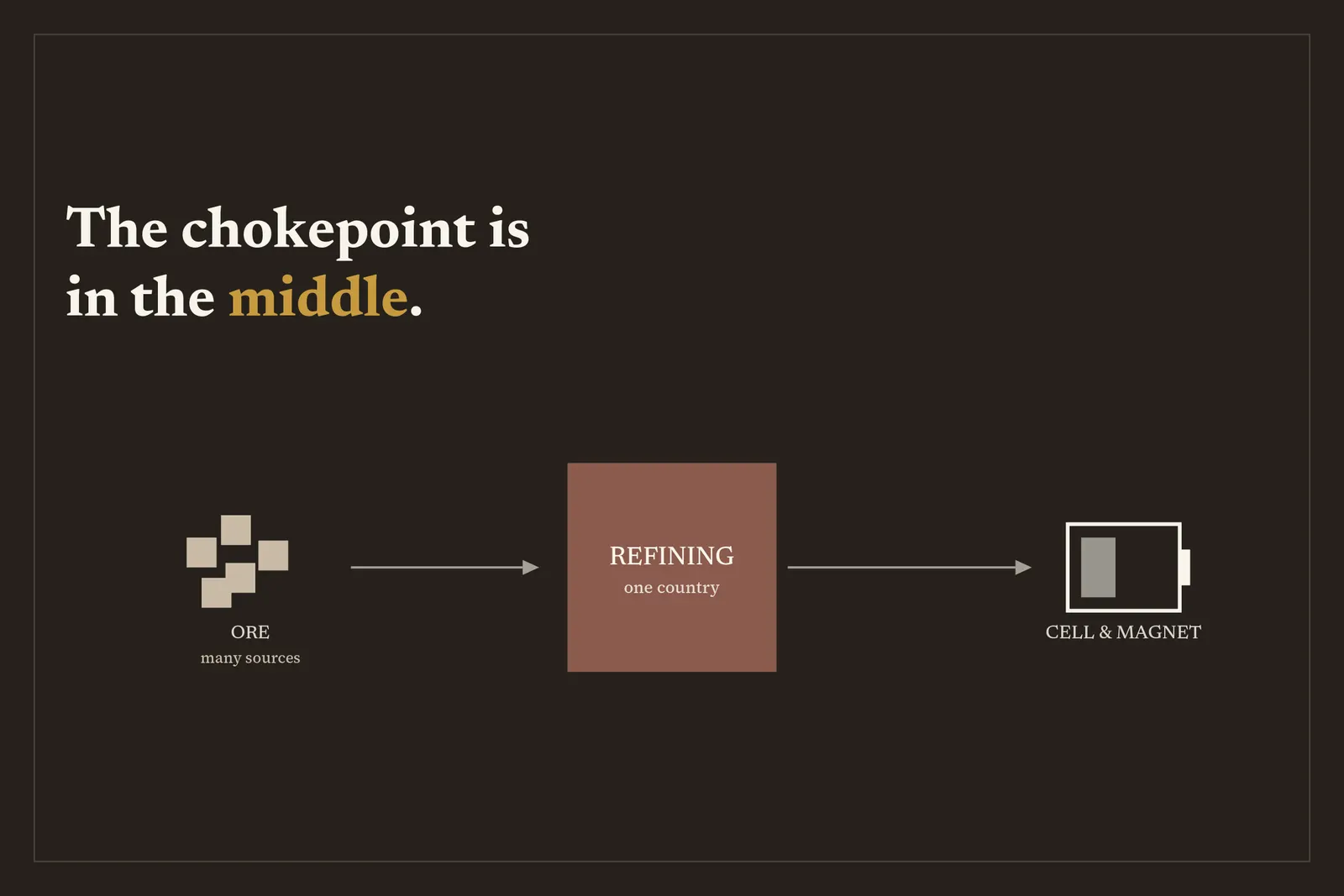
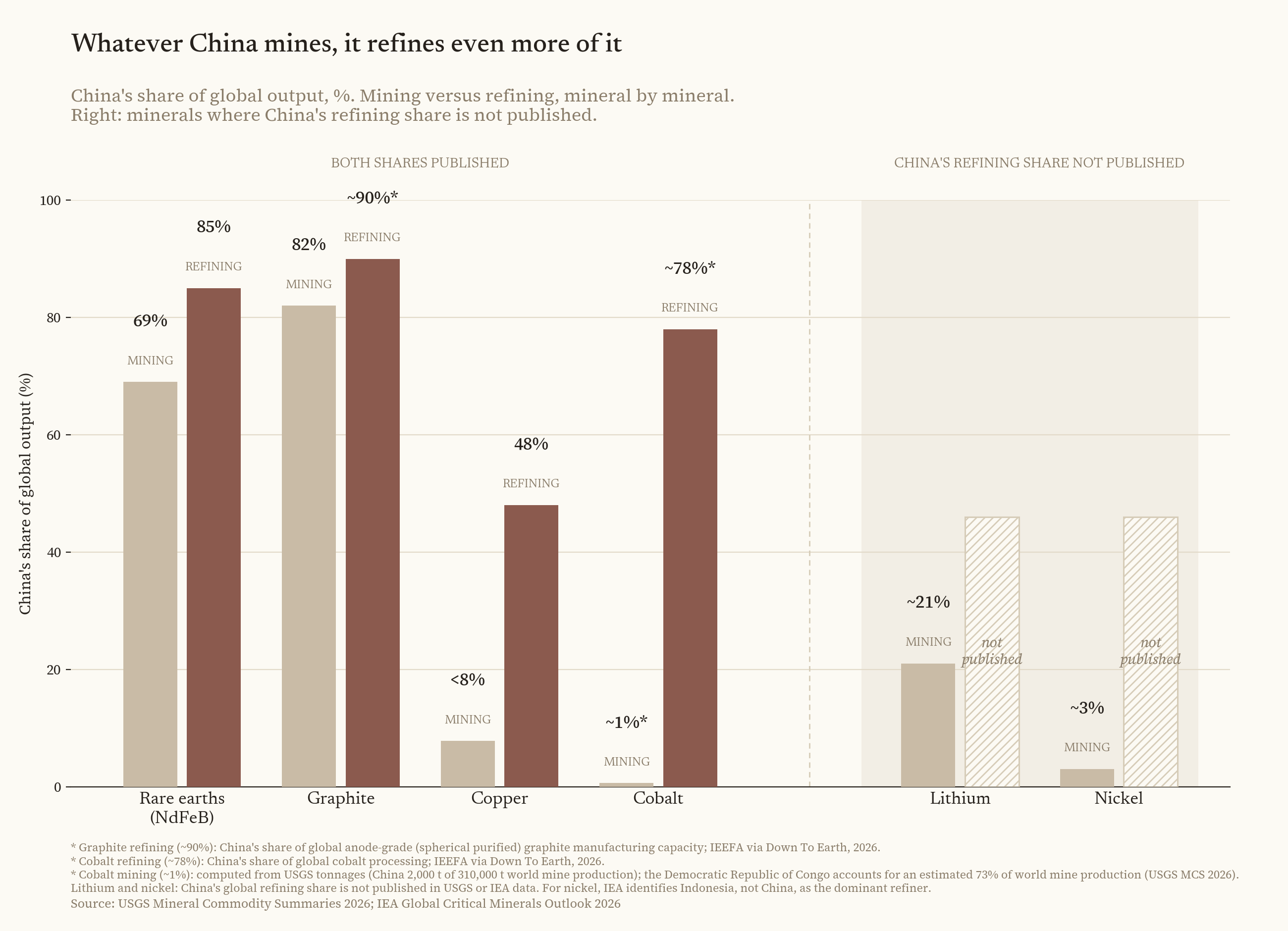
- Mining is spread across many countries; refining is concentrated. Chile mines the most copper but China refines nearly half of it. China's share of rare-earth refining was about 85% in 2025, well above its roughly 69% share of rare-earth mining. The gap between those two numbers is the story.
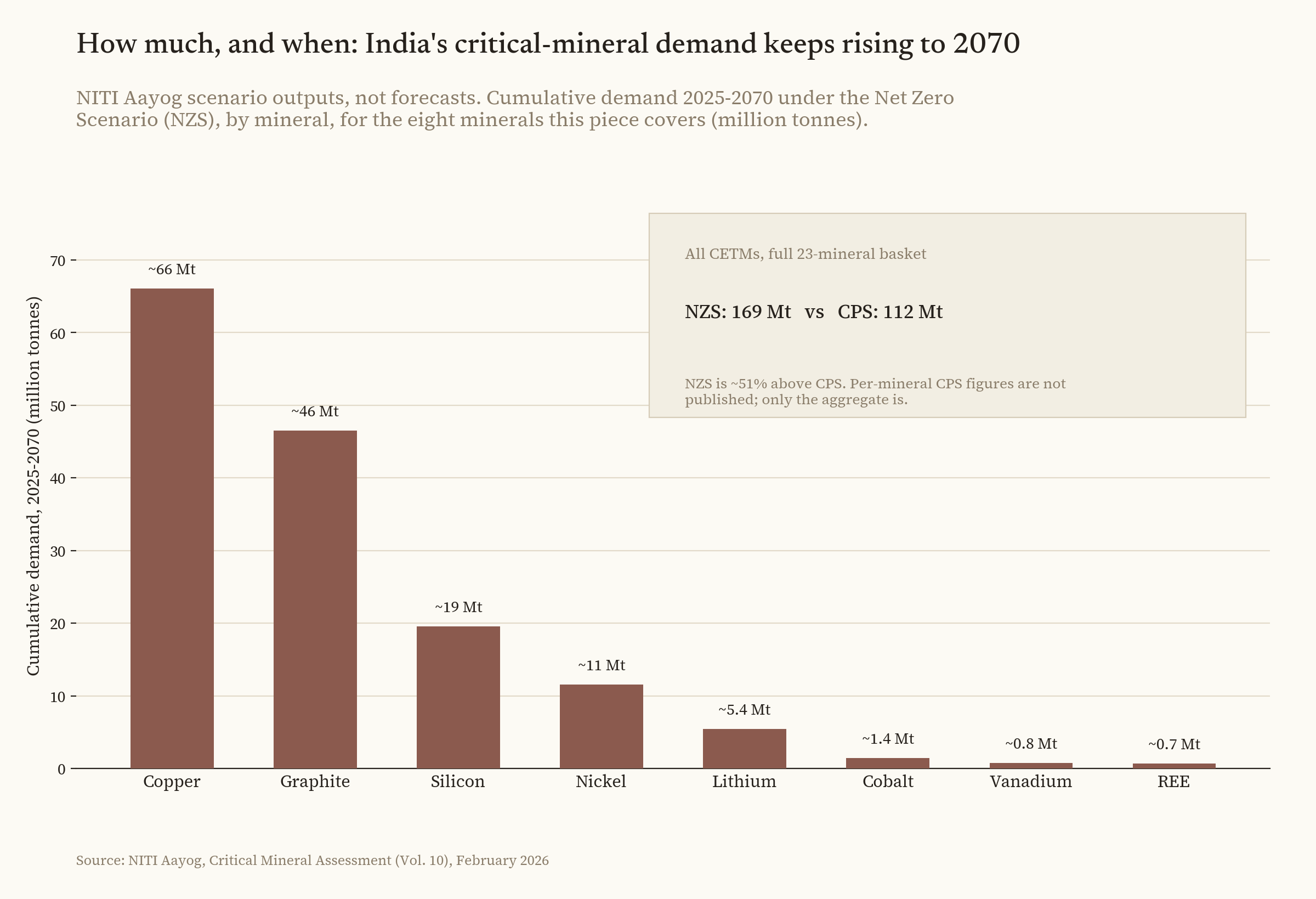
- India's demand is set to rise steeply and unevenly. NITI Aayog projects cumulative critical-mineral needs of about 169 million tonnes to 2070 under its Net Zero pathway, roughly 51% above its current-policy case, with electric-vehicle batteries driving over half of it.
- The government has built real machinery quickly: a minerals list, auction reforms, a national mission, an overseas-acquisition arm and recycling rules. The distance between what has been announced and what can be verified is largest exactly where the constraint is tightest, at refining.
- No single move fixes this. The defensible answer is a sequenced portfolio across refining, overseas ore access, recycling and alliances, with the trade-offs stated honestly rather than a flagship project promised as a cure.
The minerals in one battery
Lift the floor of an electric car and the argument of this piece is sitting there in metal. The pack holds lithium, nickel and cobalt in its cells, graphite in the anodes and copper running through everything. The motor beside it turns on a permanent magnet made mostly of neodymium and iron, with a little dysprosium to keep it working when it gets hot. Six or seven critical minerals, one machine.
Now ask two separate questions about each of them: where was it mined, and where was it refined into the form the battery actually uses. The mining answer is scattered. Australia leads lithium mining, Indonesia dominates nickel, the Democratic Republic of the Congo accounts for roughly 73% of mined cobalt, and China produces an estimated 82% of natural graphite.1 The refining answer is not scattered at all. It points, again and again, at one country. China refined about 85% of the world's rare earths in 2025 and does most of the world's battery-material processing.2
That concentration stopped being abstract in April 2025, when China placed export controls on seven rare-earth elements. Export volumes dropped sharply, and automakers in the United States, Europe and beyond were left scrambling for permanent magnets, with some cutting output or idling lines.2 India, which imports effectively all of its rare-earth magnets, sat on the same exposed side of that trade.3
Two different numbers, not one
The phrase "import dependence" hides a trap. It is really two numbers, and they behave differently. One measures how much of the ore a country has to bring in. The other measures how much of the refined, usable material it has to bring in. For India, the second number is the one that decides its energy security, and it is the one that gets least attention.
Copper is the clean illustration. Chile mines about 23% of the world's copper ore, more than any other country, while China mines under 8%. Yet China refines roughly 48% of the world's copper, against Chile's 6%.1 The ore travels to the smelter, and the smelter is where the concentration lives. Since 2005 China has accounted for over 90% of the growth in global copper smelting, lifting its share of capacity from around 15% to 50%.2 Rare earths show the same split more starkly: China mines around 69% of them but refines about 85%.1 2
This is the distinction the rest of the piece is built on. A country can raise its own mining, sign overseas supply deals and still be exposed, because the step that sets prices and can be switched off is the refining step, and diversifying mines does not touch it. The midstream, the refining, separation and conversion of ore into cathode, anode and magnet material, is where the pressure point is.
The scale of what is coming
Before the exposure matters, the demand has to be real, and it is about to become large. NITI Aayog's February 2026 assessment models India's mineral needs out to 2070 under two futures. Under its Current Policy Scenario, cumulative demand for critical energy-transition minerals reaches about 112 million tonnes. Under its Net Zero Scenario, the pathway to net-zero emissions by 2070, it reaches about 169 million tonnes, roughly 51% higher, with the increase concentrated in battery-linked minerals.3
The growth is uneven, which is the useful part. Electric-vehicle batteries account for about 55% of that cumulative demand and solar technologies for about 30%, so a handful of minerals decide the outcome.3 By volume the heaviest are copper at roughly 66 million tonnes and graphite at about 46 million tonnes over the period; of the minerals this piece follows, silicon comes next near 19 million tonnes, then nickel around 11 million tonnes, lithium about 5.4 million tonnes and cobalt near 1.4 million tonnes. (NITI Aayog's basket also counts nearly 17 million tonnes of phosphorus, which sits outside this piece's scope.)3 The demand is also heavily backloaded: NITI Aayog estimates that only about 2% of it falls before 2030 and roughly two-thirds after 2050. That timing cuts both ways. It buys India years to build, and it removes the excuse to wait.
Where geology genuinely binds
The thesis is stronger for conceding where it does not apply. For part of the basket, India really does lack economic domestic ore, and no refinery fixes that. NITI Aayog's own resource table lists lithium, cobalt, nickel and rare earths at 100% import dependence, and for lithium, cobalt and nickel it records no proven reserves at all.3 This is a genuine upstream gap. India cannot refine lithium it does not have and cannot buy cheaply enough.
The nuance is that "no reserves" is not the same as "no rock." India holds the world's eighth-largest resource of rare earths and sizeable identified resources of cobalt and nickel, but these have not been converted into mineable reserves, which NITI Aayog attributes to limited domestic expertise and slow industrial uptake rather than to an absence of geology.3 India even mines a little rare-earth ore already, around 2,900 tonnes in 2025, through beach-sand operations.1 So the honest map has two upstream categories: minerals India will have to import as ore for the foreseeable future, and minerals it has in the ground but has not yet learned to pull out and process at scale.
Where the real chokehold is
Take the four minerals that carry the transition and the pattern resolves. Each makes the same point in a different way.
Lithium is double-stacked. India has no proven reserves and imports all of it, and it also has almost no capacity to convert spodumene or brine into the battery-grade carbonate and hydroxide that cells need.3 Even the raw compounds arrive from abroad: in 2024-25 India imported its lithium carbonate mainly from Ireland, Chile and China, and its lithium hydroxide from Chile and China.4 Buying more ore would not remove the second dependence.
Rare earths are the cleanest test of the thesis, because here India does hold resource. The constraint is almost purely midstream: separating the individual oxides and then making the sintered neodymium-iron-boron magnets. India does neither at scale. Its state processor, IREL, runs a large beach-sand operation but its established commercial base is ilmenite, rutile, zircon and garnet rather than separated rare-earth oxides or finished magnets.5 The government approved a Rare Earth Permanent Magnet scheme worth Rs 7,280 crore in November 2025 to seed about 6,000 tonnes of annual magnet capacity, but as of publication that capacity is a tender, not a factory: bids for the manufacturing scheme closed only at the end of July 2026, with beneficiaries yet to be selected.6
Graphite is the "we have it but cannot use it" case. India mines graphite and its raw-graphite import dependence is only around 28%, yet the anode-grade material batteries actually need, coated spherical graphite, is processed almost entirely offshore.3 In 2024-25 India imported synthetic graphite overwhelmingly from China, which supplied over 91% of it.4 The ore is not the problem; the processing is.
Cobalt is closest to a pure import story at both stages. India has no reserves worth mining, and refining is concentrated abroad, with roughly 78% of processing in China even though the ore comes from the Congo.4
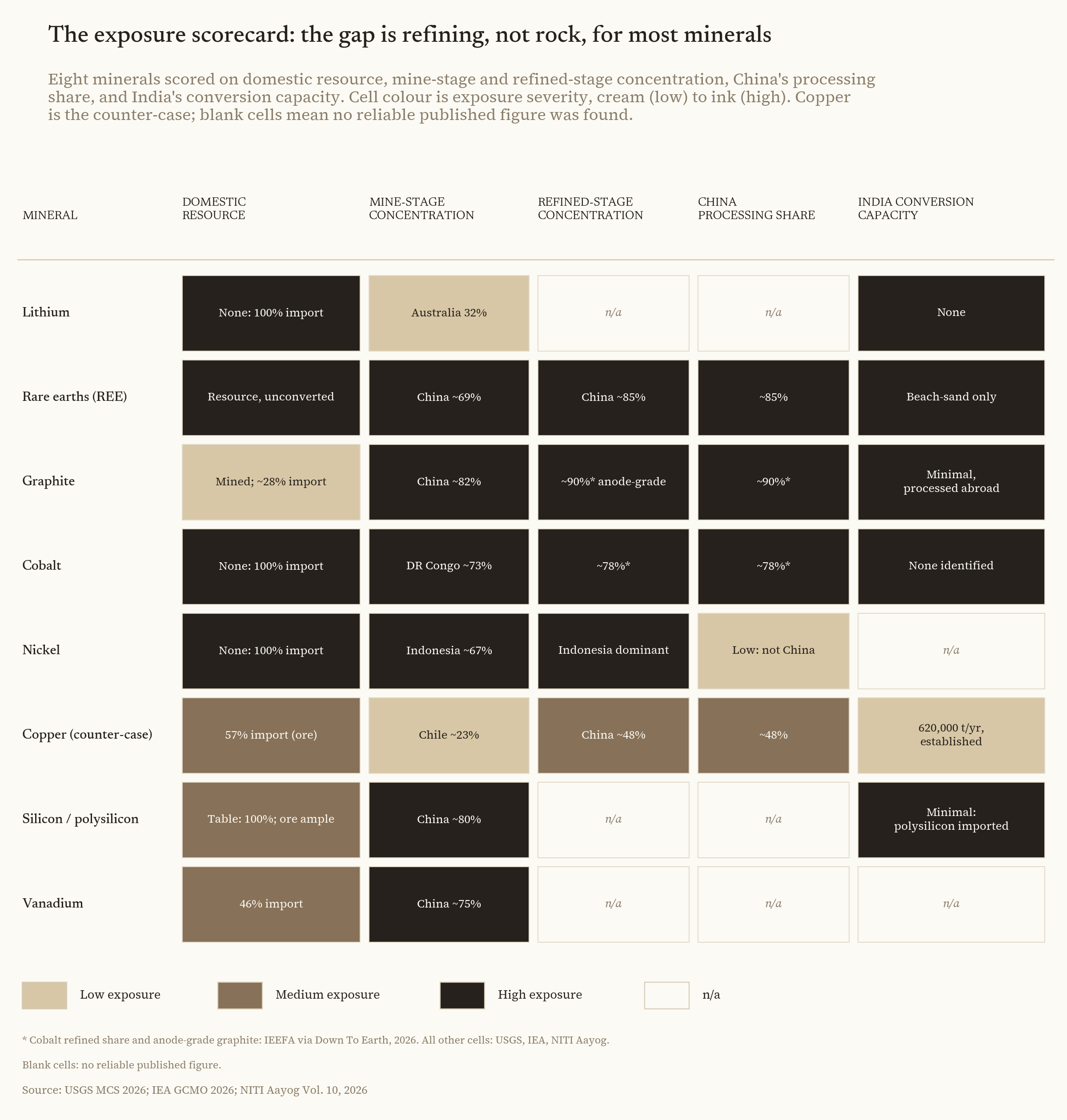
The scorecard also shows where the framework has an edge. Copper inverts it. India refines around 620,000 tonnes of copper a year but mines only about 23,000 tonnes, so its gap is ore, not plant: it imports concentrate to feed smelters it already owns.1 Silicon splits the same way as graphite. NITI Aayog's table lists it at 100% import dependence, yet its own text says overall import dependence is low and names imported polysilicon for solar wafers as the real chokepoint.3 For both silicon and graphite, the flat percentage misleads; the processed-material dependence is what binds.
The world is re-wiring, and India is arriving late
While India builds, the rest of the world is rebuilding these supply chains around security rather than lowest cost, and it is doing so from both directions at once.
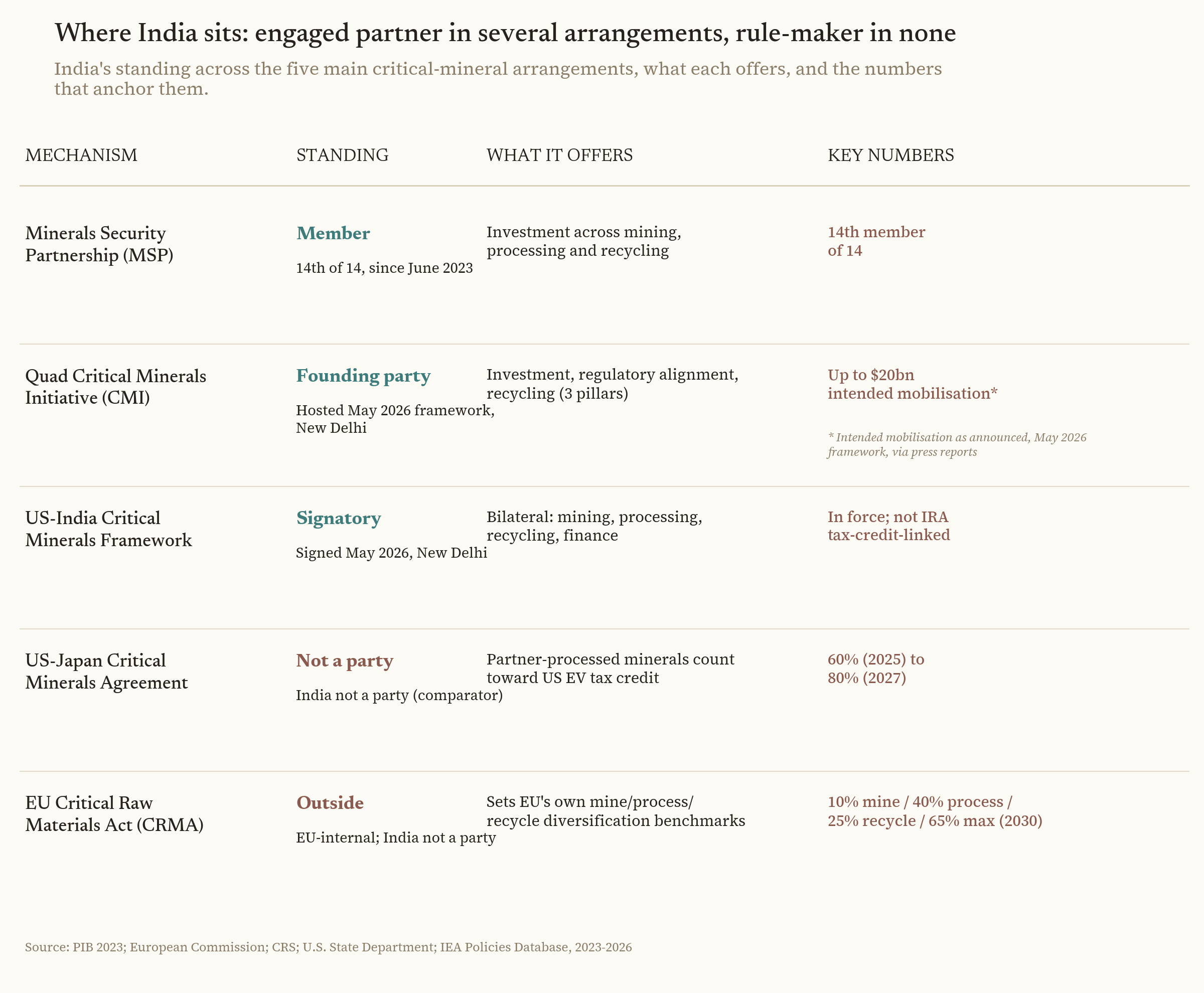
On one side are the friend-shoring blocs. India joined the Minerals Security Partnership in June 2023 as its fourteenth member, alongside the United States, Japan, Australia, the European Union and others.7 The European Union's Critical Raw Materials Act sets hard 2030 benchmarks: at least 10% of annual consumption mined at home, 40% processed, 25% recycled, and no more than 65% from any single third country.8 The United States and Japan went further and bilateral, signing a Critical Minerals Agreement in 2023 that lets Japanese-processed minerals count toward American electric-vehicle tax credits.9 India has its own bilateral instrument, the Strategic Critical Minerals Cooperation Framework it signed with the United States in May 2026, spanning mining, processing, recycling and finance.10 That framework is a cooperation pact rather than a market-access one: unlike the Japan agreement, it does not, as announced, make India-processed material eligible for those tax credits. India is also a founding party to the Quad Critical Minerals Initiative and hosted that initiative's framework announcement in New Delhi in May 2026, its strongest seat at any of these tables.11
On the other side is coercion. China's export controls escalated through 2025: licensing on seven rare-earth elements in April, an October expansion that for the first time asserted control over foreign-made products containing Chinese rare earths, then a one-year suspension of the October measures in November while the April controls stayed in place.2 1 The Congo, source of most mined cobalt, moved from an export ban to a quota system over the same year.1 The European Commission's Koen Doens put the logic plainly at a Brussels summit in May 2026: "Power will rest in the hands of those that control extraction, refining, processing, transport standards, financing, and ultimately industrial capacity."12 On that measure India is an engaged partner in several arrangements and the rule-maker in none.
The discovery that went nowhere
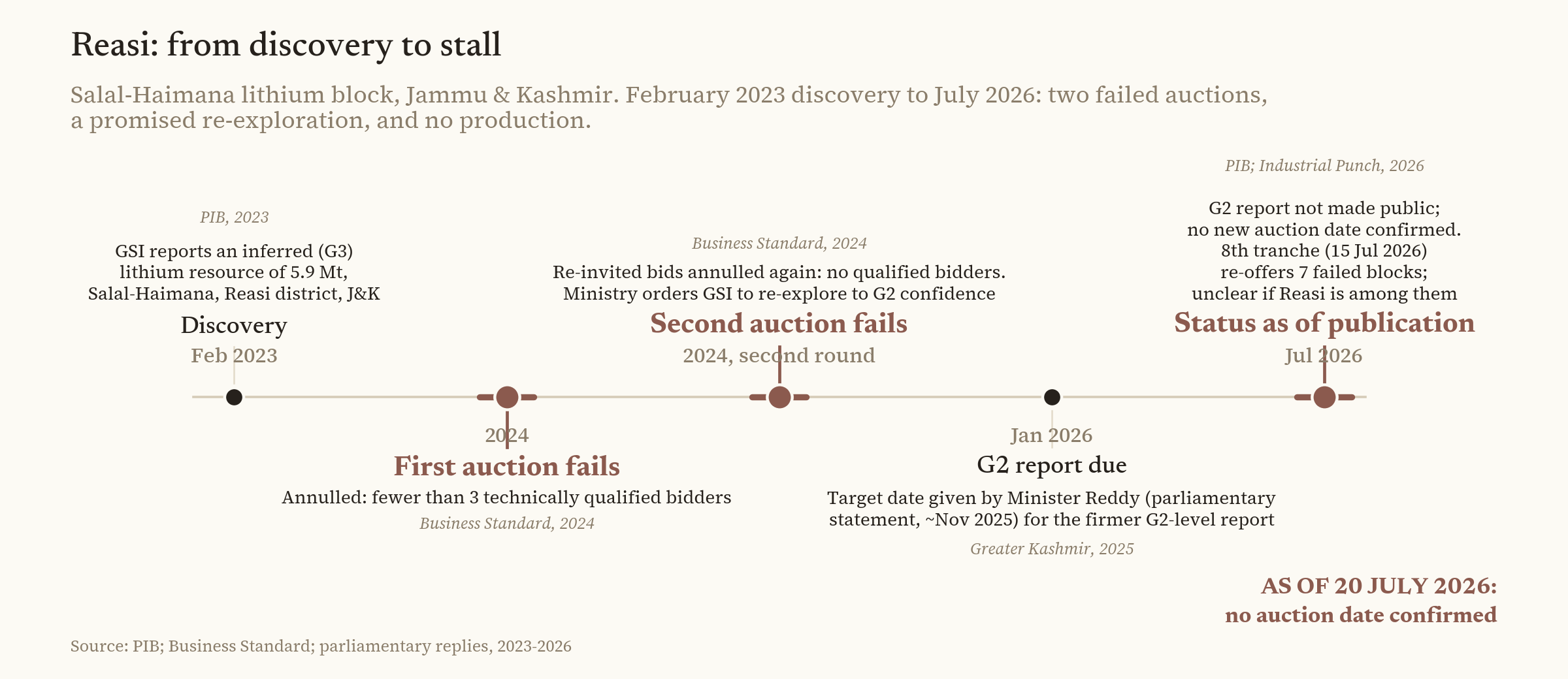
If any single episode proves that a discovery is not a supply chain, it is Reasi. In 2023 the Geological Survey of India reported an inferred lithium resource of 5.9 million tonnes at Salal-Haimana in Reasi district, Jammu and Kashmir, and for a moment it read like an answer.13 It has not become one.
The block was auctioned twice in 2024 and failed both times for want of qualified bidders.14 The reasons are structural, not incidental. The 5.9 million tonnes is a G3 estimate, the lowest confidence tier, inferred rather than proven, which is a hard thing to raise money against. The deposit type is awkward, the location is sensitive, and, most tellingly, there is nowhere in India to sell the output into, because the conversion capacity does not exist. The government directed the Survey to re-explore the block to a firmer G2 level, targeted for January 2026. The minister then in charge, G. Kishan Reddy, described the conditionality with unusual candour: "After the receipt of the final GSI report in January, the auction will be done, but if there are fewer deposits, then private bidders cannot and will not enter the auction process."15 As of publication, that re-exploration report had not been made public and no new auction date had been confirmed. The eighth auction tranche, launched on 15 July 2026, re-offered seven previously failed blocks, and it could not be confirmed whether Reasi was among them.16
What the government has actually built
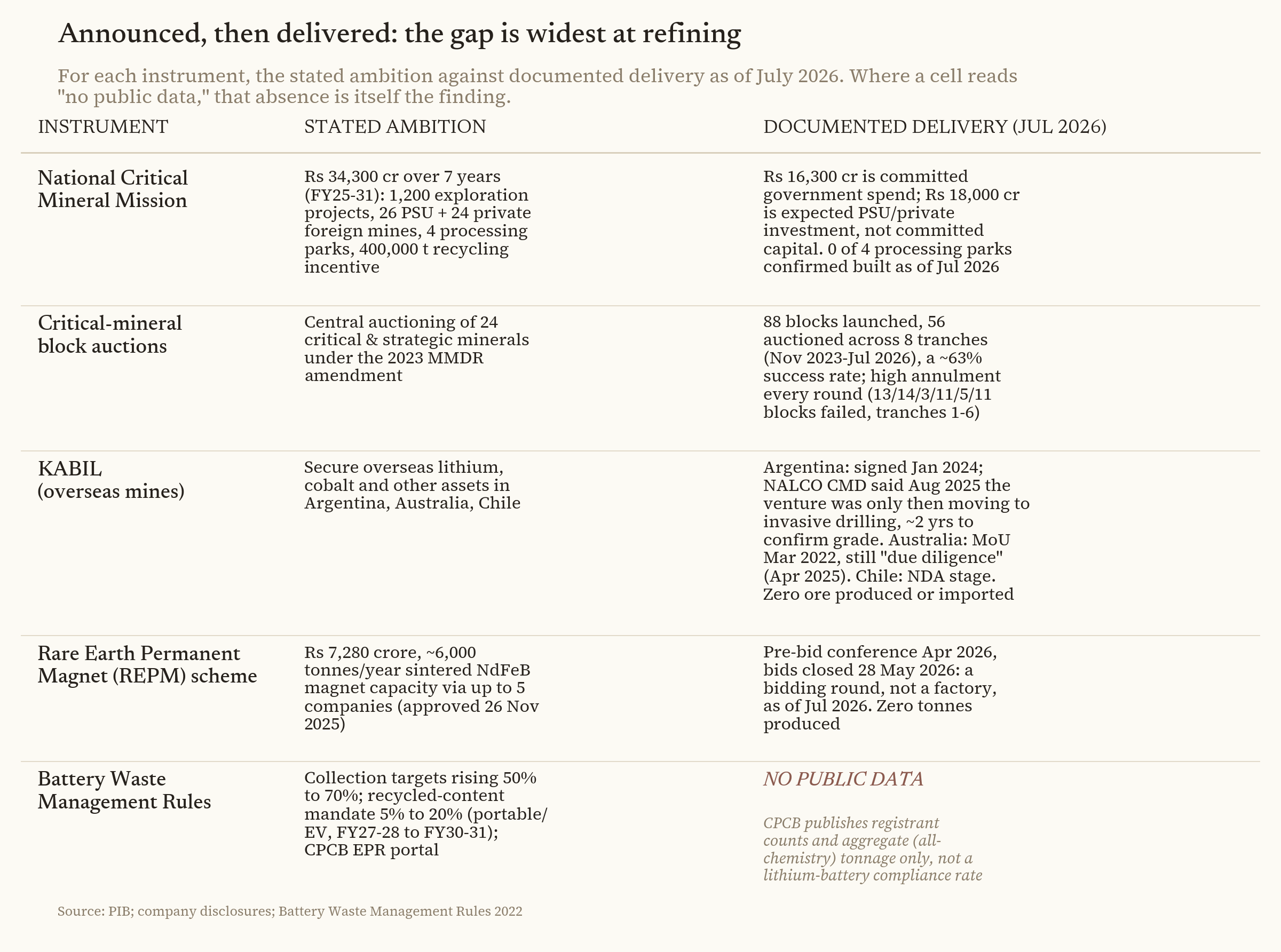
The scaffolding is genuine and recent, and it deserves to be described plainly before it is judged. In July 2023 the Ministry of Mines released a list of 30 critical minerals.17 A 2023 amendment to the mining law classified 24 minerals as critical and strategic, moved their auctioning to the central government and opened the first tranche of blocks.18 By the eighth tranche in July 2026, the Mines Secretary, Piyush Goyal, reported that 88 blocks had been launched and 56 auctioned, a success rate near 63%.19
The centrepiece is the National Critical Mineral Mission, approved in January 2025 with a headline outlay of Rs 34,300 crore over seven years. The number needs reading carefully: Rs 16,300 crore is government money, and Rs 18,000 crore is expected investment by public-sector firms and others, not committed public capital.20 The mission's targets run to 1,200 exploration projects, 26 foreign mines through public-sector firms and 24 through private ones, four mineral-processing parks and a strategic stockpile.5 Overseas acquisition runs through KABIL, a joint venture of three state firms. And the Battery Waste Management Rules of 2022 set a rising collection schedule for spent batteries, from 50% to 70% across each category's compliance cycle, and a separate recycled-content mandate that ramps from 5% to 20% for portable and electric-vehicle batteries between 2027-28 and 2030-31, and sits at 35% to 40% for automotive and industrial batteries.21
The gap between announced and delivered
The distance between those announcements and what can be verified is itself the finding, and it is widest exactly where the constraint is tightest.
Overseas ore first. KABIL signed its Australian memorandum in March 2022 and was still at due diligence three years later.5 Its Argentine agreement dates to January 2024, yet in August 2025 NALCO's chairman said the venture was only then moving to the invasive drilling that would take another two years to establish the grade and quantity of lithium present.22 Its Chilean engagement rests on a non-disclosure agreement with the state firm ENAMI.23 Across all three, no ore had been produced or imported from a KABIL-controlled asset as of publication.5 Recycling next, and it deserves a fairer hearing than the usual dismissal. A battery recycler's product is battery-grade material, which makes recycling the one route into the midstream that needs neither a mine nor imported ore. Every tonne recovered at home replaces an import at the refined stage, where India's exposure is worst, and it comes from a supply no foreign government can switch off. The mission takes it seriously, with an incentive scheme targeting 400,000 tonnes of recycling capacity,5 and India's peers treat it as strategic rather than sanitary: the EU has made 25% recycled supply a 2030 benchmark, and recycling is one of the Quad initiative's three pillars.8 11 The constraint is feedstock and timing, not chemistry. A fleet that has not retired cannot be recycled, and India's electric fleet is young, so the near-term feedstock is manufacturing scrap and imported cells rather than end-of-life batteries; recycling can supplement primary supply, not substitute for it. But the timing objection inverts on inspection. India's demand is backloaded toward mid-century, exactly when today's vehicles begin reaching the shredder in volume, and the collection networks and plants have to exist before that wave arrives. The private recyclers are moving: Lohum says it has opened India's first battery-grade lithium refinery at 1,000 tonnes a year, and Attero says a Rs 150-crore expansion will lift its capacity toward 244,000 tonnes.24 25 These are company statements, not audited output, and no public data on compliance with the lithium-battery recycling mandates could be located, which is a finding in its own right. Refining last, and this is the point: it is the true bottleneck, and it is where the least verifiable capacity has actually been built. The magnet scheme is a bidding round, the lithium refineries are announcements, and the processing parks are lines in a mission document.
What would actually work
No single move solves this, and the flagship-project reflex is part of the problem. The binding constraint is midstream, so refining and separation capacity is where the scarce public money should concentrate first, because a refinery serves ore from any source while an overseas mine without downstream conversion still leaves India dependent on someone else's plant. Overseas ore access matters, but it earns its keep only when paired with committed offtake and, eventually, with domestic conversion to feed. Recycling is a compounding long game, not a near-term substitute, and it should be funded as one rather than sold as a quick fix: the loop that matures in the 2040s is built in the 2020s. Alliances are worth what they can hand over, technology, offtake and finance, and no more; membership is not security, and India's own planners concede the limit, noting that its projected demand is "sizable in absolute terms but insufficient for price-setting power."3
The trade-offs are real and should not be smoothed over. Speed argues for importing processing know-how fast; control argues for the slower path of building sovereign capacity. Alliances buy time but keep India junior. And both mining and refining carry environmental and community costs at home that are frequently the actual reason projects stall, not a footnote to them. The IEA's Fatih Birol frames the premium honestly: diversified supply costs more, but "this can be viewed as a mineral security premium in a time of geopolitical uncertainty, a form of economic insurance against major supply risks."26 India has spent three years building the demand side of its energy transition and the policy scaffolding around the supply side. The next three will be judged on one question: whether any refined material comes out of it. The mine was never the hard part. The factory in between is.
Sources
- Mineral Commodity Summaries 2026, U.S. Geological Survey, 2026.
- Global Critical Minerals Outlook 2026, IEA, 2026.
- Critical Mineral Assessment, Demand and Supply (Vol. 10), Scenarios Towards Viksit Bharat and Net Zero, NITI Aayog, Government of India, 2026.
- India's critical mineral imports remain highly concentrated, exposing supply risks and driving diversification push, Puja Das, Down To Earth, 2026.
- National Critical Mineral Mission, Powering India's Clean Energy Future, PIB, Ministry of Mines, Government of India, 2025.
- India's Rare Earth Strategy, Manufacturing, Corridors, and Global Integration, PIB, Government of India, 2026.
- Strengthening of Mineral Supply Chains, PIB, Ministry of Mines, Government of India, 2023.
- Critical Raw Materials Act, European Commission, Directorate-General for Internal Market, Industry, Entrepreneurship and SMEs.
- U.S.-Japan Critical Minerals Agreement, Congressional Research Service.
- India-United States Strategic Critical Minerals Cooperation Framework, IEA Policies Database, 2026.
- Quad Critical Minerals Initiative Framework, U.S. Department of State, 2026.
- Global race for critical raw materials is about power, EU Commission says, Euronews, 2026.
- Lithium Deposits Found, GSI to Carry out More Exploration in J&K, PIB, Government of India, 2023.
- J&K's 5.9 mn tonne lithium reserve to be re-explored after failed auction, Business Standard, 2024.
- G2 stage of Lithium exploration in J&K to be completed by Jan 2026, Reddy, Greater Kashmir, 2025.
- Ministry of Mines to Launch Eighth Tranche of Auction of Critical and Strategic Mineral Blocks, The Industrial Punch, 2026.
- Thirty Critical Minerals List Released, PIB, Ministry of Mines, Government of India, 2023.
- Cabinet approves royalty rates for mining of 12 critical and strategic minerals, PIB, Ministry of Mines, Government of India, 2024.
- Centre offers 20 critical mineral blocks in eighth auction tranche, Nandini Keshari, Business Standard, 2026.
- Cabinet Approves National Critical Mineral Mission to Build a Resilient Value Chain for Critical Mineral Resources Vital to Green Technologies, with an Outlay of Rs. 34,300 Crore over Seven Years, PM India, PIB, 2025.
- Battery Waste Management Rules, 2022, Gazette of India, Ministry of Environment, Forest and Climate Change, 2022.
- KABIL Confident of Lithium Finds in Argentine Mines in 2 Years, Detailed Exploration Underway, NALCO CMD, Aditi Ray Chowdhury, Outlook Business, 2025.
- KABIL is exploring opportunities for acquisition of overseas critical minerals assets in Argentina, Australia and Chile, PIB, Government of India, 2024.
- Lohum announces India's first battery-grade lithium refinery, pv magazine India, 2025.
- Attero to Invest INR 150 Crore to Expand E-Waste, Copper and Lithium-Ion Battery Recycling, Energetica India.
- Supply concentration, export restrictions and declining investment put critical mineral security at risk, IEA News, 2026.